

Matamoros Airport Transfer Rule Reshapes Border Plans
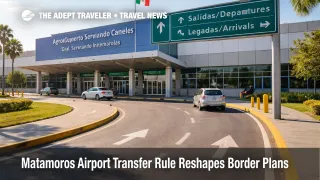
Travelers using General Servando Canales International Airport (MAM) in Matamoros, Tamaulipas, Mexico, or planning same day airport and border movements through Matamoros or Reynosa, should read the current U.S. guidance as a routing warning, not just a crime advisory. The U.S. State Department says an armored vehicle is required for all travel to and from the Matamoros airport and for all travel to Reynosa, imposes a midnight to 6:00 a.m. curfew for U.S. government employees in Matamoros, and bars land travel between Tamaulipas border cities on interior Mexican highways, directing personnel to route between cities on the U.S. side instead. For private travelers, that is not a blanket legal rule, but it is a strong operational signal that the simplest airport pickup, rental car, or cross border transfer plan may no longer be the lowest risk option in this corridor.
Matamoros Airport Transfer Rule, What Changed
The practical shift is that airport access and onward ground movement now need to be planned as one problem. A traveler might still find a workable flight into Matamoros or a cross border arrival through Brownsville, Texas, but the travel system stops being simple once the plan depends on late night pickup windows, direct road transfers to Reynosa, or interior highway moves between Tamaulipas border cities. The advisory narrows the set of routes that U.S. personnel are allowed to use, and that makes it a useful planning proxy for civilians who want to avoid improvising ground transport after arrival.
That matters most for three groups. First, U.S. based travelers using Matamoros as a cheaper or closer airport for onward domestic Mexico flights. Second, travelers with business, family, or medical reasons to move between Brownsville, Matamoros, and Reynosa in one trip. Third, anyone trying to pair a border crossing with a same day departure or arrival, where even a modest delay can push the ground segment into the overnight curfew window or into the wrong side of daylight routing logic.
Which Border Travelers Face the Tightest Constraints
The highest exposure is not the tourist who stays put after a daytime crossing. It is the traveler stacking multiple moving parts into one day. Same day cross border flyers, travelers booking hotels on the wrong side of the river for an early departure, anyone planning to land in one city and drive onward to another, and travelers relying on ad hoc pickup arrangements face the most fragile plans. Once the trip depends on a late arrival, a missed pickup, or a road leg to Reynosa, the margin for error falls quickly.
The advisory also changes the logic for rental cars and self drive plans. The State Department's language does not merely warn against generalized risk in Tamaulipas. It specifically says U.S. government employees may not travel by land between cities in Tamaulipas using interior Mexican highways, and instead must route between those cities on the U.S. side of the border. That means the issue is route structure, not just destination choice. A plan that looks short on a map can still be the wrong plan if it relies on the interior Mexico segment the advisory is trying to keep personnel off.
That route logic is what makes this more serious than a generic "exercise caution" note. In operational terms, it pushes airport selection, bridge choice, hotel placement, and departure timing into the same decision. A hotel in Brownsville can be the more resilient choice for an early morning departure or a late inbound delay, while a hotel or pickup plan that leaves the traveler needing to move around Matamoros after midnight becomes much harder to defend. Travelers comparing airports should also weigh whether a U.S. side overnight and daylight border crossing reduces exposure compared with arriving late and trying to complete the ground segment in Mexico after dark.
What Travelers Should Do Now
The cleanest response is to separate the air segment from the border segment whenever possible. If your trip touches Matamoros or Reynosa, avoid same day cross border plans that rely on precise timing, especially for evening arrivals and early morning departures. Build the trip around daylight movement, and choose lodging based on the next day's transfer rather than the cheapest rate or the shortest nominal distance.
For travelers who still need this corridor, the decision threshold is simple. Rework the plan if your itinerary requires a late night airport pickup, a direct road move to Reynosa, or an interior highway drive between Tamaulipas border cities. Wait only if you have a fully daytime plan, a known pickup arrangement, and enough slack to absorb a delayed crossing or flight change without rolling into the overnight window. In an earlier Adept Traveler article, Mexico Travel Advisory Updated to Level 2 explained how U.S. employee restrictions often give civilian travelers a more realistic risk picture than the national headline level alone. Travelers who need broader country context can also use Mexico - Travel News and Guides from The Adept Traveler.
The next signals to watch are not only advisory level changes. Watch for any new U.S. Mission security alerts tied to Tamaulipas, reports of road disruptions or checkpoint slowdowns, and any change in the State Department language on Matamoros airport access or Reynosa travel. Temporary February 2026 security operations elsewhere in Mexico eased, and OSAC noted that Tamaulipas conditions had returned to normal from that specific incident cycle, but the standing route restrictions for Matamoros and Reynosa remained in the general Mexico advisory. That distinction matters. It suggests this is not a short lived event headline, but a persistent corridor planning issue. In an earlier Adept Traveler article, Mexico Security Alert Eases, PVR and GDL Flights Return showed how quickly airport and road logic can diverge during Mexico security events.
Why the Corridor Now Works Like a Routing Problem
The broader mechanism is straightforward. Border trips fail less often at the flight itself than at the handoff between air, road, and crossing layers. When an advisory narrows acceptable routes, limits overnight movement, and singles out airport access plus a neighboring city for stricter handling, it removes the redundancy travelers usually rely on. You lose the easy fallback of "we will just drive over," and that turns small delays into missed departures, extra hotel nights, or abandoned same day plans.
The Matamoros airport transfer rule is therefore most useful as a decision tool. It says the corridor should be planned around daylight, buffers, and fewer handoffs. Travelers who can keep the trip on the U.S. side longer, cross only when the next segment is ready, and avoid same day onward moves to Reynosa or other Tamaulipas border cities will usually have a more resilient plan than travelers trying to optimize for speed or convenience alone.