

Mexico Security Alert Eases, PVR and GDL Flights Return
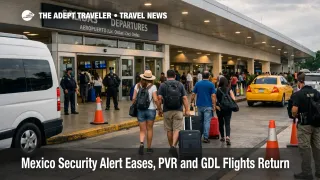
Travel restrictions tied to western Mexico security operations have stepped down, but they have not disappeared. A February 24, 2026 U.S. Mission update said U.S. citizens are no longer urged to shelter in place, while also keeping nighttime curfews for U.S. government staff in Guadalajara, Puerto Vallarta, Ciudad Guzman, and Tijuana, and directing U.S. staff in Jalisco and Monterrey to remain inside their metro areas. At the same time, airlines have begun restoring schedules through Licenciado Gustavo Díaz Ordaz International Airport (PVR) and Miguel Hidalgo y Costilla Guadalajara International Airport (GDL), which is the practical signal most travelers care about because it usually follows improving road access, staffing stability, and workable risk assessments.
Mexico Security Alert Update, What Changed For Travelers
The immediate change is that "stay inside" guidance aimed at the general public has eased, and the travel system is moving from pause to restart in Puerto Vallarta and Guadalajara. That matters because, during the worst part of these events, travelers were often safer inside hotels than they were trying to move, especially when roadblocks and transport interruptions hit the airport transfer layer first.
Flights through PVR and GDL are now restarting, with carriers reintroducing service in stages rather than flipping every route back on at once. This is also where travelers should keep their expectations realistic, a resumed schedule reduces the chance you are stranded for days, but it does not eliminate same day cancellations, aircraft swaps, or crew positioning constraints that can ripple for several rotations after an irregular operations weekend.
On the Caribbean side, the "is Cancun affected" question remains mostly about information hygiene. The U.S. State Department's Mexico advisory is Level 2 overall, and it includes specific cautions for Quintana Roo, including staying alert after dark in downtown areas of Cancun, Tulum, and Playa del Carmen. That said, U.S. Mission messaging has treated Quintana Roo differently from the hardest hit western areas in this incident cycle, and there has not been broad shelter guidance for the Cancun region tied to these February 22 events.
Which Trips Are Still Most Exposed
The highest exposure remains travelers whose itinerary requires ground movement in, or near, the places where U.S. Mission staffing still faces curfews or metro limits, especially Jalisco and parts of Baja California. For leisure travelers, that does not automatically mean resorts are unsafe, it means the roads that make your trip work can fail faster than the hotel layer fails, and that is what strands people, misses flights, and breaks connections.
The second group to watch is anyone traveling on fixed dates, especially return trips home, weddings, conferences, cruises, or prepaid touring with timed pickups. When security conditions disrupt mobility, you do not need violence at your hotel to lose the trip, you only need a blocked corridor, a suspended transfer operator, or an airport you cannot reliably reach.
If your trip is to Cancun International Airport (CUN) and the Riviera Maya, the risk profile is different but not zero. Local reporting described arson incidents in Quintana Roo on February 22, 2026, including a convenience store fire in Tulum and vehicles set on fire, with follow up reporting on detentions tied to those fires. For travelers, the decision relevance is not to catastrophize, it is to avoid rumor driven detours, stick to mainstream corridors and vetted transport, and be more conservative about nighttime movement in downtown zones.
What Travelers Should Do Now
If you are departing from, or connecting through, Puerto Vallarta or Guadalajara in the next several days, treat the trip as a recovery operation even if the airport looks "normal." Build buffer into your airport transfer plan, favor daytime transfers when possible, and confirm your ground transportation directly with your hotel or a vetted provider before you leave the property.
For flights, use waivers as a tool, not a substitute for decision making. United has published flexibility for travelers ticketed to Puerto Vallarta or Guadalajara within the late February window, allowing itinerary changes that can push travel into early March without change fees under the carrier's stated conditions. If your itinerary includes tight connections, same day events, or a cruise embarkation, the safer play is often to rebook earlier onto the most reliable routing you can get, even if it is less convenient, because the second order risk is missed downstream commitments, not just the first canceled flight.
If you are headed to Cancun and the Riviera Maya, make your call based on verified advisories and your personal risk tolerance, not social virality. The State Department's Mexico advisory is stable at Level 2 overall, but several states carry higher cautions, and Quintana Roo's standard guidance emphasizes situational awareness and avoiding higher risk areas after dark. Practically, that usually translates into staying inside well traveled tourist zones at night, using hotel arranged transport for late dinners, and avoiding spontaneous downtown roaming if you are not familiar with the area.
Why Operations Restarted, But Restrictions Persist
Security incidents like this create an asymmetric travel problem, the airside layer can remain physically intact while the landside layer becomes unpredictable. When roadblocks, vehicle fires, and localized violence disrupt access routes, airlines can keep an airport "open" in theory, but still cancel because crews and passengers cannot safely reach the terminal, and because the carrier cannot reliably operate a full day of turns.
That is why a step down from public shelter guidance can happen at the same time as targeted restrictions remain for specific staff populations. Curfews and metro limits are an operational signal that the situation is improved but not fully normalized, especially for movement at night when traffic control and situational awareness tend to be weaker.
It is also why travelers should separate destination reputation from itinerary mechanics. A resort can be operating normally, and still be functionally "cut off" if the transfer corridors fail. In this event cycle, multiple reporting threads have pointed to mobility, not resorts, as the dominant traveler failure mode, and the restart phase is about restoring that mobility predictably enough for airlines, transfer operators, and travelers to plan again.
For continued coverage and verified, location specific guidance, travelers can cross check airport status and corridor realities in Puerto Vallarta, Guadalajara Airports Resume Flights and Caribbean side context in Cancun Travel Safety After Jalisco Unrest Alerts, then use Puerto Vallarta Airport Disruption, What's Verified as a misinformation filter when social claims outrun confirmed facts.
Sources
- Security Alert, Update 6 clip (U.S. Embassy in Mexico Facebook)
- Mexico Travel Advisory (Travel.State.gov)
- How Civil Unrest in Mexico Is Impacting Travelers in Puerto Vallarta and Guadalajara (Condé Nast Traveler)
- What to do if you're stranded in Mexico right now (The Points Guy)
- Cars and businesses set on fire, retaliation hits Quintana Roo (Riviera Maya News)
- Police detained youths with gasoline bottles, investigated for Tulum fires (Riviera Maya News)
- Puerto Vallarta, Guadalajara Airports Resume Flights (The Adept Traveler)
- Cancun Travel Safety After Jalisco Unrest Alerts (The Adept Traveler)