

United-American Merger Talk Raises U.S. Fare Risk
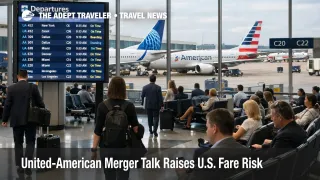
A possible United and American tie up is still rumor, not a filed deal, but the travel signal changed sharply on April 14. Reuters reported that United Airlines CEO Scott Kirby raised a potential merger with American Airlines in a February 25 White House meeting, days after Transportation Secretary Sean Duffy said there is room for more airline mergers. For travelers, the immediate issue is not tomorrow morning's operation. It is whether Washington is becoming more open to a structural shift that could eventually affect fares, route competition, loyalty value, and hub choice across the United States.
U.S. Airline Merger Risk, What Changed
What changed is that airline consolidation is no longer just analyst chatter. Reuters reported that Kirby floated a United, American combination directly to President Trump, and that Duffy separately said larger airline mergers could be possible, though any deal would face close scrutiny and likely asset divestitures. No merger has been announced, the White House has not endorsed one publicly, and Reuters said the details of Kirby's proposal were not clear. That distinction matters. A rumor can die quietly. A serious policy opening can change how airlines, investors, and corporate travel buyers think about the market long before any filing appears.
The seriousness here is structural, not immediate. Reuters reported that four airlines already control about 80 percent of the U.S. domestic passenger market, while BTS market share data for February 2025 through January 2026 shows Delta, American, Southwest, and United clustered at the top of domestic traffic. A United, American combination would not just be another small network tuck in. It would turn the current Big 4 into a Big 3 and create a much larger competition fight over fares, schedule depth, slots, gates, and city pair overlap.
Which Travelers Could Feel It First
The travelers most exposed first are not bargain hunters booking one simple round trip. They are frequent flyers, small and midsize city passengers, and corporate travelers whose options depend on network competition at large hubs and overlapping routes. Reuters flagged Chicago as one metro area with significant overlap concerns. More broadly, a combined carrier would have more power over schedule design, connecting banks, and premium sales strategy, which can matter even before fares rise across the whole system.
Loyalty customers also have something to watch. When consolidation reaches the scale of hubs, gates, and frequent flyer ecosystems, the traveler question is not only whether ticket prices rise. It is whether award availability tightens, elite perks become harder to use, and one carrier gains more leverage in markets where travelers already have limited nonstop or same day fallback options. In an earlier Adept Traveler article, JetBlue Sale Talk Puts JFK and Boston Travelers on Watch, the main traveler risk was future competition and loyalty value, not same day disruption. That logic applies here too, only at a much larger scale.
What Travelers Should Do Now
Travelers do not need to rebook existing United or American trips because of one Reuters report. There is no filed merger, no public timeline, and no announced remedy package. The better move is to treat this as a watch item for fall and 2027 booking strategy, especially if you rely heavily on one airline for status, a co branded card, or hub convenience. If your travel pattern already depends on one dominant carrier, it is worth preserving flexibility in loyalty earning and avoiding unnecessary lock in until it is clearer whether Washington is merely entertaining ideas or preparing to bless a deal process.
The decision threshold is simple. Ignore the rumor for near term operational travel. Start paying attention if there is a formal announcement, a regulatory filing, or clear talk of divestitures at overlap airports. That is the point where travelers should look harder at whether alternative carriers, nearby airports, or transferable points matter more than marginal status gains. For corporate travel managers, the threshold comes earlier, because even live merger exploration can affect contract strategy and negotiation leverage.
In an earlier Adept Traveler article, U.S. Airline Fuel Shock Deepens Summer Flight Risk, the main warning was that higher fuel costs were already thinning weaker flying and making schedules less forgiving. If fuel pressure stays elevated while consolidation chatter grows, travelers could face a worse mix, higher prices, fewer backup flights, and more power concentrated in fewer hands. That is still an emerging scenario, not a finished outcome, but it is the one worth monitoring.
Why This Is Happening, And What Comes Next
The mechanism is straightforward. American is still carrying heavy debt, and Reuters reported that industry officials see elevated fuel costs and weaker balance sheets as reasons consolidation talk has resurfaced. American said in January that it ended 2025 with $36.5 billion of total debt. Reuters also reported that Kirby argued a combined airline would compete better internationally, where foreign carriers hold most long haul seat capacity to and from the United States. That is the strategic case for a merger. The antitrust case against it is just as clear, less domestic competition, more route overlap, and more pricing power in a market already dominated by a few carriers.
What happens next depends on whether this remains trial balloon politics or turns into a formal process. Reuters quoted antitrust experts who see enormous obstacles, and the DOJ's successful challenge to JetBlue's Spirit acquisition is a reminder that airline tie ups can still be blocked when courts believe they would harm competition. That said, Duffy's remarks matter because they tell the market this administration is at least willing to discuss bigger combinations than the last one was. For travelers, the most honest near term conclusion is restraint. Nothing operational changes this week. But the policy climate around U.S. airline merger risk looks more permissive than it did a month ago, and that alone makes fares, hubs, and network competition worth watching more closely.
Sources
- United-American mega deal could raise fares and face antitrust roadblock, Reuters
- U.S. transportation secretary sees room for airline mergers, Reuters
- American Airlines reports fourth-quarter and full-year 2025 financial results, American Airlines Newsroom
- Airline Domestic Market Share February 2025 to January 2026, Bureau of Transportation Statistics
- Justice Department Statements on District Court Decision to Block JetBlue's Acquisition of Spirit Airlines, U.S. Department of Justice