

U.S. Airline Fuel Shock Deepens Summer Flight Risk
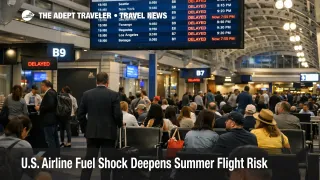
U.S. airline fuel shock looks more serious on March 31, 2026 than it did a day earlier. Rising jet fuel costs are no longer showing up only in airline warnings and fare increases. They are now feeding into weaker earnings guidance, thinner schedules, and a more fragile summer booking environment, especially on off peak flights and marginal connections. For travelers, the immediate consequence is simple, some itineraries may get both more expensive and less recoverable at the same time.
U.S. Airline Fuel Shock: What Changed
What changed is that the fuel story kept worsening after Monday's first wave of airline warnings. Reuters reported on March 30 that United Airlines is already pulling about 5 percent from planned flying, including weaker midweek, Saturday, overnight, and some Chicago O'Hare International Airport (ORD) capacity, while Delta Air Lines said higher jet fuel prices added about $400 million to its March fuel bill and American Airlines said the spike added about $400 million to first quarter costs. On March 30, Alaska Air also cut its first quarter outlook, citing higher fuel costs and external demand hits, which is a sign that the pressure is not limited to the three biggest legacy carriers.
That makes today's publication angle different from a pure fare story. In an earlier Adept Traveler article, Fuel Shock Cuts Summer Flights as Fares Rise, the main shift was that airlines had started to pair price increases with some schedule trimming. Today, the stronger point is that the pressure is broadening into a more durable planning problem. Reuters also reported on March 31 that Korean Air will enter emergency management mode in April because of the same oil shock, underscoring that carriers are treating this as an operational stress event, not a brief pricing spike.
Which Travelers Face the Most Summer Disruption
The most exposed travelers are not necessarily the ones buying the cheapest tickets. They are the ones whose trips depend on limited frequency, late day departures, short hub connections, or a single remaining fallback flight. When airlines cut weaker dayparts first, they do not need to remove many flights to make a network less forgiving. A small reduction in schedule depth can turn a same day recovery into an overnight disruption.
That is especially relevant at large connecting hubs. In an earlier Adept Traveler article, United Flight Cuts Raise Summer Risk at O'Hare, the problem was already clear at Chicago O'Hare, where fewer off peak options can raise fares and make missed connection recovery harder. The broader summer risk is that the same pattern can spread beyond one hub when fuel remains elevated and carriers keep protecting only their strongest departures and most profitable banks.
First order, travelers can expect higher fares and fewer low value departures. Second order, hotel nights, meal costs, cruise embarkation risk, and onward rail or event misconnects all rise when schedule slack disappears. That risk gets worse in a market already constrained by delayed aircraft deliveries and limited fleet flexibility. FAA Delays on Boeing 737 MAX 10 Hit Airline Capacity remains relevant here because a thinner replacement pipeline gives airlines less room to absorb another shock cleanly.
What Travelers Should Do Now
Travelers with fixed dates should treat this as a booking quality problem, not only a fare problem. If a trip depends on a cruise departure, a wedding, a tour start, or an international long haul connection, the safer move is usually to protect the itinerary rather than chase the lowest fare. Earlier departures, nonstop flights, and longer hub buffers have more value when carriers are trimming weaker flying and preserving core demand first.
Waiting can still make sense if a route has heavy competition and multiple daily frequencies, but the threshold for waiting is narrower on small city origins, hub dependent itineraries, and late day departures. If you are already booked, monitor even minor schedule changes. A small retime can be an early sign that your flight sits in a weaker bank where more changes may follow. If you are booking now, avoid assuming that summer 2026 will offer normal same day fallback options just because seats are still on sale.
The next decision point is whether fuel remains elevated into April rather than easing after a headline spike. Travelers should also watch for more airline commentary that shifts from fare recovery to capacity discipline, because that usually means the market is moving from pricing pain to itinerary pain. If that happens, rebooking early will matter more than waiting for a marginally better fare.
Why This Is Happening, And What Comes Next
The mechanism is straightforward. Reuters reported that jet fuel prices jumped to about $4.24 per gallon last Thursday from about $2.50 just before the first strikes on Iran, while United is modeling Brent crude as high as $175 a barrel and above $100 through 2027 in a prolonged stress case. Fuel accounts for roughly a quarter of airline operating costs, and airlines sell many tickets weeks or months in advance, which leaves them exposed when fuel rises faster than fares can adjust.
What happens next depends on duration and which balance sheets crack first. Reuters reported that Moody's and S&P see stronger carriers such as Delta and United as better positioned because of liquidity, margins, and premium revenue, while lower cost and already unprofitable carriers are more vulnerable if fuel remains high. That does not mean big airlines are safe from disruption. It means the weakest parts of the network, weaker dayparts, thin leisure routes, and carriers with less financial cushion are likely to feel the stress first. For travelers, the practical outlook is that U.S. airline fuel shock is moving from a cost headline into a summer network reliability issue.
Sources
- US airlines face fuel-driven financial shakeout, Reuters
- Airlines face fare dilemma as fuel spike threatens travel demand, Reuters
- Alaska Air signals bigger first-quarter loss as fuel costs surge, Reuters
- Korean Air to shift to emergency mode in April amid rising oil prices from Iran war, Reuters
- Fuel Shock Cuts Summer Flights as Fares Rise
- United Flight Cuts Raise Summer Risk at O'Hare
- FAA Delays on Boeing 737 MAX 10 Hit Airline Capacity