

Delta Seoul Baggage Screening Cuts Connection Risk
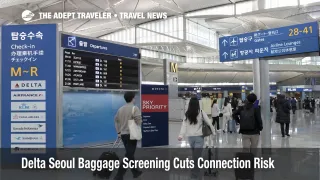
Travelers connecting onward in the United States after flying Delta from Seoul, South Korea, now have a more reliable path through two major Midwest hubs. Delta said on April 15, 2026 that its Seamless Baggage Transfer program now covers Seoul Incheon arrivals into Minneapolis St. Paul International Airport (MSP) and Detroit Metropolitan Wayne County Airport (DTW), allowing eligible passengers with onward Delta flights to clear U.S. Customs and Border Protection and security, then go straight to their next gate without reclaiming and rechecking checked bags unless CBP refers the bag for further inspection. Delta says the program saves up to 25 minutes on average, while South Korea's transport ministry said the Detroit and Minneapolis expansion starts Thursday, April 16, 2026.
Delta Seoul Baggage Screening: What Changed
The immediate change is operational, not cosmetic. Seoul departures into Minneapolis and Detroit now join Atlanta in Delta's remote baggage screening flow, which means the old U.S. connection weak point, bag claim, recheck, and the risk of missing a short onward bank while doing it, becomes less severe for eligible travelers on a single Delta itinerary. Delta launched the same program for Atlanta bound customers in 2025 and said the Minneapolis and Detroit expansion builds on that earlier rollout.
That matters most on itineraries where the connection itself is the real stress point. A traveler arriving from Seoul and continuing to a smaller U.S. city often loses time twice in the normal process, once at passport control and customs, and again at baggage reclaim and recheck. Removing one of those steps does not eliminate connection risk, but it does reduce one of the most unpredictable parts of a long haul arrival. In an earlier Adept Traveler article, ICE Leaves Some U.S. Airports, TSA Recovery Uneven, the focus was broader U.S. screening recovery. This Delta move is narrower and more useful for Seoul origin passengers because it cuts friction inside the transfer process itself, not just at the checkpoint.
Who Benefits Most From the Easier U.S. Connection
The clearest winners are passengers flying from Incheon International Airport (ICN) to Minneapolis or Detroit and continuing on Delta the same day, especially those connecting to smaller Midwestern, East Coast, or Canadian markets where later backup flights can be limited. Shorter connection windows become less fragile when bags do not have to be reclaimed landside and handed back into the system. Business travelers with fixed meetings, and leisure travelers trying to protect cruise departures, tours, or final short hops, benefit more than passengers terminating in Minneapolis or Detroit.
The benefit is still conditional. Delta said customers must still clear CBP and security, and bags can still be pulled if CBP wants additional inspection. That means this is not a bypass of U.S. arrival formalities. It is a reduction in process steps after arrival. Travelers on separate tickets, or those whose onward flight is not the covered Delta connection, should not assume they will get the same time savings.
What Travelers Should Do Now
For travelers booking Seoul to U.S. connecting trips, this improvement makes Minneapolis and Detroit somewhat stronger connection choices than they were before, especially when the alternative is a tighter same bank transfer through a hub that still requires full bag reclaim and recheck. The tradeoff is that the program currently applies to a specific set of covered flows, so travelers should confirm their operating carrier and onward segment before treating the shorter transfer as guaranteed.
For already ticketed passengers, the useful move is simple. Keep your connection realistic, but do not overbuild as much extra time solely out of fear of the baggage step if you are on the covered Seoul to Minneapolis or Seoul to Detroit flow. If your onward segment is time sensitive, monitor whether your bag is referred for inspection, because that remains the main exception that can break the smoother handoff. Travelers connecting later this year through Seattle Tacoma International Airport (SEA) on Delta or Korean Air, or through Los Angeles International Airport (LAX) on Korean Air, should also watch for the next expansion phase rather than assuming those routes are live now.
Why the Change Matters Beyond Two Routes
The bigger significance is that Delta and Korean authorities are trying to remove friction from the international connection process at the point where long haul trips often fail. South Korea's transport ministry said the system works by sending checked baggage X ray images from Incheon to the United States in advance, allowing U.S. officials to screen the bag before the aircraft lands. If the bag clears, it can transfer directly to the onward flight. That changes the mechanics of the connection, not just the customer messaging around it.
This also looks like a network signal. Delta's April 15 announcement said Seattle and Los Angeles are next later in 2026, with Seattle covering Delta and Korean Air flights from Seoul and Los Angeles covering Korean Air flights from Seoul. If those additions arrive on schedule, the practical result is a broader set of U.S. gateways where Seoul origin travelers can protect tighter onward itineraries without the usual bag reclaim penalty. The main thing to watch next is scope, whether more carriers, more hubs, or more eligible connection types get folded into the program after this phase.