

Mediterranean Cruise Growth Still Pressures Gateway Cities
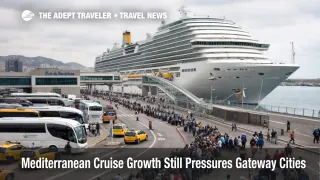
Mediterranean cruise gateway pressure is rising in Barcelona, Spain, the Rome Civitavecchia corridor, and Piraeus, Greece, even without Caribbean style growth. Cruise Lines International Association, CLIA, says the Mediterranean drew 5.96 million cruise passengers in 2025, up 3.4% from 2024, which means nearly one in six global ocean going cruise passengers sailed the region. That is a smaller gain than the Caribbean, but it is still large enough to keep pressure on pre cruise hotel inventory, airport to port transfers, and same day embarkation timing when several ships turn at once. Travelers booking Mediterranean cruises for 2026 should treat gateway logistics as part of the trip, not as an afterthought.
Mediterranean Cruise Gateway Pressure Is Still Building
The headline change is not that the Mediterranean suddenly overtook the Caribbean. It did not. CLIA's 2026 State of the Cruise Industry report shows the Caribbean, Bahamas, and Bermuda added more than 1.25 million passengers in 2025, while the Mediterranean added about 190,000. But 5.96 million passengers is still a large base, and the region remains the number two destination globally. That matters operationally because Mediterranean cruises often depend on dense urban gateways where cruise passengers compete with city break visitors, airline arrivals, rail travelers, and local traffic at the same time.
Barcelona is the clearest example of how that pressure moves ashore. The Port of Barcelona says it is Europe's leading cruise port in the Mediterranean, handling about 3.1 million cruise passengers a year, and notes that Adossat pier terminals depend on a shuttle link into the city center rather than being directly on the public transport grid. When several ships turn on the same day, that extra transfer layer can turn a routine arrival into a longer hotel, taxi, or coach queue, especially for travelers trying to combine a flight arrival, a short city stay, and embarkation on the same day.
Which Gateway Cities Feel It First
The most exposed travelers are not only the people boarding the biggest ships. They are the passengers trying to save money or time by cutting buffers too close. In the Mediterranean, that often means flying in on embarkation day, booking one night instead of two in a gateway city, or assuming the port sits right next to the airport when it often does not.
Rome bound cruise passengers are a good example. Civitavecchia is the main cruise gateway for Rome itineraries, but the Port of Rome information site still frames Leonardo da Vinci Rome Fiumicino Airport as roughly half an hour away and points travelers toward dedicated shuttles, taxis, and other transfer services. In practice, that means a Mediterranean cruise sold as "Rome" still depends on a separate road transfer, with less slack when flights run late, baggage delivery slows, or traffic builds around ship turnaround windows. The same pattern holds in Athens, where Piraeus is Greece's main cruise gateway rather than the airport itself. Piraeus Port Authority says the port handled 863 cruise ships and about 1.85 million cruise passengers in 2025, a new record, reinforcing its role as a high volume Eastern Mediterranean hub.
The Venice area belongs in the same category even when itineraries use alternate embarkation points outside the historic center. Travelers see "Venice" in cruise marketing and often picture a simple city boarding experience. The real planning problem is that lagoon area cruise logistics can involve extra ground movement, extra hotel positioning, and more brittle timing than a classic walkable port city embarkation. The tradeoff is clear, Mediterranean gateway cities add pre and post cruise value, but they also add more moving parts than many Caribbean homeports.
What Cruise Travelers Should Do Now
Travelers should book Mediterranean gateway cities as if the hotel night and the transfer are part of the cruise fare. If your sailing starts in Barcelona, Civitavecchia, Piraeus, or the Venice area, the safest default is to arrive at least one night early, and two nights early if your inbound flight is long haul, your fare is restrictive, or your embarkation falls in peak summer. CLIA's consumer data shows 64% of cruisers stayed at least one room night pre or post cruise in the port city, which supports the idea that overnight positioning is already normal behavior, not over planning.
The next decision point is transfer design. Use an airport hotel only if it clearly improves your port transfer the next day. Otherwise, a hotel closer to the cruise corridor may be the better hedge, especially in Barcelona where some terminals rely on shuttle links, or in Rome cruise planning where the airport and port are separate systems. If you are traveling with a large group, heavy luggage, or a tight schedule, pre booked private transfers can be worth the extra cost because they cut one more line out of the trip.
Wait for lower hotel prices only if your sailing date is still flexible. Rebook earlier if your cruise is fixed and your current plan still depends on same day flying, same day rail, or a self managed port transfer after an overnight arrival. The main signals to monitor are cruise line pre departure notices, airport schedule changes, major city events, and any local transport disruption that affects port access roads or coach capacity.
Why Modest Growth Still Hits Hard
The mechanism is simple. Cruise growth does not need to be explosive to strain gateway cities. It only needs to be concentrated. Mediterranean embarkation patterns funnel millions of passengers through a relatively small set of famous cities and port corridors, while cruise demand itself is still rising. CLIA forecasts global ocean going cruise passengers will grow from 37.2 million in 2025 to about 38.3 million in 2026 and about 42.1 million by 2029. That suggests gateway friction will stay relevant even if yearly regional growth moderates.
First order, that means fuller hotels, tighter transfer windows, and less forgiveness for late arriving flights on embarkation day. Second order, it can push travelers into pricier room categories, longer taxi waits, or extra buffer nights they had not planned to buy. In an earlier Adept Traveler article, Caribbean Cruise Growth Tightens Port Hotel Pressure the same onshore capacity logic showed up in the Caribbean. In Europe, the issue is often less about sheer growth rate and more about older city layouts, port to airport separation, and tighter urban transport corridors. Barcelona also already faces a separate capacity management debate, as shown in an earlier Adept Traveler article, Barcelona to Cut Cruise Terminals by 2030 to Tackle Crowds. That is why Mediterranean cruise gateway pressure belongs on the booking checklist, not just the destination wish list.
Sources
- 2026 State of the Cruise Industry Presentation, Cruise Lines International Association
- Cruise Ships, Port of Barcelona
- Transport Services, Port de Barcelona
- Piraeus Port Authority Inaugurates the 2026 Cruise Season, New Passenger Record in 2025
- Cruise Terminal, Piraeus Port Authority
- Transfer From Civitavecchia to Rome Airports, Port of Rome
- Caribbean Cruise Growth Tightens Port Hotel Pressure
- Barcelona to Cut Cruise Terminals by 2030 to Tackle Crowds