

Podgorica Airport Access Risk Persists in Zeta Protests
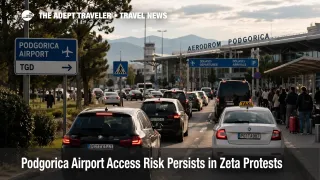
Travelers using Podgorica Airport (TGD) should keep treating the ground leg as the weak point on April 18, 2026, because the U.K. Foreign, Commonwealth & Development Office says protests in the municipality of Zeta can disrupt access to the airport. The practical problem is not necessarily a closed terminal or canceled flight. It is the risk that the road approach fails first. For airport departures, arrivals, rental car returns, and same day onward transfers, that makes extra surface buffer the most important protection right now.
Podgorica Airport Access Risk, What Changed
What changed for article purposes is not a new nationwide Montenegro warning. It is that the airport access warning remains current, with FCDO still telling travelers that protests in Zeta can disrupt access to Podgorica Airport. Airports of Montenegro's own site places the airport in Zeta, which explains why a municipal protest can become an aviation problem without any need for the terminal itself to shut down.
That distinction matters because travelers often read a normal departure board as proof that an airport is fully usable. In this case, that can be the wrong assumption. If the approach road slows, diverts, or blocks traffic near the terminal area, passengers can still miss check in, bag drop, or boarding even while flights continue to operate. The failure starts on the road, then moves into the airport timeline.
In an earlier Adept Traveler article, Montenegro Protests Still Threaten Podgorica Airport Access described the same corridor problem when the warning was still live in late March. The key update now is that the advisory remains current on April 18, 2026, so this should still be treated as an active planning issue rather than an expired one day alert.
Which Travelers Face the Most Exposure
The highest exposure falls on travelers who have little slack in the ground segment. That includes early departures, separate ticket itineraries, checked bag passengers, rental car returns, private transfers, and anyone trying to fly out after a same day drive from the coast, from inland Montenegro, or from Albania. Once the road margin disappears, the rest of the itinerary can unravel fast, from missed check in to missed boarding to expensive rebooking.
Leisure travelers heading to or from Montenegro's Adriatic corridor are especially vulnerable because Podgorica often works as the air gateway for trips that extend well beyond the capital. Airports of Montenegro lists normal drive times of about 40 minutes from Cetinje, 90 minutes from Tivat, and 55 minutes from Bar. Those times stop being reliable planning tools if a protest compresses traffic near the airport approach. A delay close to the terminal can erase the margin from a much longer trip upstream.
Arrivals also face a quieter version of the same problem. A flight can land on time, yet hotel pickups, taxis, and onward transfers can still become late or more expensive if access near the airport is disrupted. For travelers crossing into resort stays, mountain itineraries, or Albania bound overland plans, a local airport access problem can become a wider timing and handoff problem within the same afternoon.
What Travelers Should Do Now
The immediate move is to add real road buffer, not symbolic buffer. Podgorica Airport's operator says passengers should arrive at the airport about two hours before departure. For a live airport access warning, that airport timeline should sit on top of extra transfer time, not replace it. Travelers leaving from farther away should assume the drive needs more margin than usual, especially on a departure that would be expensive or difficult to miss.
For early morning flights, last flights of the day, or any itinerary with a separate onward ticket, the cleaner decision is often to stage in Podgorica or close to the airport corridor the night before. That adds hotel cost, but it reduces the much larger risk of losing the whole departure because the final road segment fails. Travelers with only hand baggage, flexible tickets, and low consequence if delayed can accept more uncertainty. Travelers with checked luggage, children, fixed tours, or cross border handoffs should be more conservative.
Over the next 24 to 72 hours, the signals to watch are straightforward. Monitor local media, official announcements, and the FCDO page itself. Do not rely only on airline flight status, because airline systems may still show a normal operation while the actual pressure point remains outside the terminal on the approach road.
Why a Local Protest Keeps Reaching the Airport
The mechanism here is simple. Podgorica Airport sits in Zeta, and airports depend on their access corridors just as much as on runways and terminals. A protest near a key roundabout or approach road does not need to close the airport to create disruption. It only needs to slow or reroute enough vehicles to break the timing assumptions behind departures, pickups, and onward connections.
That is why the operational seriousness is higher than the short wording in the advisory might suggest. First order, travelers can miss flights even on a day when airport operations look normal. Second order, the missed flight can then spill into rebooked car hires, late hotel arrivals, extra transfer costs, and broken onward leisure plans deeper into Montenegro or across the Albania border. The narrower the itinerary margins, the more expensive a local road protest becomes.
What happens next depends less on airport operations than on whether protests continue to interfere with the access corridor. There is no current sign in the FCDO advice of a nationwide aviation shutdown. The live variable remains the road approach. That means the Podgorica airport access risk is still best managed as a transfer and timing problem first, and a flight problem second.