

Rabat Protest Travel Risk Hits Sunday City Access
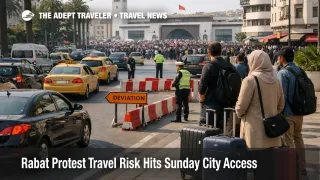
Rabat protest travel risk is elevated for Sunday, April 19, 2026, because the U.S. Embassy in Morocco says it has received reports of a large scale protest planned in the city, and local reporting points to a central route that starts at Bab El Had at 10:00 a.m., runs along Mohammed V Avenue, and ends in front of Rabat Ville train station. Travelers with short city stays, same day rail departures, or airport transfers from central Rabat face the highest friction. The main issue is not a citywide shutdown, but a tight central corridor where road access, taxis, and timed hotel movements can become unreliable for several hours. The practical move is to shift nonessential central crossings earlier, add buffer to any departure, and avoid building a precise schedule around downtown road travel.
Rabat Protest Travel Risk: What Changed
The new operational change is the dated protest alert itself. The U.S. Embassy in Morocco said it had received reports of plans for a large scale protest in Rabat on Sunday, April 19, 2026, and advised people to monitor local media, stay alert in public places, avoid large crowds, and keep a low profile. That shifts the traveler problem from general Morocco caution to a specific Sunday movement issue in the capital.
Local reporting gives the most useful route detail now available. Yabiladi reported that the march is set to start at Bab El Had at 10:00 a.m., proceed along Mohammed V Avenue, and end in front of Rabat Ville train station. Visit Rabat describes Mohammed V Avenue as one of the city's main central thoroughfares, stretching between Rabat Ville station and the Parliament area, which means the likely pressure zone is not a side street protest but one of the capital's most important administrative and visitor corridors.
That matters most for travelers who planned to treat central Rabat as a quick, walkable stop with easy taxi access. A protest on that axis can slow not just the exact march path, but nearby hotel pickups, ride hail availability, and cross center transfers when police redirect traffic or drivers avoid the area. The likely disruption window is late morning into at least part of the afternoon, based on the announced 10:00 a.m. start and the route length through the city center. That timing is an inference, not an official end time.
Which Travelers Face the Most Sunday Friction
The most exposed travelers are those staying near Bab El Had, central medina edges, Mohammed V Avenue, the Parliament district, or Rabat Ville station. Anyone relying on Rabat Ville for an intercity departure should treat station access as the clearest pinch point, because the announced route ends in front of the station itself. A train may still run, but reaching it on time becomes less predictable when the approach roads and sidewalks are the protest destination.
Airport travelers are the next group that should take this seriously. Visit Rabat identifies Rabat-Salé Airport as the region's main international gateway and says the city is linked by regular transport connections, but a Sunday departure from a hotel in central Rabat still depends first on surface movement out of the city. If traffic control or spontaneous spillover slows the downtown to airport leg, a normal departure cushion may no longer be enough. That does not mean Rabat-Salé Airport (RBA) itself is expected to shut down. It means the weak point is the city access chain between hotel, car, and terminal.
Short stopover visitors and weekend leisure travelers also face a higher cost from even modest delay. A one hour slowdown in a long trip can be absorbed. A one hour slowdown in a Sunday city break can break a prepaid tour, compress lunch and sightseeing plans, or turn a comfortable rail or flight transfer into a rushed one. In an earlier Adept Traveler article, Morocco Passport Help Tightens During Eid Closure, the reporting noted another Morocco travel problem where the real pressure point was not the headline itself, but the chain between city movement, paperwork, and departure timing. The same logic applies here. A central protest does not need to become violent to cause real itinerary damage.
What Travelers Should Do Now
Travelers crossing central Rabat on Sunday should move earlier, not later. If you need to reach Rabat Ville station, cross Mohammed V Avenue, or transfer from a central hotel to the airport, the safest approach is to complete that movement before the 10:00 a.m. start where possible. If your hotel can arrange a very early car, that is more reliable than trying to source one as the protest builds.
The decision threshold is simple. If your plan depends on being somewhere in central Rabat at an exact time after midmorning on April 19, you should change the plan now. That can mean switching to an earlier train, leaving for the airport with far more buffer than usual, rescheduling a guided tour, or avoiding a same day hotel change across the city center. If your itinerary is flexible and purely local, waiting the central corridor out is often the lower stress option.
What to monitor next is narrow and practical. Watch for any overnight update from the U.S. Embassy in Morocco, local media reporting on turnout, and same morning hotel guidance on road closures or diversion points. Travelers should not expect perfect official precision on clearing times. Once a large march is underway, the better signal is whether cars are still moving normally near Bab El Had, Mohammed V Avenue, and Rabat Ville, not whether the original march notice has changed.
Why Central Rabat Is the Main Pressure Point
The mechanism here is straightforward. The announced route links one of central Rabat's historic gateways, Bab El Had, with Mohammed V Avenue, a major downtown spine, and finishes at Rabat Ville station, which is both a transport node and a landmark in the heart of the city. When a march occupies that corridor, disruption spreads outward through the usual travel system layers: first roads and pedestrian flow, then taxi and pickup reliability, then rail arrival margins, and finally airport transfer confidence for anyone starting from the center.
The seriousness level looks like meaningful disruption, not structural shutdown. The alert is city specific and date specific. There is no official indication that Morocco's wider transport network is closing, and there is no verified notice at this stage of a Rabat-Salé Airport shutdown or national rail stoppage tied to the protest. The risk is concentrated, but very real for travelers whose Sunday plan runs through the center.
What happens next depends on turnout and policing, both of which are still uncertain. Large central demonstrations can stay contained, or they can generate rolling diversions beyond the announced line. Travelers should therefore read this as a central access problem first. If you are sleeping outside the center or not moving until evening, your exposure drops sharply. If you are crossing downtown during the protest window, your margin for error does not.