

EU Jet Fuel Stocks Raise Summer Flight Risk
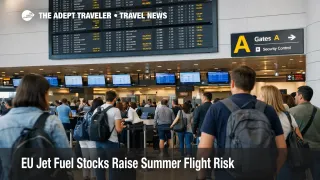
Travelers booking Europe summer air should stop treating fuel stress as only a fare problem. Brussels is now openly prepared to coordinate a release of jet fuel stocks if Strait of Hormuz disruption persists, a step Reuters first reported on April 17 and that Spain backed publicly on April 20. That does not mean Europe is out of fuel, and it does not confirm summer cancellations. It does mean officials now see the risk as serious enough to prepare a physical contingency, not just watch prices rise. For travelers holding late May through August tickets, the practical move is to value flexibility, nonstop options, and stronger hub choices more than they did a week ago.
Europe Summer Flight Risk: What Changed
What changed is the level of official response. Reuters reported on April 17 that an EU spokesperson said the bloc is prepared to coordinate a release of jet fuel stocks if Strait of Hormuz disruption continues. On April 20, Spain's energy minister said Madrid would actively participate in a potential EU sharing plan and also signaled support for joint purchases, which turns the idea from a quiet contingency into a more concrete policy option. That is a different signal from earlier warnings about higher prices or thinner airline margins. It tells travelers that Brussels is now thinking about physical supply management.
The seriousness is still uneven. The European Commission's oil security framework requires member states to hold emergency stocks equal to at least 90 days of net imports or 61 days of consumption, and the Commission coordinates consultation before withdrawals in a supply crisis. At the same time, Reuters reported that Europe relies heavily on Gulf jet fuel flows, that airport fuel systems do not always hold large long term inventories, and that independently held jet fuel stocks in the Amsterdam, Rotterdam, Antwerp hub fell to a four year low last week. In plain language, the stock release lever exists, but it sits inside a system where aviation fuel can still tighten faster than headline oil supply numbers suggest.
Which Travelers and Markets Look Most Exposed
Exposure is not uniform across Europe. Reuters reported earlier this week that Spain is better placed than many peers because of its refinery base and diversified supply from the Americas and North Africa, and its minister said kerosene stocks are near maximum levels. Britain, by contrast, has already been highlighted in prior reporting as more import dependent than Spain, and the wider European network remains exposed because big hub systems depend on steady, predictable fuel flows even when one country is better supplied than another. The travelers most at risk are not everyone flying to Europe, but passengers relying on weaker frequencies, self connections, island links, late day departures, and tightly timed summer itineraries.
The first order effect, if supply stress worsens, is not necessarily a dramatic airport shutdown. It is more likely to show up through selective frequency cuts, aircraft downgrades, fewer same day backup flights, and fare pressure as airlines protect core hubs and stronger routes first. The second order effect lands on travelers whose plans depend on precise timing, cruise embarkations, weddings, tours, short resort stays, or expensive nonrefundable hotels. IATA said on April 17 that Europe could start seeing cancellations by the end of May for lack of jet fuel, while Reuters reported on April 20 that Europe is still drawing record inflows from the U.S. and Nigeria even as stocks remain tight. That combination means the system is not broken yet, but it is operating with less slack than summer travelers usually assume.
What Travelers Should Do Before Buying Summer Flights
Late May, June, July, and August buyers should treat fare flexibility as part of the itinerary, not as an optional extra. If the price gap between a rigid basic fare and a changeable ticket is modest, the flexible fare now buys real operational value. It gives you room to react if a carrier trims frequencies, swaps aircraft, or pushes your routing onto a weaker connection. Travelers already ticketed should watch for schedule changes, not just fare changes, because schedule revisions are often the first visible sign that airlines are preserving fuel and network resilience.
It also makes sense to be choosier about airport and routing structure. Nonstops, longer layovers, early day departures, and one ticket itineraries are worth more while fuel availability remains part of the story. A cheap self connect through a major hub can still work, but it carries more risk if the first cut hits marginal feeder flights or if same day reaccommodation weakens. In an earlier Adept Traveler article, Europe Flight Cancellation Risk Moves to Late May, the pressure point had already shifted toward a named timing window for possible cancellations. Travelers building around fixed events should think harder about arriving the day before, not the day of.
Travelers should also watch what kind of language airlines and regulators use over the next several days. "Higher fuel costs" is painful but manageable. "Fuel availability," "rationing," "slot relief," or public stock sharing guidance is a different stage. Reuters reported that the European Commission is due to publish broader refining and fuel measures on April 22, and that the Dutch government believes current production plus reserves could cover about five months of kerosene demand under present disruption levels. That argues against immediate panic, but it does not eliminate the risk of selective summer disruption if the supply picture worsens or if airport level bottlenecks appear before reserves can smooth them.
What a Stock Release Can, and Cannot, Solve Next
A stock release would help with one specific problem, physical supply pressure. It can buy time, support priority flows, and reduce the chance that airports or fuel consortia run short while replacement imports from the U.S., Nigeria, and elsewhere move into Europe. That matters because the EU's emergency stock system was built for supply disruptions, and Brussels now appears willing to use that coordination power for aviation if needed.
What it does not solve cleanly is the whole airline summer equation. A stock release cannot fully erase higher fuel prices, restore lost network slack, or guarantee that carriers keep every marginal route in place. Airlines may still protect their best performing hubs and trim weaker flying first, especially if prices stay near recent highs or if physical distribution stays uneven between countries and airport systems. In an earlier Adept Traveler article, Travel Fuel Risk Is Becoming a Refinery Fit Problem, the deeper issue was already moving beyond crude volume into whether the right refining and product chains could keep jet fuel flowing where it is needed. That remains the harder structural question behind the summer outlook.
The next real decision point is not whether Brussels has a lever. It is whether officials need to pull it, and whether replacement imports plus refinery output stabilize the market before late May. If those signals improve, Europe summer flight risk can settle back toward a fare and booking story. If they do not, travelers should expect the first visible cracks to appear in schedules and connection reliability before they appear as headline airport shortages.
Sources
- EU could release jet fuel stocks if Hormuz disruption persists, Reuters
- Spain says it would join potential EU jet fuel sharing as data shows more supply coming, Reuters
- EU has reserves, production for five-months supply of jet fuel, Dutch government says, Reuters
- EU working on jet fuel plan as Iran crisis threatens air travel, Reuters
- Security of oil supply, European Commission
- IATA Statement on Potential Jet Fuel Shortages