

Europe Flight Cancellation Risk Moves to Late May
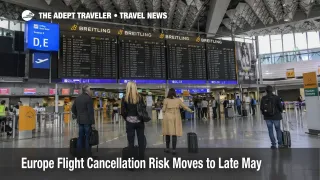
Europe flight cancellation risk has moved from contingency talk to a named timing window. On April 17, the International Air Transport Association said cancellations in Europe could start by the end of May if jet fuel disruption tied to Middle East supply routes continues, pushing the problem closer to summer booking and rebooking decisions. For travelers holding late May and June tickets, this is no longer only a fare story. It is now a schedule reliability problem, especially for trips built around tight hub connections, cruise departures, tours, or nonrefundable hotels.
In an earlier Adept Traveler article, Europe Jet Fuel Risk Moves Into Emergency Planning, the issue was still whether Brussels would move from monitoring into policy preparation. In another earlier Adept Traveler article, EU Jet Fuel Plan Raises Summer Flight Risk, the pressure point had shifted to draft EU measures expected on April 22. The new change is narrower, and more operational. IATA is now saying the likely traveler consequence could be cancellations from the end of May, not just higher prices or vague summer risk.
Europe Flight Cancellation Risk: What Changed
What changed on April 17 is that an industry body put a calendar on the problem. IATA said Europe could start to see cancellations by the end of May and called for authorities to prepare coordinated contingency plans, including possible fuel rationing and slot relief if shortages worsen. That lands on top of the European Commission's draft work on refinery capacity and jet fuel measures due on April 22, and the International Energy Agency's April 14 warning that Europe could face physical shortages by June if it replaces only half of the fuel it normally gets from the Middle East.
The seriousness here is not that a continent wide cancellation wave has been confirmed. It has not. The confirmed change is that the warning has escalated from supply stress and emergency planning to a specific late May disruption window. For travelers, that matters because airlines can cut weaker frequencies before airports visibly run short, which means the first sign may be schedule revisions, thinner same day backup options, and higher fares on the flights that remain.
Which Travelers and Airports Look Most Exposed
The exposure is uneven. Reuters reported that Europe relies on the Middle East for about 75 percent of its jet fuel imports, while Britain imports about 65 percent of its own demand and Spain is a net exporter of jet fuel. That points to greater pressure on import dependent markets and on hub systems that need large, predictable fuel flows to protect dense banks of short haul and long haul departures. Amsterdam, Heathrow, Frankfurt, Paris, and other major connection hubs matter more here than isolated point to point airports because disruption at those banks spreads quickly into misconnects and overnight stays.
The most exposed travelers are the ones with the least slack. That includes passengers on once daily flights, island links, self connections, short haul feeds into long haul departures, cruise embarkation days, and trips with expensive nonrefundable hotels or tours at the far end. First order, airlines are likely to protect their strongest routes and cut weaker margins first. Second order, when one bank shrinks, recovery options narrow, onward rail and cruise timing gets harder, and extra hotel nights become more likely.
What Travelers Should Do Before Paying More Nonrefundable Costs
Late May and June travelers should treat the next several days as a booking discipline window, not a panic window. If a fare is flexible for a modest premium, that premium now buys more than comfort. It buys room to react if airlines trim frequencies before departure day. Travelers already ticketed should watch for schedule change notices, aircraft swaps, and disappearing alternative departures on the same day, because those are practical signs that slack is leaving the system.
For hub connections, the tradeoff is now clearer. A cheaper itinerary with a tight connection may save money today, but it is more fragile if Europe flight cancellation risk turns into selective schedule cuts. Nonstop flights, longer layovers, early day departures, and one ticket itineraries are worth more in this environment than they were a week ago. Travelers building a cruise, wedding, or tour around an arrival date should be especially cautious about same day connections and prepaid add ons that cannot move. A one night buffer before a fixed event is increasingly rational for late May trips.
The next decision point is policy and carrier messaging. Watch the European Commission's April 22 package, any public guidance on rationing or slot relief, and airline language that shifts from fuel cost to fuel availability. If authorities stay in planning mode and replacement imports keep improving, the risk window could ease. If airlines begin talking about protecting fuel allocation, reducing weaker frequencies, or revising summer schedules, travelers should assume rebooking options will get worse, not better.
Why Late May Matters, and What Happens Next
The mechanism is straightforward. Europe's problem is not only the price of oil. It is the availability of the right refined product in the right place at the right time. Reuters reported record April inflows of jet fuel from the United States and Nigeria, but those extra barrels still do not fully replace lost Gulf supply. Stocks at the Amsterdam Rotterdam Antwerp hub have already fallen to their lowest since March 2023, and Europe's emergency oil reserve rules do not require specific minimums for jet fuel.
That is why late May has become the key traveler window. IATA's end of May warning lines up with the IEA's June shortage scenarios and with the Commission's effort to get refinery and supply measures into place before summer demand peaks. What happens next depends on two things, whether Middle East flows normalize enough to stabilize imports, and whether Europe can keep enough inventory above the threshold where select airports start facing physical shortages. Until that becomes clearer, Europe flight cancellation risk belongs in the same planning conversation as fare, baggage, and seat choice for any late May or June itinerary.
Sources
- IATA Statement on Potential Jet Fuel Shortages
- Europe faces summer flight cancellations from jet fuel shortage, IATA says, Reuters
- EU working on jet fuel plan as Iran crisis threatens air travel, Reuters
- Europe could see jet fuel shortage by June, IEA says, Reuters
- Europe facing jet fuel crunch sees record inflows from US, Nigeria, Reuters
- Europe Jet Fuel Risk Moves Into Emergency Planning
- EU Jet Fuel Plan Raises Summer Flight Risk