

Iraq Flights Resume on a Limited Basis, Risk Remains
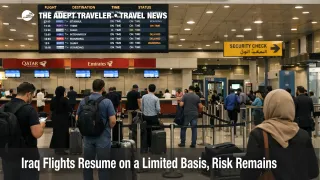
Iraq limited commercial flights resumed on April 20, 2026, after Iraqi airspace reopened, but the operating picture is still closer to a constrained exception than a normal restart. The U.S. Embassy in Baghdad said flights are back only on a limited basis and kept its warning about missile, drone, and rocket risk in Iraqi airspace, while the U.S. State Department still rates Iraq Level 4, Do Not Travel. For travelers, that means some entry and exit paths may work again, but schedule reliability, onward connections, and same day recovery options remain weak. Anyone already in Iraq should treat a confirmed seat as useful, not as proof the system is stable.
Iraq Limited Commercial Flights, What Changed
The immediate change is that Iraq is no longer in the overland only phase described in In an earlier Adept Traveler article, Iraq Airspace Closure Leaves Only Overland Exits. On March 25, the working assumption was no commercial air exit at all. On April 20, the embassy shifted that assumption by saying Iraqi airspace has reopened and limited commercial flights have resumed. That is a meaningful operational improvement, but it is not the same as a broad network recovery, because the embassy paired the reopening language with a fresh warning that missiles, drones, and rockets still threaten Iraqi airspace.
That distinction matters. A reopened airspace notice tells travelers the system can move some aircraft again. It does not tell them how many flights are actually operating, how many seats are for sale, which carriers have fully reloaded schedules, or how durable those schedules are if the regional security picture worsens. The European Union Aviation Safety Agency, or EASA, still has an active conflict zone information bulletin for Iraq and the wider Middle East corridor through April 24, 2026, which is a strong signal that aviation risk management has not returned to ordinary peacetime assumptions.
Which Travelers and Routes Are Most Exposed
The most exposed travelers are people using Iraq for immediate exit, short notice business travel, contractor movements, family emergencies, or itineraries that rely on one successful departure to unlock the rest of the trip. Leisure travelers looking at Iraq as a normal bookable destination are reading the situation wrong. The State Department still says do not travel to Iraq for any reason, and the U.K. Foreign, Commonwealth & Development Office still advises against all travel to both Federal Iraq and the Kurdistan Region because the regional conflict remains volatile and unpredictable.
In practical terms, the most realistic airport assumptions are Baghdad International Airport (BGW) first, then possibly Erbil International Airport (EBL) or Basra International Airport (BSR) where carriers and airport operations are actually loaded and ticketable. The available booking and destination pages that are visible now point more toward Gulf connection logic than broad network normality, with Qatar Airways showing Baghdad service, and Emirates and flydubai showing Baghdad booking paths and Baghdad departures. That does not guarantee smooth travel, but it does suggest travelers should think in terms of narrow corridor recovery through hubs such as Doha and Dubai, not a fully restored menu of regional and European options.
The second order risk is where trips still break. A flight may operate, but one delay, one renewed warning, or one airport pause can still strand travelers after checkout, burn a hotel night, and wipe out onward Gulf or Europe connections. That is especially true for anyone trying to self connect, switch airlines on separate tickets, or reach a same day meeting, tour, or onward border crossing. Limited flights are better than none, but they still leave very little slack in the system.
What Travelers Should Do Now
Travelers already in Iraq should work backward from the consequence, not the headline. If the goal is to leave, the right threshold for booking is not whether a flight appears online, but whether it is confirmed, near term, and backed by a plan for what happens if it slips. Rebook toward a working seat now if your current plan depends on a same day long haul connection, a visa deadline, a timed event, or a hotel checkout that leaves you nowhere to absorb disruption. Wait only if you already have secure lodging, high schedule flexibility, and a realistic road backup.
The leave now versus wait logic is fairly blunt. Leave now if you hold a confirmed ticket out of Iraq in the next one to three days, your route does not depend on a risky self connection, and you can get to the airport without turning the ground segment into its own security problem. Waiting makes more sense only if the available flights are speculative, overpriced, or force a worse exposure than staying in place briefly with secure accommodation and local support. Travelers should not confuse patience with safety when the wider advisory picture still says do not travel and consular help remains limited.
Overland logic also stays relevant. The return of limited commercial flights reduces pressure on land exits, but it does not eliminate the need for a fallback. Jordan, Türkiye, Saudi Arabia, and Kuwait were the core overland alternatives during the closure phase, and that planning should not be discarded until Iraq's flight network shows several consecutive days of stable, wider operations. A traveler who heads to the airport without a road fallback is still assuming the air side will behave normally, and that assumption is not supported yet.
Why Iraq Travel Is Still a Limited Recovery Story
The mechanism is straightforward. Airspace reopening restores permission to operate, but not full resilience. Airlines still have to decide whether crews, aircraft, insurance, routing, passenger demand, and security risk justify putting more capacity back into Iraq. Regulators and safety managers are still treating the region as a conflict exposed environment, which is why EASA's current bulletin remains active and why official travel advice has not softened with the reopening notice.
That leaves Iraq in an awkward middle phase. The shutdown logic has eased, but the normalization logic has not arrived. What happens next depends on whether limited flights expand into repeatable schedules without new missile, drone, or rocket incidents affecting Iraqi airspace or nearby corridors. The clearest stabilization signals would be more carriers openly restoring service, a broader set of ticketable departures from Baghdad, Erbil, and Basra, and a softer official risk posture. The clearest warning signs would be renewed airspace restrictions, carrier pullbacks, airport advisories telling passengers not to travel to terminals without reconfirmation, or another wave of regional conflict alerts. Until those signals move decisively, Iraq limited commercial flights should be read as a fragile reopening, not normal operations.
Sources
- Security Alert - U.S. Embassy Baghdad, Iraq - April 20, 2026
- Iraq Travel Advisory, U.S. Department of State
- Iraq Travel Advice, U.K. Foreign, Commonwealth & Development Office
- Airspace of the Middle East and Persian Gulf, EASA CZIB 2026-03-R6
- Book Flights to Baghdad, Qatar Airways
- Flights from Baghdad (BGW) to Dubai (DXB), Emirates
- Flights from Baghdad, flydubai