

Japan Quake, Tsunami Alert, Tohoku Delays April 20
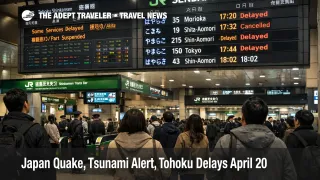
Japan earthquake tsunami travel conditions changed on April 20, 2026, after a powerful offshore quake near Sanriku triggered coastal tsunami warnings, evacuation orders, and transport checks across northeastern Japan. The Japan Meteorological Agency listed the quake at magnitude 7.5, while early wire coverage also reported 7.7, a normal spread in early magnitude estimates after large events. The tsunami warning was later downgraded and then lifted, but the operational problem for travelers did not end at the same moment, because rail inspections, coastal restrictions, and aftershock risk can still slow same day plans across Tohoku.
Japan Earthquake Tsunami Travel: What Changed
The confirmed sequence is clear enough for trip planning. JMA said the quake struck off the Sanriku coast at 4:53 p.m. local time on April 20, and its tsunami page later showed that no tsunami warnings or advisories remained in effect. Reuters and AP reported that authorities initially warned of waves up to 3 meters, but observed waves reached about 80 centimeters before the warning was downgraded and the tsunami risk was later declared over.
The main traveler consequence shifted quickly from immediate coastal evacuation to network friction. Reuters and AP both reported evacuation orders in coastal communities, brief bullet train suspensions, and some highway closures. JR East's live status pages then showed Tohoku Shinkansen delays tied to the earthquake, plus knock on delays on some conventional lines in the wider Tohoku network.
That makes this a meaningful disruption story, but not a broad Japan shutdown story. There were no immediate reports of major damage, and authorities said no abnormalities were found at nearby nuclear facilities. For most travelers outside northeastern coastal Japan, the issue is not whether Japan is open, it is whether a specific train segment, station transfer, or coastal day trip still works tonight and into the next day.
Which Tohoku Travelers Face the Most Friction
The most exposed travelers are those moving through northeastern Honshu by rail, especially anyone relying on the Tohoku Shinkansen north of Sendai or on local lines feeding coastal towns in Iwate, Miyagi, and neighboring prefectures. JR East's English language status pages show why, they are useful for broad delay awareness, but the operator also warns that posted information can lag real world operations. That gap matters when a station board clears more slowly than an online page, or when trainsets and crews are still being repositioned after an inspection stop.
Coastal travelers face a different problem. Even after tsunami warnings end, beaches, harbors, river mouths, and some local access routes can remain poor places to linger during the transition back to normal operations. Authorities in past Sanriku events have used that same pattern, clear the highest alert first, then work through inspections, local instructions, and transport normalization. In an earlier Adept Traveler article, Japan Quake Lifts Tsunami Advisory, Shinkansen Inspected the main lesson was that the advisory can end before rail timing fully recovers. That same planning logic fits April 20.
The next layer of exposure is itinerary chaining. A short delay leaving Sendai can become a missed hotel check in, a broken regional rail connection, or a lost timed entry booking farther north. That is where earthquake travel disruption spreads, not as a single dramatic closure, but as a series of small timing failures across trains, buses, tours, and lodging arrivals. AP also reported that officials issued a follow on advisory saying the chance of a stronger quake in the next week is still low, but elevated above normal, which adds more uncertainty for tightly built coastal plans.
What Travelers Should Do Now
For travelers in Tohoku tonight, the practical move is to convert the event into buffer time. Recheck JR East status pages, then verify again at the station before boarding. If your plan depends on a same platform or short window transfer at Sendai, Morioka, Hachinohe, or Shin Aomori, treat that connection as fragile and build more slack into the trip.
For travelers headed to the coast, the immediate threshold is simpler. Do not return to beaches, ports, or river mouths just because the headline warning has ended. Wait for local authorities, operators, and accommodation staff to confirm access conditions. If your lodging or tour is in a low lying coastal area, ask whether access roads, harbor operations, and pickup points are actually running before you depart.
For travelers elsewhere in Japan, this is mostly a monitoring problem rather than a cancellation problem. Tokyo, Osaka, Kyoto, and other distant hubs are not facing the same operational exposure. But if your next 24 to 72 hours include northern coastal rail, a domestic connection into Tohoku, or a fixed schedule tour, that is the point where rebooking a later departure can save the itinerary even if the headline alerts have already cleared. In an earlier Adept Traveler article, Japan Megaquake Advisory Puts Northern Travel On Watch the useful distinction was between staying alert and overreacting. That still applies here.
Why Rail Delays Can Linger After Alerts End
The mechanism is straightforward. A tsunami warning and a rail delay are related, but they are not the same operational problem. The warning is about coastal water risk. The rail delay is about whether tracks, power systems, signaling, and rolling stock can be cleared safely after strong shaking. That is why bullet trains can restart in phases, why online status pages can show uneven recovery, and why local lines can still drag behind the headline all clear.
This also explains what happens next. The highest risk of broad coastal danger has passed, but aftershocks and precautionary checks can keep parts of the network unstable into the next operating cycle. AP and Reuters both reported an official advisory that the chance of a larger quake over the coming week is still only around 1 percent, not a prediction, but enough for authorities to tell residents and travelers in affected coastal areas to review evacuation routes and supplies. That does not mean northern Japan is closed. It means April 20 changed the reliability math for coastal Tohoku, especially where one late train breaks the rest of the trip.
Sources
- Japan Meteorological Agency, Tsunami Warning / Advisory
- Japan Meteorological Agency, Earthquake Information
- JR East Train Status Information, Shinkansen
- JR East Train Status Information, Tohoku Area
- Reuters, Japan eases back tsunami warning after magnitude 7.7 quake, no immediate reports of casualties, damage
- AP News, Japan warns of slightly increased risk of mega quake after a 7.7 magnitude one