

Cuba Fuel Shortage Squeezes Havana Exit Plans
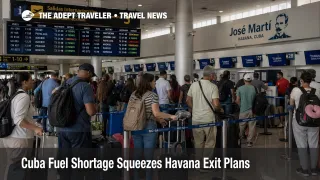
Travelers in Cuba should now treat departure planning as the main priority, not a last day logistics task. The U.K. Foreign, Commonwealth and Development Office says all of Cuba's international airports are without aviation fuel, Terminal 2 at José Martí International Airport (HAV) in Havana has closed, and some airlines have suspended service while others are cutting frequencies. That shifts the problem from broad destination strain to a live exit risk, especially for travelers with fixed onward flights, visa deadlines, cruise joins, or limited cash and communications backup. Travelers still in Cuba should confirm flights directly with their airline and protect alternate departure options now.
Cuba Fuel Shortage: What Changed
What changed is that the pressure is now clearly visible at the airport system itself. The FCDO says Cuba is dealing with severe and worsening infrastructure disruption, persistent power outages, and fuel shortages, and adds that all international airports are without aviation fuel. The same advisory says Terminal 2 at José Martí International Airport, which handles U.S. flights and some charter traffic, has closed and flights have been diverted to Terminal 3. That is not a routine terminal shuffle. It concentrates more demand into a thinner operating setup at the country's main international gateway.
The airline picture is also narrower than many travelers may assume. The FCDO says all Canadian airlines, Air France, and LATAM have suspended flights to and from Cuba, while Iberia and Air Europa are reducing weekly Havana to Madrid service and other airlines are keeping routes under review. Iberia has also published a Cuba travel notice tied to suspended flights and rebooking flexibility for affected Havana itineraries. That combination means published schedules alone are no longer a reliable measure of how easy it will be to leave.
This is also a sharper version of the risk Adept flagged earlier this month. In an earlier Adept Traveler article, Cuba Airport Fuel Crunch Cuts Havana Exit Options, the focus was the shift from background economic strain to harder airport limits. The new development is that the official warning still points to shrinking exit capacity, and several major carriers have already reduced or withdrawn service rather than waiting for a full operating breakdown.
Which Travelers Face the Most Pressure
The most exposed travelers are those who need a dependable outbound seat on a fixed date. That includes travelers with nonrefundable onward tickets, visa validity limits, medical needs, cruise embarkations, work deadlines, or family travel that depends on a same day connection elsewhere. It also includes anyone assuming Havana airport processing will remain normal despite terminal diversion, power instability, and weaker transport conditions across the island.
Canadian travelers remain one of the clearest exposed groups because the FCDO says all Canadian airlines have suspended Cuba service. Reuters reported in February that Air Canada, WestJet, and Air Transat suspended operations as Cuba warned of unreliable aviation fuel supplies, while Air Canada organized repatriation flights and Air Transat paused flights until the end of April. Air France later said it would suspend Paris to Havana flights from March 28 through June 15, and AP reported those flights had already been making refueling stops in the Bahamas on return trips. Even travelers not booked on those carriers are affected because fewer airlines means fewer fallback seats once anything slips.
The second order effects are where this gets expensive. A lost outbound seat is not just one more hotel night. It can mean more time in a market already facing power outages, fuel stress, transport disruption, and communication problems. That raises the chance of missed onward travel, cash shortages, document issues for third country routings, and harder access to medicines or reliable ground transport while waiting for the next viable departure.
What Travelers Should Do Now
Travelers already in Cuba should move from passive monitoring to active exit protection. Check the operating status of your flight directly with the airline, not only with an online travel agency or app, and confirm both terminal assignment and airport arrival guidance. Because Terminal 2 traffic is being pushed to Terminal 3, travelers leaving Havana should also assume processing patterns may differ from what they planned when the ticket was booked.
For travelers with a functioning outbound seat, the main decision point is whether to keep the current plan or leave earlier while seats still exist. Leaving early makes more sense when the itinerary depends on a single carrier, a tight onward connection, or a time sensitive border, visa, or cruise commitment. Waiting makes more sense only if the trip is flexible, cash reserves are strong, documents for alternate routes are in hand, and the traveler can absorb extra nights or a forced reroute without larger consequences.
For new bookings into Cuba, this is the point where deferring leisure travel becomes the more defensible default unless the trip is essential and the exit plan is unusually strong. Travelers who do proceed should carry extra cash, keep devices charged whenever power is available, protect medications, and avoid building a plan around the assumption that airport capacity, local transport, and airline continuity will improve quickly. The practical test is simple, if one broken segment can collapse the whole trip, the margin is already too thin.
Why the Disruption Is Spreading, And What Happens Next
The mechanism is broader than one terminal closure. Cuba's airport strain sits inside a larger energy and infrastructure problem. The FCDO says severe and worsening disruption is affecting transport, medical care, communications, and other basic services. Reuters reported that Cuba has historically relied on Venezuela for much of its jet fuel, and that blocked oil flows and wider fuel constraints were behind the aviation shortfall. When energy supply tightens at a national level, airports compete with the rest of the system for limited fuel and operating stability.
That helps explain why the next meaningful signals are not only airport notices. Travelers should watch for more airline suspensions, deeper frequency cuts, longer refueling detours, or new warnings that remaining routes are under review. Iberia's April 13 flexibility notice for Cuba shows the market is already moving into contingency mode, not normal seasonal planning. If more carriers follow Air France or if remaining Europe links thin further, Havana exit planning becomes even more fragile for travelers who thought they still had time.
For now, the clearest read is that the Cuba fuel shortage is an airport and departure problem first, and a leisure planning problem second. Travelers with live outbound options should treat them as perishable. Travelers considering new trips should assume Cuba fuel shortage risk can still reshape Havana airport operations, carrier availability, and exit timing with limited warning.