

Lebanon Route 51 Carveout Tightens Beirut Airport Access
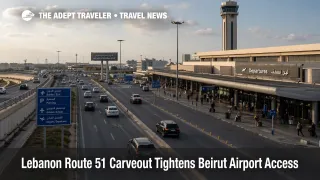
Beirut airport access is now a corridor planning problem, not a simple citywide warning. The U.K. Foreign, Commonwealth & Development Office updated its Lebanon advice on April 10, 2026, and now advises against all travel to a longer list of Beirut districts and southern suburb areas while explicitly excluding Route 51 from central Beirut to Rafic Hariri International Airport (BEY) from that surrounding no travel zone. For travelers still exposed to Lebanon, that makes the road to the airport more important than the flight listing itself, because insurance validity, departure timing, and the basic feasibility of an airport run now depend on where you start and which roads you use.
Beirut Airport Access: What Changed
The operational change is geographic. FCDO says it now advises against all travel to Tariq el Jdideh, Ghobeiry, Chiyah, Haret Hraik, Burj Al Barajneh, Mraije, Laylaki, Basta, Bachoura, Zekak Al Blat, Barbour, Khandak El Ghamik, Jnah, the Golf Club of Lebanon area, and additional areas west of the Camil Chamoun Boulevard and Old Saida Road corridor, while specifically excluding Route 51 from central Beirut to the airport from that no travel zone. It also advises against all travel to a defined southern section of Mount Lebanon Governorate, while keeping the rest of Beirut and Mount Lebanon under all but essential travel advice.
That carveout does not mean normal mobility has returned. It means one airport corridor remains outside a wider block of newly defined higher risk areas. The airport itself continues to publish live flight information and passenger services on its official site, so the immediate weak point is not necessarily whether a plane is scheduled to leave, but whether a traveler can reach the terminal without relying on movements through areas the FCDO now places under stronger warning language.
Which Travelers Face the Most Lebanon Exposure
The most exposed travelers are the ones whose hotel, family stay, office, or pickup point sits south of central Beirut, close to the southern suburbs, or in a location that requires crossing restricted districts before joining the airport corridor. Same day departures are especially brittle for families, travelers with heavy baggage, older passengers, and anyone trying to pair checkout, meetings, or multiple city stops with an international departure.
This is also a sharper problem for travelers who assume a live ticket solves the bigger risk. It does not. A valid booking can still fail on the ground segment if the journey begins in the wrong place, uses an improvised taxi plan, or depends on last minute cross city movement. In an earlier Adept Traveler article, Beirut Airport Access Now Depends on Route 51, the key point was that Beirut airport access had already narrowed to a route specific problem. The April 10 update makes that logic more restrictive by expanding the surrounding areas that sit outside normal travel assumptions.
What Travelers Should Do Now
Travelers who still need to depart via Beirut should treat lodging choice as a transport decision first. Staying closer to a cleaner Route 51 airport run is often safer operationally than preserving a better hotel location elsewhere in the city. The extra hotel cost can be smaller than the cost of a missed departure, a forced rebooking, or an added night after a failed transfer.
The main decision threshold is whether your current departure plan depends on driving through, around, or out of areas now listed under the stronger no travel warning. Reposition earlier if it does. Wait only if you already have a confirmed ticket, a point to point airport transfer plan, and a starting location that does not require unnecessary movement through newly defined red zones. Travelers should also assume that going against FCDO advice can invalidate insurance and that consular support is severely limited where FCDO advises against travel.
Over the next 24 to 72 hours, the key things to monitor are any change to the Route 51 carveout, any shift in airline schedules at Beirut, and any sign that airport transfers are failing in practice even while flights remain bookable. If the corridor language tightens further, or if on the ground access starts breaking before departure, the situation moves from difficult planning into a narrower exit window.
Why the Route 51 Exception Matters Next
The Route 51 exception matters because it creates a narrow usable path inside a much broader deterioration in Lebanon's travel map. FCDO advises against all travel to South and Nabatiyeh Governorates, the Beqaa Governorate, Baalbek-Hermel Governorate, Akkar Governorate, Tripoli, and parts of the North, while warning against all but essential travel to the rest of Beirut and Mount Lebanon and the rest of the Northern Governorate. That means Beirut is not operating as a normal urban gateway even when the airport remains open.
The second order effects are practical and expensive. When viable airport access is concentrated on one corridor, hotel selection, driver reliability, check in timing, family coordination, and evacuation planning all become more fragile. A city that still appears connected on a map can behave like a much smaller, more segmented transport system in practice. That is why travelers with Lebanon exposure should stop thinking in city level terms and start thinking in neighborhood, corridor, and pickup point terms instead.