

Beirut Airport Access Now Depends on Route 51
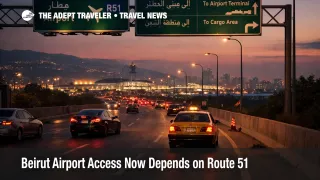
Beirut airport access is now a corridor management problem, not just a broad Lebanon security warning. The U.K. Foreign, Commonwealth & Development Office, or FCDO, now says its all travel exclusion across parts of Beirut's southern suburbs explicitly excludes Route 51 from central Beirut to and past Rafic Hariri International Airport, while the rest of Beirut and Mount Lebanon still sit under all but essential travel advice or worse. That matters because it turns airport planning into a neighborhood by neighborhood routing decision. Travelers who still intend to depart should avoid improvising across the city, keep a confirmed booking in hand, and treat airport transfers as controlled point to point moves rather than routine city travel.
The new value here is the map itself. Adept Travelers's earlier Beirut coverage focused on limited commercial flights and thinner embassy support. This update is more operational, because the advisory now identifies a specific corridor that remains outside the surrounding all travel exclusion, which changes where travelers should stage, how drivers should route, and how much slack a departure plan needs.
Beirut Airport Access: What Changed
What changed is not that Beirut Rafic Hariri International Airport (BEY) suddenly became normal. It did not. What changed is that FCDO now gives travelers a more usable piece of routing logic by carving out Route 51 from central Beirut to and past the airport, even as it continues to advise against all travel in large surrounding areas and against all but essential travel to the rest of Beirut and Mount Lebanon. That is a practical distinction, because it means the airport corridor is the exception, not the rule.
The airport itself is still functioning. Beirut Airport's official site continues to publish live arrivals and departures, with updates every three minutes, which supports the idea that BEY remains operational even in a fragile environment. FCDO also says there are limited commercial flight options from Beirut Airport and warns passengers not to travel to the airport unless their airline has confirmed the reservation.
That keeps Beirut in a narrow operating category. This is not a fully closed gateway, but it is also not an airport where a traveler should plan to solve problems at the curb, at the counter, or by trying a different city route at the last minute. The corridor matters because the rest of the urban map is heavily constrained.
Which Travelers Face the Most Disruption
The most exposed travelers are the ones staying south of central Beirut, near the edges of the excluded zones, or in neighborhoods that require crossing the wrong side of the map to reach Route 51. In practice, that means hotel location now matters almost as much as ticket status. A confirmed seat helps, but it does not solve the ground movement problem if your pickup starts from a poorly placed property or relies on a driver unfamiliar with the current routing logic.
Early morning long haul passengers are also exposed, especially anyone trying to chain together a hotel checkout, a security sensitive road move, and a flight with little recovery time. The same is true for families, travelers with heavy bags, and anyone depending on ad hoc taxis rather than a pre arranged transfer. In a city where the usable path to the airport is now effectively a designated corridor, small delays can cascade into missed check in windows, cancelled pickups, or a forced extra night in the wrong place.
This also raises the stakes for airline crews, corporate security teams, and tour operators handling clients still inside Lebanon. Their problem is no longer only whether flights remain on sale. It is whether staff and passengers can be staged close enough to the Route 51 corridor to move when the window is open, without relying on unnecessary cross city movement. That is the same broader logic behind earlier Adept coverage, Beirut Exit Flights Stay Limited on March 8 and Lebanon Beirut Exit Planning Gets Harder, but the route level detail now makes the ground plan much more concrete.
What Travelers Should Do Now
Travelers who still plan to fly out should stage in central Beirut or another location that lets them reach Route 51 without a complicated detour through the southern suburbs. The wrong hotel can now create a transport problem even if your flight is still operating. The right hotel is not just the nicest or closest property, it is the one that reduces the amount of uncertain urban movement between your room and the corridor.
For departures, build more buffer than you would on a normal day. Beirut Airport's own homepage tells passengers to arrive at least three hours before departure, and that should be treated as a floor, not an optimistic target, when corridor security and transfer timing are both in play. A same day airport dash from a marginally located hotel is weak planning. An overnight stay positioned for a cleaner Route 51 pickup is often the safer call for early flights.
The other decision threshold is simple. Do not go to the airport without a confirmed reservation, and do not assume a working airport means a workable trip. FCDO says not to travel to the airport unless your airline has confirmed your reservation, and U.S. Embassy Beirut messaging echoed on OSAC says commercial flights are currently offered and that Americans should strongly consider departing if they believe it is safe to do so, while also being prepared to shelter in place if they do not use available options. That means travelers should commit only when three things line up at once, a confirmed seat, a driver with a corridor based route plan, and a staging point that avoids unnecessary exposure.
How Route 51 Changes the Map
The reason this matters is that the airport is no longer the whole story. In many disruptions, the failure point is the terminal, the runway, or the airline schedule. In Beirut right now, the weak link can be the urban approach. FCDO's advisory draws a practical distinction between Route 51 and surrounding southern suburb areas where it advises against all travel, which means travelers should think of BEY as reachable through a controlled corridor, not reachable from anywhere by ordinary city movement.
That changes the second order effects quickly. Hotel selection becomes a security and timing choice. Taxi dispatch becomes a routing choice. Check in timing becomes more sensitive because a delay on the road cannot be solved once you are already committed to the airport move. Even pickups on arrival become more complicated, because the return move from the airport into the city may place travelers or drivers back into more constrained geography if they have not planned the destination carefully.
It also explains why this is a better traveler story than a generic warning headline. The airport remains live, but the map around it is fragmented. Travelers do not need abstract reassurance. They need to know that the usable airport access logic is now route specific, that surrounding neighborhoods can change the risk profile of an otherwise valid ticket, and that buffer time is part of the safety plan, not just a convenience margin.