

London Tube Strike Disrupts Heathrow Access on April 21
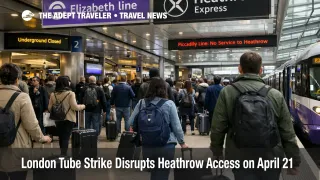
Travelers moving through London, England, this week should treat the Tube strike as a live airport access problem, not a calendar warning. As of Tuesday, April 21, 2026, Transport for London shows the Circle line suspended, severe delays on the Central, District, Jubilee, and Piccadilly lines, and reduced frequency across most of the rest of the Underground, with affected services finishing early and travelers told to complete journeys by 8:00 p.m. That hits Heathrow Airport (LHR) hardest because the Piccadilly line is the cheapest direct Tube link to the terminals, and Heathrow is already warning that there will be little to no Underground service to the airport through Friday, April 24.
In an earlier Adept Traveler article, London Tube Strike Hits Heathrow Access Again, the focus was the confirmed strike window and expected disruption. The change on April 21 is that line by line operating conditions are now visible in live service, which makes this a same day transfer and timing story for airport travelers, hotel movers, and anyone trying to connect between London rail terminals and timed events.
London Tube Strike Heathrow Access: What Changed
The immediate change is that live network damage now matches the warnings. TfL's status page shows no Circle line service at all, while the Piccadilly line has no westbound service between Cockfosters and Acton Town and reduced frequency elsewhere. The Central line is under severe delays across the line, the District line is running at sharply reduced intervals on multiple branches, and the Jubilee line is also reduced. TfL says services on affected Underground lines will finish early on Tuesday, with travelers urged to complete journeys by 8:00 p.m.
For Heathrow specifically, that turns the usual cheap Tube transfer into an unreliable bet right away. Heathrow says Heathrow Express, the Elizabeth line, and local buses are running normally during the strike period, but also warns those alternatives will be busier than usual. National Rail adds that the strike pattern is not a one time afternoon drop. The action runs midday to midday, with Tuesday and Thursday degrading after noon, and Wednesday and Friday mornings still seeing significant disruption before recovery later in the day.
Which Travelers Face the Most Disruption
The most exposed travelers are people landing at or departing from Heathrow on budget minded transfers, because the Piccadilly line normally gives them a direct path into central London without the premium price of Heathrow Express. Anyone staying along the Piccadilly corridor, changing hotels between west London and the West End, or trying to reach Paddington, King's Cross St Pancras, Victoria, or Liverpool Street for onward rail faces a higher chance of late arrivals, crowding, and missed same day connections.
The risk is not limited to Heathrow. Circle, District, and Jubilee disruption pushes passengers onto shared alternatives and road transport. That means more pressure on the Elizabeth line into Paddington and central London, more crowding on buses, and more volatile road times for taxis and ride hail. TfL has said the Elizabeth line, DLR, London Overground, and trams are expected to run normally, but that is exactly why those modes become the pressure valves when Underground capacity disappears.
Travelers with evening flights, theatre tickets, Eurostar departures, or fixed tour slots are more exposed than flexible leisure travelers. Early finishes on affected lines matter almost as much as the headline delays. A transfer that might still look possible at 5:00 p.m. can become much weaker later in the evening when service thins out further and replacement options are already crowded.
What Travelers Should Do Now
For Heathrow trips through Friday, the safer default is to price your transfer around Heathrow Express or the Elizabeth line first, then use the Tube only if live conditions improve enough to make it sensible. Heathrow itself is telling passengers to plan ahead, allow extra time, and expect those rail substitutes to be busier than usual. Travelers who are still relying on the Piccadilly line should build a larger buffer than they would on a normal day, especially for departures later in the afternoon or evening.
The decision threshold is simple. If you have checked baggage, a nonrefundable long haul ticket, or a same day rail or event connection, this is not the week to optimize for the cheapest route across London. Switch early to the more resilient path, even if it costs more. If your plan is flexible, hand luggage only, and close to a functioning Elizabeth line or National Rail path, waiting and monitoring can still work, but only with time to absorb crowding and platform access delays. Travelers unfamiliar with London's rail geography should review London Travel Guide: The Ultimate 7-10 Day Itinerary for First-Time Visitors for baseline airport transfer context, then override the usual Piccadilly advice for this strike window.
What to monitor next is not just whether trains are running, but when recovery actually sticks. National Rail says Wednesday, April 22, and Friday, April 24, should still see significant disruption until midday, with some disruption lingering into the evening, and TfL's weekly status view shows another broad strike hit coming on Thursday, April 23. In practice, that means travelers should recheck live status each morning and again before any afternoon airport move, not assume that the day after a strike start will behave like a normal operating day.
How the Disruption Spreads Through London Travel
The mechanism is straightforward. London Underground is not just one airport link, it is the distribution layer that feeds hotels, mainline stations, business districts, and entertainment areas. When multiple lines lose frequency at once, the first order effect is slower platform to platform movement and canceled or thinner direct journeys. The second order effect is that surviving rail options, buses, and roads inherit extra demand from travelers who all reroute at the same time.
That is why Heathrow access becomes the headline problem even though the strike is system wide. Heathrow can still be reached, but the cheapest direct path is degraded, so more passengers are forced onto premium rail, indirect rail, or road options. The result is not a total airport cutoff. It is a citywide timing squeeze that turns manageable journeys into riskier ones once queues, platform crowding, and road congestion stack together.
What happens next depends less on one line reopening than on whether enough frequency returns across the network to take pressure off the substitutes. TfL's earlier guidance says the strike series continues beyond this week into May and June if the dispute remains unresolved, so London travelers should treat this as a repeatable pattern, not a one off anomaly. For this week, the practical move is to protect time critical airport and rail transfers first, accept the higher cost where necessary, and avoid building any itinerary that depends on a smooth late evening Tube ride.
Sources
- Tube, Overground, Elizabeth line, DLR & Tram status updates, Transport for London
- Heathrow Airport travel notice on London Underground strike action
- Industrial action to affect London Underground services from Tuesday 21 to Friday 24 April, National Rail
- Customers urged to check before they travel ahead of strike action next week, Transport for London
- Strikes, Transport for London