

London Tube Strike Hits Heathrow Access Again
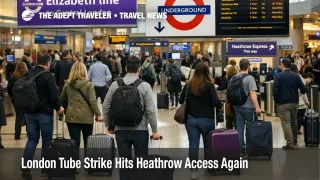
Travelers moving through London this week should rebuild airport transfer plans now, not after stations start thinning out. Transport for London says Tube strike action is planned from Tuesday, April 21, 2026, to Friday, April 24, 2026, and National Rail says each action block runs from midday to midday, with disruption continuing into afternoons and evenings. That timing matters for air travelers because the cheapest direct Underground link to Heathrow Airport (LHR), the Piccadilly line, is one of the most exposed transfer paths when the network loses reliability. The safer move is to price and time a backup before the midday dropoff starts.
London Tube Strike Heathrow Access, What Changed
The practical change is that this is no longer just a spring strike calendar entry or a Heathrow specific warning. TfL has now confirmed a live four day strike window for this week, and it expects significant disruption with service varying across lines. National Rail adds the operational detail many travelers miss, each strike pulse starts at midday and keeps spilling into the next day, so a Tuesday afternoon airport run, a Wednesday morning hotel transfer, and a Friday evening return into central London can all be caught by the same rolling disruption pattern.
For Heathrow passengers, the main exposure is simple. The Piccadilly line is the lowest cost direct Tube route between central London and all Heathrow terminals. When that line becomes unreliable, demand gets pushed onto the Elizabeth line, Heathrow Express, buses, coaches, taxis, and private hire cars at the same time. That does not just change the mode. It changes crowding, queue times, and the chance that a same day check in window gets tight.
In an earlier Adept Traveler article, London Tube Strike Threatens Heathrow Transfers, the focus was the confirmed late April strike threat and the initial Heathrow warning. What is different now is that the active window starts on Tuesday, April 21, and the midday to next day pattern makes this a timing problem across several consecutive days, not a single morning commute issue.
Which Trips Are Most Exposed This Week
Heathrow travelers starting in central London are the clearest risk group, especially if the plan depends on the Piccadilly line from hotel districts or tourist heavy areas in the West End, South Kensington, King's Cross, or Holborn. The most fragile itineraries are same day airport runs, short business trips with no overnight buffer, and any long haul departure where losing an hour on the ground can erase the safety margin before bag drop or security.
The risk is broader than Heathrow departures alone. Arrivals into Heathrow that depend on the Tube for an inexpensive hotel transfer will face the same squeeze in reverse. So will travelers connecting from Heathrow into London Paddington, London St Pancras, or London Euston for onward rail. If one part of that chain slips, the second order effects can spread fast, missed rail departures, later hotel check in, retimed tours, and a much more expensive final leg by taxi or last minute rail ticket.
The midday timing also changes who gets hit. Early Tuesday and early Thursday journeys may still work better than travelers assume, but the position can deteriorate late in the morning and remain poor into the following afternoon or evening. That makes lunch hour and post work airport runs more dangerous than very early departures. In an earlier Adept Traveler article, London Heathrow Transfers Still Snag on Weekend Closures, the planning lesson was that Heathrow disruption does not need a full shutdown to break a transfer. This week is the same logic on a wider scale.
What Travelers Should Do Now
For Heathrow, rail substitutions make more sense than waiting for the Tube to recover. Heathrow says the Elizabeth line serves Terminals 2, 3, 4, and 5, linking the airport with Central London, East London, and Essex. Heathrow also says Heathrow Express runs non stop from the airport to Paddington every 15 minutes, with a journey time of about 15 minutes. Those are the strongest rail fallbacks when Piccadilly line reliability drops, even though Heathrow Express usually costs more.
Travelers with hard deadlines should decide based on margin, not optimism. If you are checking bags, traveling at peak afternoon times, or heading to a long haul flight, shifting to Elizabeth line or Heathrow Express before the strike window degrades is the better call. If your Heathrow trip begins after midday on Tuesday, April 21, or Thursday, April 23, assume the Tube may already be worsening. If your move is on Wednesday, April 22, or Friday, April 24, treat the morning as part of the disruption window and keep extra time for station crowding and slower transfers.
Road substitutions need caution as well. Buses, coaches, taxis, and private hire vehicles can absorb overflow, but that usually means the road option gets slower and more expensive as more travelers abandon the Tube. For airport hotel stays, this is one of the few cases where paying for the extra night or moving closer to Paddington can protect a larger itinerary. Travelers trying to save money by keeping a thin same day transfer may end up buying that time back at a much worse price.
Why The Disruption Spreads Beyond The Tube
Tube strikes rarely stay inside the Underground network because Heathrow access is part of a wider London transport system. When the Piccadilly line weakens, airport demand spills first into the Elizabeth line and Heathrow Express. After that, overflow hits buses, coaches, and roads. The result is not just a different route map. It is a citywide competition for spare capacity, where every displaced traveler is chasing the same limited alternatives.
That mechanism is why the midday start matters so much. A clean midnight to midnight strike would at least be easy to plan around. A midday start and next day drag means the network loses predictability across lunch, afternoon, evening, and the following morning. That is exactly when many business travelers head to the airport, when short city break travelers change hotels, and when visitors make station to airport handoffs after sightseeing or meetings.
What happens next depends on whether the action proceeds as planned and how much service TfL can preserve on individual lines. The strongest traveler signals to watch over the next 24 to 72 hours are TfL's live strike page, the TfL Go app, National Rail disruption notices, and Heathrow's own journey guidance. If line level guidance worsens, or if Elizabeth line crowding starts building at Paddington, the threshold for switching to Heathrow Express or leaving much earlier gets lower very quickly.