

Trinidad State Of Emergency Keeps Trips Heavier
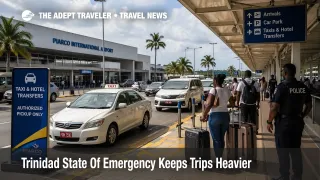
Trinidad state of emergency conditions are still changing how trips work, even though the April 13, 2026 U.S. advisory update did not raise the country above Level 3. The headline change was limited, the advisory stayed at Reconsider Travel, but the State Department added an area of increased risk, updated its summary, and kept the nationwide emergency declared on March 2 in the foreground. For travelers, that means Trinidad and Tobago should still be planned as a higher friction destination where policing, ground movement, nightlife timing, and airport transfer choices matter more than they would on a routine Caribbean trip. The safest baseline is simpler logistics, earlier arrivals, and less dependence on spontaneous city movement after dark.
Trinidad State Of Emergency: What Changed
The practical shift is not that Trinidad suddenly became unbookable. It is that the official warning now makes the emergency posture impossible to treat as background noise. The State Department says the April 13 update removed the kidnapping indicator, added an area of increased risk, and kept Trinidad and Tobago at Level 3, Reconsider Travel. It also says the emergency powers remain in effect after the March 2 declaration, with police able to arrest on suspicion of illegal activity, search and enter public and private property as needed, and operate alongside the defense force under similar rules. Bail is suspended for suspects, while curfews and restrictions on public gatherings are not currently in force.
That combination matters because it changes the traveler failure mode. On a normal leisure trip, a late airport arrival, an improvised taxi plan, or a casual night out is mostly a question of convenience. Under an emergency setting, those same choices can run into more checkpoints, more police activity, faster shifts in local conditions, and less margin for error if transport plans break. The advisory also says restrictions may change with little or no notice, which makes rigid same night plans weaker than they look on paper.
Which Travelers Face The Most Friction
The exposure is not evenly spread. Resort style travelers staying in Tobago, or visitors whose plans are limited to controlled hotel and airport movements, are in a different category from travelers building city heavy itineraries in Trinidad. The State Department says crime rates are lower in Tobago than in Trinidad, and it names a set of Port of Spain areas where U.S. government employees are barred at any time, including Laventille, Piccadilly Street, Besson Street, and Beetham, Sea Lots, Cocorite, and the interior of Queen's Park Savannah. It also bars U.S. personnel from Port of Spain beaches, downtown Port of Spain, Fort George, and Queen's Park Savannah at night.
That makes certain trip styles more fragile. Independent travelers, nightlife focused visitors, event attendees crossing the city after dark, and anyone landing late without a prearranged pickup carry more operational risk than travelers on tightly managed itineraries. Families and older travelers can also feel the friction faster because a broken transfer, a slow roadside stop, or a longer than expected urban crossing is harder to recover from once the day slips. The country also already added a new digital pretravel step in March, which means airport processing now depends more on travelers arriving prepared and less on staff smoothing things over at the last minute. In an earlier Adept Traveler article, Trinidad and Tobago Entry, Exit Cards Go Digital, that earlier process change already pushed more trip risk into predeparture readiness.
What Travelers Should Do Now
The smartest move is to make the trip more structured than usual. Arrive in daylight where possible, confirm a hotel or vetted driver pickup before departure, and avoid treating airport to hotel movement as a detail to solve curbside. A late landing into Piarco International Airport (POS) followed by a long cross city transfer is now a worse trade than paying slightly more for an earlier flight or an airport area first night. That is not panic planning. It is recognizing that ground transport reliability matters more when police powers are elevated and local conditions can tighten with little notice.
The next decision point is whether your itinerary depends on flexible evening movement in Trinidad. If the trip is mostly hotel based, business campus based, family based, or limited to prearranged transfers, the destination is still workable for some travelers. If it depends on unstructured urban exploration, nightlife hopping, or same day improvisation after arrival, the threshold to defer, simplify, or move lodging closer to your primary activities should be much lower. Travelers should also check whether their insurance and assistance provider will support security related transport changes and medical evacuation from Trinidad, not just routine health claims.
For the next 24 to 72 hours before departure, the useful signals are not only whether your flight is on time. Watch for another advisory edit, any change in emergency restrictions, and whether your hotel or transport provider can reconfirm late arrival procedures. Print or save your arrival documents, keep offline copies of lodging and driver details, and avoid building an itinerary that fails if one road segment, one pickup, or one evening movement goes wrong.
Why The Emergency Posture Changes Trip Mechanics
The mechanism is straightforward. A travel advisory level tells you the broad risk rating, but the emergency setting tells you how the destination may actually behave when a trip needs to move through the system. In Trinidad, the current gap is between a familiar Caribbean leisure image and a security environment that still includes emergency policing powers, named no go areas for U.S. personnel, and official warning language about crime and terrorism risk. That does not mean every visitor will have trouble. It means the cost of a small planning mistake can be higher than the destination headline alone suggests.
First order, the pressure lands on urban transfers, evening movement, and how confidently travelers can recover when a car, route, or plan changes. Second order, that same pressure can spill into hotel choice, event timing, airport buffers, and whether travelers feel comfortable keeping the last night in the city or moving closer to the airport. What happens next depends on whether the government loosens or extends emergency measures and whether the State Department changes the advisory again. Until that changes, Trinidad state of emergency conditions should be treated as an operational planning factor, not just a line in a warning page.
Sources
- Trinidad and Tobago Travel Advisory, U.S. Department of State
- Trinidad and Tobago International Travel Information, U.S. Department of State
- State of Emergency in Effect for Trinidad and Tobago, OSAC
- Trinidad and Tobago declares new state of emergency over persistent violent crime, AP News, March 3, 2026