

FAA Wants $10B More for Air Traffic Control Software
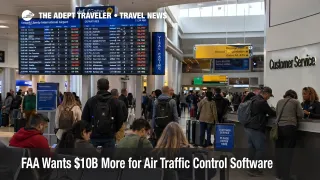
The next phase of America's air traffic control rebuild is no longer mainly about replacing old wires and radios. It is about whether the FAA can get the software layer it says is needed to manage crowded airspace more intelligently, after a year in which telecom failures and traffic caps exposed how little slack remains in the system. Transportation Secretary Sean Duffy told Reuters he wants another $10 billion from Congress for software development on top of the $12.5 billion already awarded, arguing that better traffic management logic could help the FAA move flights more efficiently and cut systemic disruptions.
U.S. Air Traffic Control Upgrade: What Changed
What changed on April 21, 2026 is not the existence of the overhaul. Congress already gave the Transportation Department $12.5 billion for modernization, and DOT says it has already replaced nearly half of all copper wiring, converted about 270 radio sites, installed new surface awareness systems at 54 airports, and moved 17 towers to electronic flight strips. The new development is that Duffy is now drawing a sharper line between physical hardware work and the software still needed to manage the airspace itself, calling that layer the "real magic" in comments to Reuters.
That shift matters because travelers do not usually feel infrastructure spending as a visible event. They feel it when overloaded hubs get capped, when arrival rates are cut to protect safety margins, and when delays at one airport start infecting connections elsewhere. The FAA now says that by the end of 2028 the system should include 5,000 high speed network connections, 27,000 new radios, and 612 new radars, but the practical traveler question is whether the software layer arrives fast enough to make those hardware gains show up as fewer disruptions rather than just newer equipment behind the scenes.
Which Travelers Are Most Exposed Before the Upgrade Lands
The most exposed travelers are not only the people flying through failure prone airports. They are anyone whose itinerary depends on the FAA squeezing heavy traffic through constrained airspace with little recovery margin. That includes passengers connecting through major hubs, people on last flights of the day, separate ticket travelers, and trips tied to cruise embarkations, tours, weddings, or expensive same day commitments. When the system runs close to its ceiling, even a short outage or staffing problem can strip away the backup options that normally save an itinerary.
Newark is the clearest recent warning. Reuters reported that the FAA slowed flights there on April 28, 2025 after telecommunications and equipment issues, and later reported another 90 second communications outage on May 9, 2025. The FAA's own Newark statements show those problems fed directly into flight slowdowns, temporary rate limits, and a push to add more resilient fiber links and local system redundancy. That is the traveler facing pattern this software push is trying to address, not only at Newark, but across a broader network that still depends on aging systems and thin staffing margins.
There is also a second layer of exposure. Duffy told Reuters airlines often schedule beyond what FAA traffic capacity can comfortably absorb, which means software is being pitched not just as a safety and resilience tool, but as a way to distribute demand more realistically across the airspace. In practical terms, that could eventually mean fewer blunt caps and flow restrictions at overloaded airports, but until the software exists and proves itself, travelers should assume schedule padding and connection planning still matter more than modernization promises.
What Travelers Should Do Now
Travelers should treat this as a medium term reliability story, not a near term fix. The physical work is real, but the benefits from a new software layer will take time, congressional approval, testing, rollout, and training. Anyone booking complicated domestic or international itineraries through late 2026 and into 2027 should still favor longer hub connections, earlier departures, and backup routing that does not rely on a single congested airport recovering quickly after a disruption.
For booking decisions, the threshold is simple. If your trip depends on a tight connection through an airport already dealing with runway constraints, staffing pressure, or formal FAA limits, paying a bit more for a nonstop or a roomier connection is often the cheaper move once missed hotels, ground transfers, and rebooking pain are factored in. Chicago O'Hare is a current example. In an earlier Adept Traveler article, FAA Caps Chicago O'Hare Summer Flights Through October explained how the FAA is already using hard schedule ceilings to keep congestion from overrunning the system.
Over the next 24 to 72 hours, travelers do not need to watch software procurement headlines minute by minute. They should watch for the signals that show the old problem still winning, airport arrival caps, repeated telecom incidents, controller staffing constraints, or new FAA traffic management orders at major hubs. Those are the operational signs that the U.S. air traffic control upgrade is still more promise than protection for the trip you are about to take.
Why the Software Ask Matters More Than the Hardware List
The mechanism here is straightforward. Hardware replacement keeps the pipes, radios, radar, and facility links from failing outright. Software determines how effectively the FAA can translate that infrastructure into usable airspace capacity, especially when weather, congestion, or staffing constraints force controllers and traffic managers to meter flights more carefully. That is why Duffy's framing matters. He is signaling that replacing old components alone will not solve the bigger problem if the logic that sequences and redistributes traffic remains limited.
This also explains why modernization is becoming a traveler story rather than just a government technology story. GAO has warned that the FAA relies on numerous aging and unsustainable air traffic control systems, and Reuters has repeatedly tied those weaknesses to real world disruptions, including Newark's telecom failures and the broader need for airport limits when capacity and demand stop matching. In an earlier Adept Traveler article, US Air Traffic Control Overhaul Common Platform tracked the coming software architecture, while U.S. Air Traffic Control Privatization: Reality Check explained the broader structural debate around who fixes the system and how. For travelers, what happens next is less about politics than whether Congress funds a U.S. air traffic control upgrade that turns modernization into fewer caps, fewer cascading delays, and a more resilient national network.
Sources
- US transportation secretary seeks $10 billion for air traffic control overhaul
- DRIVING THE NEWS: Trump's Transportation Secretary Sean P. Duffy Hosts First 'Modern Skies Summit' to Showcase Historic Upgrades to Air Traffic Control System, Preview New Software | US Department of Transportation
- Air Traffic Control: FAA Actions Are Urgently Needed to Modernize Aging Systems | U.S. GAO
- FAA Statements on Newark Liberty International Airport | Federal Aviation Administration
- FAA delays flights to Newark airport after equipment and staffing issues
- 'Scopes just went black again' as Newark air traffic hit by outage