

FAA Caps Chicago O'Hare Summer Flights Through October
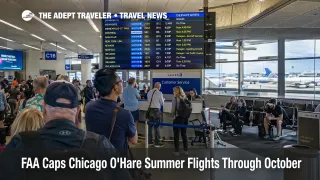
The Chicago O'Hare summer flight cap is now a formal booking constraint, not a warning. The Federal Aviation Administration said Chicago O'Hare International Airport (ORD) will be limited to 2,708 total daily arrivals and departures from May 17 through October 24, 2026, after airlines filed peak-day schedules above 3,080 operations, roughly 15 percent higher than a year earlier. For summer travelers, the practical change is that ORD will enter its busiest months with less schedule slack by design, which raises the value of longer connections, earlier departures, and backup plans that do not depend on dense same-day rebooking.
Chicago O'Hare Summer Flight Cap: What Changed
What changed is that the FAA moved from negotiation to a hard ceiling. The agency said the limit was needed because air traffic controllers are working around constrained gate capacity and ongoing taxiway closures from construction, while proposed schedules overshot what the airport could safely and reliably handle. The order uses approved summer 2025 schedules as the allocation baseline, and carriers that exceed the cap can face penalties of up to $75,000 per flight.
That matters because ORD is not just a local airport, it is a major national connection machine. When a hub like O'Hare is scheduled too tightly, the first problem is not always cancellation. It is thinning recovery margin, fewer backup frequencies, and more pressure on later banks once weather, air traffic flow controls, or a late inbound aircraft start pushing the day off plan. Reuters said last summer only about 56 percent of departures and 58 percent of arrivals operated on time, which helps explain why the FAA intervened before the full summer rush.
In an earlier Adept Traveler article, Chicago O'Hare Summer Flight Cap Planned by FAA outlined the first push toward a seasonal limit. Later, O'Hare Summer Cap Fight Keeps Schedules Unstable tracked how that proposal hardened into a reliability problem for published timetables.
Which Travelers Face the Most ORD Risk
The most exposed travelers are people using ORD as a transfer hub, not travelers on a simple local nonstop with flexibility. Short domestic to international connections, separate-ticket itineraries, final departures of the day, and trips tied to cruises, tours, weddings, conferences, or expensive timed bookings all become less forgiving when airlines have fewer marginal flights to absorb disruption.
The carriers most exposed are United Airlines and American Airlines, because the FAA and Reuters both tied the overscheduling problem to aggressive growth by ORD's two largest airlines. Reuters reported United planned about 780 daily O'Hare flights this month, up from 541 on average last year, while American said its summer daily departures would rise to 526 from 484 last summer. American publicly backed the cap, saying it would preserve competition and reliability, while United said it was reviewing the order.
Travelers who are not even flying to Chicago can still get caught in the spillover. The FAA said overscheduling at ORD can spread delay through the wider system, and O'Hare's size means a constrained bank in Chicago can turn into missed onward flights, later aircraft arrivals elsewhere, and weaker same-day reaccommodation across Midwest and national networks.
What Travelers Should Do Before Summer ORD Trips
The safest move is to stop treating legal minimum connections as good enough at ORD this summer. If the trip has a hard start time, build more margin than usual, favor earlier departures over late-day banks, and think carefully before assuming a same-day rebooking will still be available when storms or air traffic restrictions hit. A flight that remains on sale is not the same thing as a schedule with comfortable recovery room.
The clearest decision threshold is consequence. If a missed connection would mean a self-funded hotel, a lost cruise embarkation, a broken international itinerary, or a missed event that cannot be recovered, ORD should get more buffer than normal. For high-value trips, arriving the night before is stronger than trusting a tight same-day chain through Chicago, Illinois. For lower-stakes trips, the tradeoff is simpler: a longer connection may cost time upfront, but a thinner summer schedule makes delay recovery more expensive when something slips.
Travelers should also watch for quieter forms of schedule change over the next several weeks, including retimed departures, aircraft swaps, and disappearing backup frequencies on the same route. Those are often the first visible signs that a cap is reshaping real-world itinerary resilience, even before a route looks dramatically cut on paper.
Why This Is Happening, and What Comes Next
The mechanism is straightforward. The FAA is trying to align scheduled flying with what ORD can physically and operationally handle during a summer shaped by construction, gate pressure, taxiway constraints, and controller workload. Instead of letting carriers keep filing growth and then managing the fallout in real time, the agency chose a capped schedule closer to last year's operating level.
What happens next is less about whether the cap exists, and more about how airlines adapt around it. The Federal Register notice says the order was filed on April 16, 2026 and is scheduled for publication on April 20, 2026. That means the formal limit is set, but travelers still need to monitor how each carrier reshapes banks, frequencies, and backup inventory ahead of the May 17 start date.
For broader context on why strained infrastructure and staffing make major hubs harder to recover once schedules get too dense, see U.S. Air Traffic Control Privatization: Reality Check.
Sources
- Trump's Transportation Secretary Sean P. Duffy Takes Action to Prevent Endless Delays, Cancellations at Chicago O'Hare
- Order Establishing Scheduling Limits: Operating Limitations at Chicago O'Hare International Airport
- FAA clamps down on airline turf war at Chicago O'Hare with summer flight cap
- FAA to resume hearing Thursday on plan to reduce flights at Chicago O'Hare