

Heathrow Tube Risk Runs Past the Strike Window
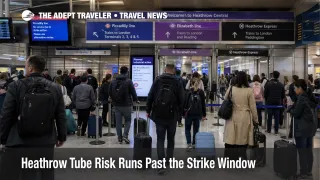
Travelers heading to London Heathrow Airport (LHR) through Saturday, April 26, 2026, should stop treating the Underground strike as a one day shock. Heathrow says there will be little to no London Underground service, including the Piccadilly line, from April 21 to April 24. National Rail says each strike block runs from midday to midday, with disruption continuing into afternoons and evenings. Then planned Piccadilly closures and Night Tube works start immediately after, keeping the airport's cheapest direct rail path unstable longer than many visitors will expect.
Heathrow Access Disruption: What Changed
The practical shift is duration. In an earlier Adept Traveler article, London Tube Strike Hits Heathrow Access Again, the main problem was the active strike block from April 21 to April 24. What is different now is that the strike window blends directly into separate Piccadilly line closures on Friday night, April 24, and on Saturday, April 25, through Sunday, April 26, even if those later works do not hit the Heathrow branch itself. For travelers, that means the wider line stays less trustworthy right after several days of network stress, recovery crowding, and mode shifting.
The airport consequence is straightforward. Heathrow has told passengers to expect little to no Underground service during the strike dates and to lean on Heathrow Express, the Elizabeth line, and local buses instead. National Rail adds the missing operational detail, the disruption ramps down from midday on April 21 and April 23, starts late on April 22 and April 24, and can linger into each day's afternoon and evening recovery. That timing catches more than a morning airport run. It can hit hotel checkouts, inbound post flight transfers, and same day returns into central London as well.
Which Heathrow Trips Are Most Exposed
The most exposed travelers are the ones who built their Heathrow transfer around the Piccadilly line because it is normally the cheapest direct rail option to all terminals. That includes leisure visitors heading in from central London with luggage, short haul travelers trying to protect a lower cost departure, and anyone making a same day handoff between a hotel, a rail station, and the airport. When the Underground weakens, demand does not disappear. It shifts into the Elizabeth line, Heathrow Express, buses, coaches, taxis, and ride hail, which means crowding and wait times spread outward even if those services are still officially running.
Terminal detail matters. The Elizabeth line serves Terminals 2, 3, 4, and 5 directly, which makes it the broadest rail fallback. Heathrow Express is the fastest option from London Paddington, with trains every 15 minutes and a 15 minute journey to Terminals 2 and 3, plus a few extra minutes to Terminal 5. That makes Heathrow Express the cleaner premium fallback for Terminal 5, while the Elizabeth line is usually the simpler direct fallback for Terminal 4. Travelers staying near Paddington or already approaching through the Elizabeth line corridor are in much better shape than those who still need the Tube for the first half of the journey.
What Travelers Should Do Now
For departures through Saturday, the safest move is to anchor your plan on Heathrow Express or the Elizabeth line first, then treat the Tube as a bonus only if live conditions improve. If you are flying long haul, checking bags, traveling with children, or protecting a nonrefundable fare, leave earlier than normal and pay for the more resilient path. This is not the week to optimize for the cheapest airport transfer if a miss would break the rest of the trip.
The clearest decision threshold is how many moving parts remain after Heathrow. Rebook or upgrade your transfer plan early if you have a same day cruise join, a rail connection, a fixed tour, or an evening departure that depends on smooth handoffs. Waiting can still work for hand luggage only travelers with flexible timing, but only if they are already close to Paddington or another strong Elizabeth line station and can absorb packed platforms and longer boarding times. For general city transfer context, London Travel Guide: The Ultimate 7-10 Day Itinerary for First-Time Visitors is still useful background, but this week's live conditions justify a more conservative posture than a normal Heathrow arrival or departure.
Why Heathrow Risk Lasts Through April 26
The mechanism is not just the strike itself. National Rail's midday to midday pattern means each action block bleeds across two calendar days, while Heathrow's warning covers the full April 21 to April 24 span. After that, TfL's separate Piccadilly closures keep parts of the line under planned constraint on Friday night and over the weekend. Even when Heathrow service itself is not fully shut by the later works, the line is still carrying the aftereffects of a disrupted week, and passengers who no longer trust it will keep crowding the non Tube alternatives.
What happens next is less about a dramatic all clear, and more about whether the recovery window ever gets room to breathe. If TfL shows stronger than expected live service late on April 24, some pressure will ease. If trains remain patchy and weekend works absorb more riders than expected, Heathrow access disruption can stay elevated into April 26 even without a fresh strike headline. Travelers should check live status the night before travel, then again before leaving for the airport, and switch to the first stable rail option rather than waiting for the Piccadilly line to prove itself under stress.