

Qatar Warning Keeps Doha Transit Risk High
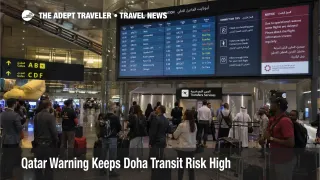
Travelers connecting through Hamad International Airport (DOH), Doha, Qatar, still need to treat Qatar as a live transit problem, not only a destination warning. Australia continues to rate Qatar at Do Not Travel, says travelers should verify border status before any movement by air, land, or sea, and warns that airports are more vulnerable to strikes amid the wider regional conflict. That changes the planning math for people who never intended to enter Qatar at all, because one of the world's biggest connection hubs can still fail at the transfer stage even as flights gradually return.
Qatar Transit Risk: What Changed
The core update is not a fresh airport shutdown. It is that the official warning language still treats Qatar as operationally unsafe for normal travel and transit decisions even after Hamad said airline partners began gradually resuming flights from April 21, 2026. Qatar Airways is still offering flexible changes and refunds for affected bookings across a long disruption window, which tells travelers the system remains fragile enough that normal assumptions about fixed itineraries still do not hold.
That distinction matters because destination risk and transit risk are not the same problem. A destination warning asks whether you should go to Qatar at all. A transit warning asks whether you should trust Doha as the hinge point for a larger itinerary to Asia, Europe, Africa, or Australia. Australia's regional conflict page makes that explicit by warning against transiting through Do Not Travel hubs and noting that airports in the region have been targeted and travelers may be unable to leave.
Which Travelers Face the Most Disruption
The most exposed travelers are those with one ticket, tight onward connections, and no easy same day fallback. That includes long haul passengers connecting between Europe and Asia, Africa and North America, or Australia and the Mediterranean, plus premium travelers whose schedules look comfortable on paper but still depend on a single hub staying open, well staffed, and securely connected to the wider network. Even a short disruption in Doha can cascade into missed onward sectors, forced overnight stops, baggage separation, and reissued tickets at much higher walk up prices.
Travelers planning to enter Qatar, cross a land border, or rely on onward sea movement face a broader layer of risk. Australia is not only warning about flights. It is telling people to verify the status of any border crossing before travel by air, land, or sea, which means the risk picture extends beyond the departures board. For travelers who view Doha as a flexible place to reroute on the fly, that flexibility is exactly what looks weaker right now.
In an earlier Adept Traveler article, Qatar Doha Flights Expand, but Connections Stay Fragile tracked the shift from emergency recovery to a named limited network. The new traveler takeaway is less about whether some flights are running and more about whether Doha is once again robust enough to be the weak link you can ignore. Australia's answer is still no.
What Travelers Should Do Now
Before departing for Doha, travelers should confirm more than ticket status. Check whether your operating carrier and any codeshare partner are both running, whether your layover leaves room for re-screening or terminal process friction, whether your passport validity supports an unexpected overnight stay, and whether you can absorb a hotel night if onward movement breaks. If you hold a Qatar Airways ticket in the affected window, review the current refund and date change options before you leave for the airport, not after a disruption starts.
Paying more for a non Gulf routing makes sense when the trip is time sensitive, the destination has poor backup service, or a missed connection would trigger larger losses such as cruise embarkation failure, a safari pickup miss, or a hard to replace event booking. The cheaper Doha itinerary still works best for travelers with slack in both directions, flexible hotel plans, and a willingness to turn one long travel day into two if the hub stumbles again. The tradeoff is simple, lower fare versus lower operational risk.
Over the next 24 to 72 hours, watch three signals first, whether Hamad continues adding partner flights without new pullbacks, whether official advisories soften their airport and border language, and whether airline waiver windows begin shrinking rather than extending. If those signals do not improve, Qatar transit risk remains a planning problem even for passengers who never leave the international transfer stream.
Why Doha Transit Still Feels Fragile
Doha's strength is also its vulnerability. Hamad works as a global bridge because huge volumes of passengers, aircraft, crew, bags, and onward slots meet in one place. When that bridge is under regional military pressure, even partial continuity can mask a brittle system. Flights may resume in phases, but travelers still depend on secure air corridors, stable airport operations, available accommodation during irregular operations, and border conditions that do not suddenly tighten around the hub.
That is why transit risk is more serious than a normal destination advisory. A traveler can choose not to visit Qatar and still be exposed if Doha is their connection point. First order, disruption hits the layover itself through delays, cancellations, or missed onward flights. Second order, the damage spreads into rebooking cost, hotel nights, visa and document stress, and itinerary failure at destinations far beyond the Gulf. Until official warnings stop treating Qatar's airports and border movements as strike exposed and operationally uncertain, Doha remains a strategic gamble, not just a convenient midpoint.