

Qatar Doha Flights Expand, but Connections Stay Fragile
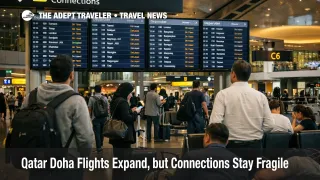
Qatar Doha flights became more usable on March 23, 2026, but not normal again. Qatar Airways' latest operations update now publishes an enhanced limited network through March 28, 2026, giving travelers a named list of cities that can still move through Hamad International Airport (DOH), Doha, Qatar. The practical gain is clarity, not full recovery. Travelers whose city pairs are back on the board may be able to preserve a trip, but Doha still behaves like a constrained bridge rather than a restored global hub, so separate tickets, tight layovers, and fixed same day commitments remain exposed.
Qatar Doha Flights: What Changed on March 23
The new value in the March 23 update is that Qatar Airways is no longer speaking only in broad limited-operations language. It now publishes a defined operating map through March 28 that spans 61 cities outside Doha, grouped across Africa, the Americas, Asia, Europe, the Middle East, and the Pacific. The listed network includes African points such as Abuja, Addis Ababa, Cairo, Johannesburg, Lagos, and Nairobi, Americas points including Miami, New York John F. Kennedy International Airport (JFK), Toronto, and Washington, DC, plus a wider Asian and European bridge that includes Bangkok, Delhi, Dhaka, Hong Kong, Jakarta, Kuala Lumpur, Manila, Mumbai, Singapore, Amsterdam, Athens, Frankfurt, London, Madrid, Milan, Paris, and Rome. Jeddah, Muscat, Riyadh, Melbourne, and Perth are also on the current list.
That is a meaningful shift from earlier Doha coverage because travelers can now test a real city pair against a real published network instead of guessing from emergency messaging. But the airline is still explicit that it is operating only a limited number of flights through March 28, 2026, and that each flight remains subject to operational, regulatory, safety, and airspace conditions. In other words, a city appearing on the list makes a trip possible again, not dependable in the way Doha normally is.
Which Travelers Can Use Doha Again, and Who Still Should Not
The best fit is travelers on one Qatar Airways ticket whose trip either starts or ends in Doha, or whose onward itinerary stays inside the currently published network. Those passengers at least have a defined corridor to work with, and Qatar says travelers with confirmed bookings on the revised schedule will be contacted with updated flight information. That still leaves choice constrained, but it is a narrower, more manageable problem than the near-total hub uncertainty of early March.
The higher-risk group is anyone trying to rebuild a normal Doha connection bank in their head. Limited flights can restore one leg of a trip before the rest of the journey regains schedule depth. First order, some passengers get moving again. Second order, partial restoration still creates misconnects, long unplanned layovers, baggage separation, hotel costs, and fare spikes on backup routes when a restored Doha segment does not line up cleanly with the next flight. That risk is highest for separate-ticket itineraries, cruise or tour joins, and any trip that cannot absorb an overnight hold. In an earlier Adept Traveler article, Qatar Doha Flights Stay Limited Through March 28 captured that earlier phase, and the core warning still holds, Doha is usable in slices, not back to normal banked connectivity.
What Travelers Should Do Before Building Around Doha
Start with the route map, not the fare. If your exact origin and destination are both on Qatar Airways' published list through March 28, confirm the booking in the app or on the website before going anywhere near the airport. Qatar's public travel alert continues to tell passengers to travel to the airport only if they hold a valid confirmed ticket, which is a stronger instruction than travelers would normally see during routine irregular operations.
The next decision point is whether Doha solves your whole itinerary or only one exposed segment. Waiting makes sense when you are on one protected Qatar Airways booking, your city pair is published, and you can absorb another shift. Rebooking away from Doha, or taking the refund, makes more sense when your trip depends on a separate onward ticket, a same day event, or a hard arrival deadline. The March 23 operations update says confirmed bookings with travel dates between February 28 and April 30, 2026 are eligible for complimentary date changes up to 14 days from the original travel date, or a refund of the unused ticket value. Qatar's customer travel alert also separately says affected passengers can request date changes or refunds and should keep contact details updated.
There is one operational detail that matters for anyone still transiting. Qatar Airways' passenger guidance says the temporary minimum connecting time in Doha for travel up to March 28 is 75 minutes, and passengers facing an 8 to 24 hour transit may qualify for a complimentary stopover room under the temporary policy. That does not remove connection risk, but it does tell travelers where the carrier expects strain to show up, longer forced waits rather than seamless sub-hour transfers.
Why the Partial Network Still Leaves Doha Fragile
The mechanism is straightforward. Doha works as a global bridge when dense waves of arrivals and departures feed each other across a deep schedule. A limited safe corridor defined by the Qatar Civil Aviation Authority changes that math. Qatar Airways says flights are operating only within a limited safe corridor and that daily flying remains extremely constrained under current conditions. When that happens, the airport can move some passengers, but it cannot instantly recreate the schedule depth, spare seats, and recovery resilience that make tight hub connections work.
That is why this remains a meaningful disruption story, not a clean recovery story. Travelers should read the enhanced March 23 city list as a narrower bridge, not a broad reopening. The immediate question is no longer whether Doha is completely unusable. It is whether Doha is usable for your exact city pair without breaking the rest of the trip. In an earlier Adept Traveler article, Middle East Airspace Closures Raise Asia Europe Fares we noted how Gulf hub constraints spill into pricing and backup-routing pressure across Asia-Europe travel. That wider network stress is still part of the Doha calculation this week. Watch for three signals next, whether cities stay on the published list, whether corridor approvals widen or tighten, and whether Qatar moves from a named limited network toward something closer to normal banked hub operations.