

Trump Floats Spirit Help as Fuel Shock Threatens Summer Trips
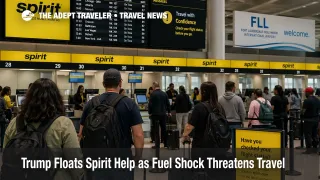
Spirit Airlines booking risk just moved into a more serious phase for summer travelers. President Donald Trump said on April 21 that the federal government might help Spirit, while Transportation Secretary Sean Duffy publicly questioned whether that would amount to throwing good money after bad. That split matters because it confirms the problem is no longer just a bankruptcy filing in the background. Spirit is still flying, but the new signals point to a carrier whose future now depends on fuel costs, creditor talks, and whether Washington offers relief quickly enough to keep the summer schedule from thinning further.
Spirit Airlines Booking Risk: What Changed
What changed is the level of official attention. Trump said he would like someone to buy Spirit and suggested the federal government might help preserve its 14,000 jobs, while Duffy said the administration still has to decide whether Spirit has a real path forward or whether aid would only delay a collapse. At the same time, Reuters reported that low cost carriers are asking Congress to suspend the 7.5 percent federal excise tax on airline tickets and the $5.30 segment tax, arguing that removing those fees would offset about one third of the incremental hit from higher jet fuel prices. That makes this story bigger than one distressed airline. It is now a test of whether the ultra low cost model can hold together through a fuel shock without cutting deeper into schedules and fares.
The pressure is real, not theoretical. Reuters reported on April 16 that Spirit built its restructuring plan around 2026 fuel costs of about $2.24 per gallon, but by mid April jet fuel was around $4.24 per gallon, roughly double that assumption. Reuters also reported that J.P. Morgan estimated Spirit's 2026 operating margin could deteriorate to about negative 20 percent if fuel stays near current levels, adding roughly $360 million in cost pressure, more than the carrier's year end unrestricted cash. Spirit itself warned in its annual report that higher fuel prices could have an immediate and substantial negative effect and could force liquidation if talks with creditors and stakeholders break down.
Which Travelers Face the Most Spirit Exposure
The biggest exposure sits with travelers booking Spirit for trips where recovery options matter more than the headline fare. A cheap nonstop for a flexible domestic weekend is one thing. A cruise embarkation, a wedding, a same day business meeting, or a separate ticket connection is different. When a stressed airline cuts frequency or trims marginal routes, the first order effect is fewer seats and thinner backup options. The second order effect is that missed departures become harder to recover, because there may not be another usable same day flight on the same carrier.
Travelers in Spirit's core markets still have the strongest chance of seeing service preserved. In its March 13 restructuring update, Spirit said it planned to focus on stronger routes and markets including Fort Lauderdale Hollywood International Airport (FLL), Orlando International Airport (MCO), Detroit Metropolitan Wayne County Airport (DTW), and the New York City area, including Newark Liberty International Airport (EWR) and LaGuardia Airport (LGA). Even there, though, a smaller fleet means less slack than before. Spirit said in that same filing that it intends to shrink to 76 to 80 aircraft by the third quarter of 2026, which narrows the margin for irregular operations even if the airline survives intact.
This is also a notable change from earlier Spirit coverage. In an earlier Adept Traveler article, Spirit Reliability Ranking Changes U.S. Booking Math the key traveler question was whether good recent operational performance made Spirit a rational low fare choice. The newer problem is different. Reliability is less useful if the network behind it keeps shrinking. In an earlier Adept Traveler article, Spirit Airlines Restructuring Labor Deals Ratified, the site noted that labor stability did not remove broader Chapter 11 risk. This week's federal support talk is the clearest proof that the larger financial stress is still driving the traveler decision.
What Travelers Should Do Now
Travelers already ticketed on Spirit for May through summer should not panic cancel, because the airline continues to operate normally and valid tickets, credits, and loyalty points remain usable during the restructuring. But they should stop treating Spirit as a normal low fare booking if the trip has no slack. If you are traveling for a fixed event, or you are connecting onward on separate tickets, build in more buffer now. A day earlier arrival, a longer layover, or a more flexible hotel can be cheaper than a last minute rescue if the schedule changes.
The main decision threshold is recovery depth. Book or keep Spirit when the fare gap is real, the route is nonstop or simple, and a same day disruption would not wreck the trip. Rebook or avoid Spirit when one cancellation would break a cruise departure, international itinerary, tour join, or expensive event. On those trips, the tradeoff is no longer just price versus comfort. It is price versus reaccommodation power. That difference becomes more important as financially weaker airlines cut off peak flying and protect cash.
Over the next 24 to 72 hours, watch three things. First, whether the Duffy meeting with Spirit, Frontier, Allegiant, Sun Country, and Avelo produces any concrete policy response. Second, whether Congress shows interest in temporary ticket tax relief. Third, whether Spirit's public signals stay focused on continued operations or start shifting toward sharper capacity and liquidity warnings. If none of those improve, Spirit Airlines booking risk will increasingly mean not just bankruptcy risk, but a weaker summer recovery bench for anyone who still chooses the cheapest fare first.
Why This Is Happening, And What Happens Next
Spirit's current problem is a simple airline math problem made worse by timing. Ultra low cost carriers depend on very low unit costs and enough fare volume to keep planes full. A fuel shock hits directly because fuel is a major operating expense, and a bankrupt airline has less room to absorb that shock while negotiating with creditors, lessors, and vendors. Reuters reported that lenders have already objected that Spirit's plan did not adequately stress test a higher fuel world, which raises doubts about whether its restructuring can still work on the original assumptions.
That is why the tax fight matters even if Congress does nothing. The Association of Value Airlines is effectively warning that travelers will pay one way or another, either through higher fares and ancillary fees, or through thinner schedules and weaker competition if smaller carriers cannot absorb the fuel spike. If Spirit disappears or shrinks faster, some leisure routes may lose their strongest low fare pressure, which can lift prices even on airlines that were never in bankruptcy themselves. That is the broader summer traveler consequence hidden inside the bailout headlines.
The next phase is not yet settled. Trump opened the door to some form of support, but Duffy's comments show the administration is far from committed. That uncertainty means the most honest traveler guidance is still practical, not political. Spirit may survive, restructure again, or find outside help. But until there is a concrete financing, merger, or policy outcome, Spirit Airlines booking risk should be treated as meaningful itinerary risk, not minor friction, especially for June through peak summer trips where backup options matter as much as the first departure on the screen.
Sources
- Saving Spirit Airlines possibly puts 'good money after bad', Transportation head Duffy says, Reuters
- US low-cost airlines seek temporary tax relief to address soaring fuel costs, Reuters
- Fuel surge threatens Spirit Airlines bankruptcy exit, raises liquidation risk, Reuters
- Spirit Airlines Announces Restructuring Support Agreement and Plan of Reorganization, Spirit Investor Relations
- Spirit Reliability Ranking Changes U.S. Booking Math, The Adept Traveler
- Spirit Airlines Restructuring Labor Deals Ratified, The Adept Traveler