

Spirit Rescue May Save Summer Flights, Not Cheap Trips
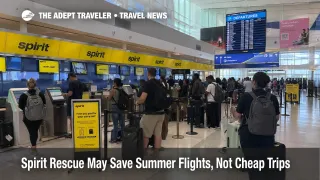
Spirit rescue talks have moved from political noise to a live summer booking signal. Reuters reported on April 23, 2026 that Spirit told a bankruptcy court it is in advanced discussions with the federal government over financing, after earlier reports from The Wall Street Journal and Bloomberg pointed to a package worth as much as $500 million. That could keep Spirit flying through a fuel shock that had pushed liquidation fears into the open. It does not mean cheap travel is safe again, and it does not remove the itinerary risk facing travelers who still need real backup options.
Spirit Rescue Talks: What Changed
What changed is that the possible bailout is no longer just presidential commentary or market rumor. Reuters reported from court on April 23 that Spirit is in advanced talks on government financing, while The Wall Street Journal reported the package could reach about $500 million and could give the federal government warrants tied to a large equity stake. Spirit itself has not confirmed terms, and the carrier told Travel Weekly it is operating normally, with tickets, credits, and loyalty points continuing to work as usual.
That is a meaningful shift from earlier coverage. In an earlier Adept Traveler article, Trump Floats Spirit Help as Fuel Shock Threatens Summer Trips, the traveler problem was that Washington had started talking about Spirit as a rescue candidate. Now there is a reported financing structure on the table, and that makes the issue more practical. Travelers no longer have to think only about whether Spirit survives. They also have to think about what kind of airline emerges, how small it becomes, and whether a rescue keeps schedules intact or only prevents a collapse.
Spirit's own March 13 restructuring announcement said it planned to shrink to 76 to 80 aircraft by the third quarter of 2026, and its restructuring materials pointed to a target fleet of 76 aircraft by mid August 2026. That means even a successful rescue would be supporting a much smaller airline than the one many travelers remember. The near term consequence is not just survival versus failure. It is survival with thinner frequency, fewer fallback flights, and more pressure to push costs back into fares and fees.
Which Travelers Face the Most Spirit Booking Risk
The travelers with the lowest exposure are the ones using Spirit for simple, nonstop, flexible domestic trips where arriving later would be annoying, but not trip ending. The risk climbs fast once the itinerary depends on same day recovery. Cruise embarkations, weddings, hard start tours, separate ticket connections, and business travel that cannot slide by a day are all much less forgiving if the airline keeps shrinking while demand and fuel costs stay high.
Spirit has already signaled where it expects to concentrate. Its restructuring plan pointed to stronger focus on core markets such as Fort Lauderdale Hollywood International Airport (FLL), Orlando International Airport (MCO), Detroit Metropolitan Wayne County Airport (DTW), Newark Liberty International Airport (EWR), and LaGuardia Airport (LGA). That helps travelers in those cities more than passengers in thinner or more seasonal markets, because core stations are more likely to keep enough service to preserve some rebooking depth.
Even then, the tradeoff is getting worse. In an earlier Adept Traveler article, Spirit Liquidation Risk Hits U.S. Summer Flights, the main threat was outright failure. Rescue talks change that, but they do not fully improve the booking math. A smaller Spirit may still leave travelers with fewer daily departures, less slack when weather or air traffic control problems hit, and weaker competitive pressure on fares where Spirit had been the main low price check on larger airlines.
What Travelers Should Do Now
Treat Spirit differently depending on what failure would cost you. For a flexible nonstop with a large fare gap, the carrier can still make sense, especially in core Florida and East Coast markets where service depth is more likely to hold. For any trip where a cancellation would break the whole journey, paying more for an airline with stronger same day recovery may now be the cheaper decision in the full trip budget.
The main decision threshold is backup depth, not the headline fare. Keep or book Spirit when the itinerary is nonstop, the savings are meaningful, and an overnight delay would not trigger cruise loss, missed tour join, or expensive event damage. Move away from Spirit when you are relying on the last flight of the day, building your own connection on separate tickets, or trying to protect a time sensitive departure such as a cruise or international long haul.
Over the next 24 to 72 hours, watch for three things. First, whether Spirit or the government publicly confirms financing terms rather than leaving the structure to court comments and media reports. Second, whether the package is framed as short bridge support for restructuring or something large enough to preserve more of the schedule. Third, whether Spirit starts signaling any new route, fleet, or fare actions alongside the rescue. A bailout that keeps planes flying is useful, but if it arrives with sharper capacity cuts or continued fuel pressure, Spirit booking risk will stay elevated for summer travelers.
Why a Rescue May Not Restore Cheap Flying
The mechanism is simple airline math. A rescue package can help Spirit survive Chapter 11, but it does not make expensive fuel cheap, and it does not rebuild network depth overnight. Reuters reported last week that Spirit's fuel assumptions had been badly overtaken by the recent surge, while the airline's own restructuring plan is built around a much smaller fleet and lower operating footprint. As a result, even a successful rescue can stabilize operations without restoring the old ultra low fare model at the same scale.
That matters beyond Spirit passengers. If Spirit survives as a smaller carrier, some routes may keep a low cost option, but with less capacity and less pressure on rivals to match the cheapest fares. If the government support buys time rather than true operating flexibility, travelers could see a blended outcome, fewer liquidation fears, but more fare discipline, more ancillary fee pressure, and weaker same day recovery across Spirit heavy leisure markets.
The practical takeaway is sharper than the political drama around a bailout. Spirit rescue talks may keep summer flights on the board and reduce the chance of a sudden collapse. They do not guarantee cheap trips, and they do not erase the risk for travelers whose itineraries need depth, resilience, and multiple ways to recover when the first plan breaks.
Sources
- Spirit Airlines in advanced talks on government financing, lawyer says
- Trump Administration Nearing Rescue Deal for Spirit Airlines
- Spirit Airlines is poised to receive a government rescue package
- Fuel surge threatens Spirit Airlines bankruptcy exit, raises liquidation risk
- Spirit Airlines Announces Restructuring Support Agreement and Plan of Reorganization
- Spirit restructuring presentation, Exhibit 99.1