

Yemen Exit Flights Still Operate, but Plans Can Break
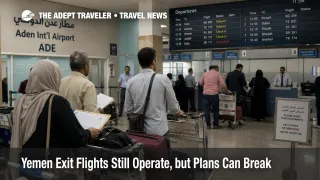
Yemen exit flights still exist on paper, but the official travel advice now makes clear that travelers should treat every departure as conditional until they are airborne. Australia's Smartraveller says most international flights remain suspended, with only limited commercial service operating from Aden, Seiyun, and Sana'a, and warns that flights and airport operations can be disrupted at any time without warning because of military strikes and political tensions. The practical problem is no longer just whether a seat can be booked. It is whether the full exit chain, road movement, airport access, check in, and the departure itself, survives long enough to work.
Yemen Exit Flights: What Changed
What changed versus a generic Yemen warning is the operational framing. Smartraveller does not just say Yemen is dangerous, it says the few commercial departures that have operated from Aden, Seiyun, and Sana'a are unpredictable and may be disrupted without prior notice, while roads in and out of cities and ports can also become blocked at short notice. The U.K. Foreign, Commonwealth & Development Office is equally blunt, advising against all travel to Yemen, telling British nationals in country to leave immediately, and warning that there are no evacuation procedures in place and only severely limited government support for onward travel.
That turns a confirmed itinerary into a much weaker planning tool than it would be in most countries. A traveler can hold a valid reservation and still lose the trip if the airport operation changes, if the road to the airport becomes unsafe or blocked, or if the onward chain outside Yemen has to be rebuilt at the last minute. In other words, the booking is only one piece of the exit plan, not the plan itself.
Which Yemen Airport Plans Fail Fastest
The three airports still cited in current Australian guidance are Aden International Airport (ADE), Seiyun Airport (GXF), and Sana'a International Airport (SAH). That does not mean they are equally usable. It means they are the limited points from which some commercial service has operated. Smartraveller's warning applies across all three, and it specifically says airport operations may be disrupted at any time without warning.
Aden has already shown why that distinction matters. In an earlier Adept Traveler article, Aden Airport Closure Disrupts Yemen Flights, Aden traffic halted on January 1, 2026, after a political dispute over flight restrictions. That earlier shutdown is not the same event as today's advisory framing, but it is a useful reminder that a Yemeni departure point can flip from gateway to dead end quickly.
The deeper warning sign is the airline layer. Yemenia's schedule tool still lists airports including Aden, Seiyun, and Sana'a, but the carrier's public home page simultaneously shows "No Flights Available" and directs customers to call for information. For travelers, that is not just a website quirk. It underlines how weak the normal signals of schedule reliability are in Yemen right now, especially if you are trying to build hotel checkouts, road transfers, or a same day international connection around one listed flight.
What Travelers Should Do Now
Anyone trying to leave Yemen should build the plan backwards from failure points, not from the ticket. The first immediate step is to hold flexible lodging near the departure city, keep passports and any visa documents ready for rapid changes, and avoid assuming a road transfer to the airport will run on the original timeline. Smartraveller warns that routes in and out of Yemeni cities and ports can become blocked at short notice, while the U.K. guidance says travelers must keep departure plans under review and be ready to cover the cost of visas, accommodation, insurance, and onward travel themselves.
The next decision point is whether to rely on one exit chain or two. A realistic backup plan now means identifying a second airport option inside Yemen if it is safely reachable, plus a separate onward recovery point outside Yemen where a ticket can be reissued, a hotel can absorb a delay, and consular contact is more realistic. For some travelers, that may mean treating a nearby third country as the place where the trip becomes normal again, not the Yemeni departure airport itself. Readers thinking along those lines may find Amman Exit Flights Make Jordan a Cleaner Exit Point useful, especially when onward ticket changes and document checks are likely to fall outside Yemen rather than inside it.
The threshold for changing plan is lower than usual. If your airline cannot confirm operating status directly, if your ground transfer depends on passing through unstable areas, or if your onward booking in a nearby country is on a separate ticket with little slack, the safer tradeoff is usually to add time and cost now rather than gamble on a same day chain that can fail at several points. That is especially true because neither Australian nor British guidance suggests travelers should count on evacuation help if the plan collapses.
Why Confirmed Tickets Are Not Enough
The mechanism is straightforward, even if the politics are not. Yemen's air exits are fragile because the disruption is layered. Military strikes and political tensions can affect airport operations directly, the wider conflict has damaged airport and seaport infrastructure, and roads to departure points can become unusable or unsafe with little warning. Once one layer breaks, the rest of the itinerary usually breaks with it.
That is why the first order effect is not just a canceled departure. It is the loss of a usable airport plan. The second order effects arrive fast, hotel extensions, missed road pickups, reissued tickets in Gulf or Jordanian hubs, and weaker consular fallback because foreign governments openly say their ability to help in Yemen is extremely limited. Smartraveller says Australia cannot provide evacuation or repatriation from Yemen, and the U.K. says it has no evacuation procedures in place and cannot help nationals leaving Yemen in any comprehensive way.
For now, travelers should read Yemen exit flights as a narrow window, not a restored network. Flights from Aden, Seiyun, or Sana'a may still operate, but the useful unit of planning is no longer the booking confirmation. It is the resilience of the whole exit chain, airport, road, buffer, documents, cash, lodging, and a fallback country where the journey can be rebuilt if Yemen shuts the door again.