

DXB Evening Arrival Delays Raise Connection Risk
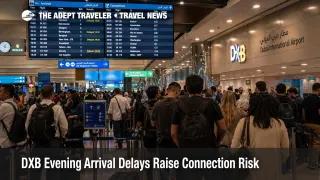
DXB evening arrival delays are becoming a more useful planning signal than a one day disruption headline. On April 24, 2026, flight tracking showed a dense run of evening arrivals into Dubai International Airport (DXB), with inbound traffic from Europe, Africa, the Middle East, and South Asia stacked into the same late day operating window. The airport is open, and weather was not the obvious constraint, but the schedule pattern matters because even moderate arrival holding can push aircraft into gate conflicts, shorten onward connections, and turn late hotel arrivals into overnight recovery problems.
DXB Evening Arrival Delays: What Changed
The immediate change is the source of risk. This is not mainly a weather story or a single airport closure story. FlightAware's Dubai International Airport page on April 24 showed multiple arrivals due between about 800 p.m. and 1040 p.m. local time, including flights from London Heathrow, Paris Charles de Gaulle, Manchester, Mumbai, Colombo, Dhaka, Istanbul, Cairo, and Jakarta. It also showed a heavy wave of scheduled departures from about 900 p.m. through 1010 p.m., many bound for South Asia and the wider region.
That concentration creates a narrower recovery window. If an inbound aircraft holds for 20 to 40 minutes, the passenger may not only arrive late. The aircraft may also wait for a stand, bags may enter the delivery system later, and connecting travelers may reach the next gate after boarding has already tightened. For passengers ending in Dubai, the same delay can move hotel check in, private transfers, and late restaurant or tour plans into a thinner overnight service window.
The confirmed public data does not yet support a precise average holding time for the evening bank. The stronger verified point is that DXB is running at record scale while Gulf airspace remains under managed constraints, so small delays have less empty space to disappear into.
Which Travelers Face The Tightest Dubai Connection Risk
The highest risk group is travelers connecting through Dubai on separate tickets, especially from Europe into South Asia, Southeast Asia, or East Africa. A through ticket gives the airline more responsibility to protect the itinerary after a late arrival. A self connection does not. If the first flight arrives late, a traveler may have to clear formalities, collect bags, recheck luggage, and re clear security without any automatic protection from the onward carrier.
Tight evening connections are more exposed than long layovers because DXB's bank structure works by gathering many long haul arrivals and departures into dense waves. Dubai Airports said DXB handled 95.2 million guests in 2025, its busiest year ever, with 25.1 million guests in the fourth quarter alone and 454,800 annual flight movements. The airport also said it was operating at the edge of physical capacity.
That capacity context matters for travelers because delays do not stay in the air. They move from approach sequencing to gate assignment, then to baggage delivery, transfer security, boarding cutoffs, and hotel inventory. Dubai Airports reported that 89% of arriving bags for terminating passengers were delivered within 45 minutes of aircraft arrival on stand in 2025, which is strong performance, but that clock starts after the aircraft reaches the stand, not when it first reaches the Dubai area.
What Travelers Should Do Now
For same carrier or same alliance connections at DXB, travelers should treat 90 minutes as a minimum comfort threshold during the evening bank and prefer 2 hours or more when the inbound flight is from Europe, South Asia, or another route affected by wider airspace constraints. For separate tickets, checked bags, terminal changes, or family travel, the safer threshold is 4 hours or an overnight stop.
Travelers arriving late in Dubai should protect the ground side of the trip before departure. Confirm whether the hotel allows late check in, keep the transfer company updated with the flight number, and avoid prepaid late evening activities on the arrival night. A 30 minute airborne delay can become a much larger practical delay if the aircraft waits for a stand, bags arrive late, and the traveler reaches the curb during a compressed hotel transfer window.
Passengers with a short onward connection should monitor the inbound aircraft before leaving for the airport, not only the posted departure time. If the inbound aircraft is already late, a legal connection can still become unrealistic. The decision point is simple: rebook proactively when the connection is under 90 minutes on one ticket, under 4 hours on separate tickets, or when the onward flight is the last practical departure of the night.
Why Dubai Airspace Congestion Can Spread
Dubai's pressure is also shaped by regional airspace, not only by terminal demand. OPSGROUP's April 22 operational update said the Emirates Flight Information Region remains partially closed and is using a strict corridor system, with arrivals and departures limited to airport specific routes and flow measures expected. It described the UAE airspace picture as controlled rather than free flowing.
EASA also extended its Middle East and Persian Gulf conflict zone bulletin on April 24, 2026, keeping recommendations for affected airspace, including the United Arab Emirates, and extending validity to May 1, 2026. The advisory says operators should closely monitor regional airspace developments and maintain updated risk assessments.
That does not mean every DXB flight is unsafe, or that Dubai International is broadly failing. It means the system has less routing flexibility than normal. When airspace corridors, evening schedule banks, and high airport utilization meet at the same time, delays can compound quickly. Travelers using DXB over the next 24 to 72 hours should watch arrival delay patterns after sunset, aircraft holding near Dubai, and airline rebooking language. If those signals worsen together, DXB evening arrival delays become a connection planning problem, not just a late landing problem.