

Dubai Resort Closure Signals a Wider Gulf Tourism Slump
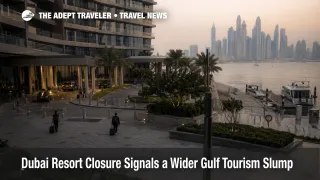
The Anantara World Islands Dubai Resort closed on April 10, 2026, but the real story is larger than one 70 room luxury property off Dubai's coast. The shutdown lands in a market where reduced flight capacity, weaker traveler confidence, fee relief from Dubai's government, and a visible wave of renovation timing all point to the same conclusion, the UAE's tourism slowdown is no longer a niche hospitality problem. It is part of a broader Middle East travel shock tied to the U.S., Israel, and Iran conflict, and the damage is spreading through aviation, hotel demand, and routing decisions across the region.
Dubai Tourism Slump: What Changed
Minor Hotels said the Anantara World Islands Dubai Resort closure was a joint decision with owner Seven Tides and blamed "a combination of external factors," while stressing it remains committed to the rest of its UAE portfolio. On its own, that could read like an isolated property level decision. In context, it does not. Travel Weekly tied the closure to a period of sharply lower hotel demand in Dubai, while Dubai's government has already moved to let hotels postpone room, food and beverage sales fees, and the Tourism Dirham for three months from April 1, 2026 to ease liquidity pressure.
That support package matters because governments do not usually defer tourism sector fees when demand is healthy. Dubai's own language says the measures are meant to help hospitality operators navigate "short term challenges," and local officials said they were responding to feedback from hotel leaders. That puts the Anantara closure in a broader operating environment where the state is trying to preserve cash flow while luxury hotels use a weak patch to renovate rather than push for full rate and occupancy recovery.
Which Travelers and Markets Are Most Exposed
Dubai is the clearest UAE pressure point because it depends heavily on being both a destination and a giant transfer machine. Reuters reported in early March that Middle East tourism, worth about $367 billion annually across the region, was already taking a hit from the widening conflict, and warned the region could lose 23 million to 38 million visitors in 2026. That makes the UAE especially exposed, because Dubai built years of tourism growth around the idea that travelers could treat it as safe, premium, and friction light, whether they were stopping for a beach week, a luxury city break, or a one stop long haul connection.
The exposure is wider than the UAE. Reuters reported this week that Asian carriers are seeing stronger Europe demand because some travelers are actively shifting away from Gulf routings while Middle Eastern hubs continue to operate below pre conflict capacity. That is the larger Middle East tourism problem in one line, even when airports stay open, confidence can still move elsewhere. In an earlier Adept Traveler article, Qatar Warning Keeps Doha Transit Risk High, the pressure on a neighboring hub was already visible from the transit side. In another, Saudi Arabia Advice Now Tilts Toward Leaving While Flights Hold, the same conflict was already changing departure decisions inside another core Gulf market.
For travelers, the first order effect is fewer or less reliable flight options into and through the Gulf. The second order effect is what that does to hotel demand, tour bookings, and pricing power. Emirates says it is still operating to more than 100 destinations, but on a reduced schedule, while Dubai Airports continues to warn passengers not to come to the airport without a confirmed departure time from their airline. That is functional continuity, not normal confidence.
What Travelers Should Do Now
Treat the UAE, and especially Dubai, as a market where availability alone is no longer the key planning test. The better question is whether your itinerary depends on the Gulf working smoothly at every stage. A nonstop into Dubai with flexible dates and a refundable hotel is one thing. A multi segment trip that depends on a same day Gulf connection, a pre paid resort stay, and fixed onward plans is a different risk category entirely.
Rebooking away from the region makes sense when the trip is time sensitive, when you are carrying large nonrefundable land costs, or when a missed connection would break something bigger, a cruise embarkation, a safari pickup, a wedding, or a complex family itinerary. Staying with a UAE or wider Gulf routing makes more sense when the fare savings are meaningful, your plans can absorb a hotel night or two, and you are booking one ticket on one carrier family rather than stitching together separate tickets across stressed networks. That tradeoff has become more important as fuel costs, schedule cuts, and routing shifts ripple beyond the conflict zone itself.
Over the next 24 to 72 hours, watch for three signals. First, whether Gulf carriers restore capacity rather than merely holding a reduced schedule. Second, whether Dubai Airports softens its current warning language. Third, whether hotel operators move from renovations and fee relief talk back toward expansion language and stronger booking windows. Until those indicators improve together, the Dubai tourism slump should be treated as part of a regional operating problem, not just a temporary mood swing in one city.
Why One Dubai Closure Matters Across the Middle East
The mechanism is straightforward. Tourism in the Gulf is deeply interconnected with air access, transfer confidence, premium branding, and the perception that travelers can move through the region with little friction. Once conflict cuts air capacity, raises fuel costs, and introduces uncertainty around airport operations, the damage does not stop at airlines. Hotel occupancy falls, rate discipline weakens, refurbishment projects get pulled forward, and demand shifts toward places that feel easier to reach and easier to trust.
That is why the UAE story matters beyond Dubai. Reuters described the conflict as a threat to years of Gulf investment in a safe, high end tourism image. WTTC said in March that the Iran conflict was already costing the travel sector at least $600 million per day. Even where airports in Dubai and Abu Dhabi remain open, a reduced but functioning schedule is not enough to protect the wider tourism system if travelers, operators, and insurers keep pricing in instability. The region does not need a universal shutdown to suffer a tourism hit. It only needs enough friction to make travelers choose Spain over Dubai, Singapore over Doha, or a nonstop over a Gulf connection.
The practical conclusion is harder than the hotel closure headline. The Anantara shutdown is not the cause of the UAE tourism downturn. It is one visible symptom of a regional travel system under pressure from the U.S., Israel, and Iran conflict. As long as the Middle East remains a reduced capacity, reduced confidence market, single property closures, delayed reopenings, and opportunistic renovations are likely to keep showing up across the Gulf.
Sources
- Anantara resort closes on Dubai World Islands, Travel Weekly
- Dubai economic measures boost hospitality and business growth, Government of Dubai Media Office
- Iran conflict threatens Gulf tourism, undermining years of investment, Reuters
- Asian airlines report Europe demand surge as Gulf hub disruption shifts traffic, Reuters
- Airline, travel industries scramble with fallout from Middle Eastern conflict, Reuters
- Travel Updates, Emirates
- Alert, Dubai Airports
- Travel & Tourism News and Press Releases, WTTC
- Adept Traveler Voice Adaptation Guide, v2.1
- Adept Traveler Article Style Guide, v2.1
- Adept Traveler Image Style Guide, v2.1