

French ATC Strike Widens Europe Delay Risk
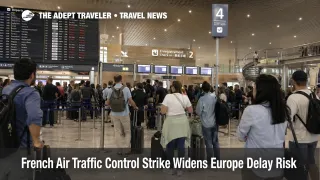
The French ATC strike risk is no longer just a Paris airport problem. A second April 2026 strike notice targeting April 25 keeps pressure on Paris Charles de Gaulle Airport (CDG), Paris Orly Airport (ORY), and the French overflight corridors used by UK, Spain, Italy, Ireland, and Mediterranean routes. The operational issue is capacity. If controllers are unavailable or sectors are regulated, airlines can lose departure slots, airborne reroutes lengthen, and aircraft rotations can fall out of sequence well beyond France.
French ATC Strike: What Changed
French air traffic controller strike notices have already targeted April 18 to 19 and April 25, 2026, during the Easter travel period in France. Ulysse reported that the notices were filed by SNCTA, the majority controller union, and that prior comparable actions led French authorities to request large preventive schedule reductions at Paris Orly and Paris Charles de Gaulle.
The April 25 risk is materially different from a routine single-airport delay day because French airspace sits across some of Western Europe's most important north-south and west-east flows. A Paris departure can be delayed by local airport flow measures, but a London to Rome, Manchester to Malaga, Dublin to Barcelona, or Madrid to Frankfurt itinerary can also be slowed if the planned route depends on French control sectors.
Eurocontrol's April 6 to 12, 2026, aviation overview shows that ATC capacity and staffing already accounted for 78% of all en-route air traffic flow management delays in the Eurocontrol area, notably in Spain and France. France represented 31% of en-route ATFM delays that week, primarily linked to Reims, Marseille, and Bordeaux area control centers.
Which Itineraries Face The Most Risk
Travelers flying to or from Paris face the clearest exposure. Charles de Gaulle is the long-haul and alliance-connection risk point, while Orly is more exposed to domestic, leisure, and short-haul European flights. A mandated schedule cut at either airport can turn a manageable delay into a cancellation, which is harder to recover from on peak Friday and weekend travel days.
The wider exposure sits above France. In a July 2025 French ATC strike, Reuters reported that Ryanair canceled 170 flights affecting more than 30,000 passengers, and the airline said the strike would also affect French overflights, including routes from the United Kingdom to Greece and from Spain to Ireland. DGAC had asked carriers to reduce Paris airport flights by 40% for July 4 during that strike period.
The city pairs most exposed are those that normally cross French airspace and have limited same-day backup capacity. That includes UK to Spain, UK to Italy, Ireland to Spain, Spain to Germany, France to Mediterranean leisure markets, and connections through Paris, Amsterdam, London, Madrid, and Frankfurt where a 45 to 90 minute arrival delay can erase a short connection.
In an earlier Adept Traveler article, French ATC Strike Warnings Could Hit Summer Weekends, the main warning was that French ATC constraints can affect travelers who never planned to land in France. The April 25 notice turns that broader summer risk into a near-term planning problem for late-April itineraries.
What Travelers Should Do Now
Travelers booked through France or over French airspace on April 25 should check airline apps now, then again 24 hours before departure and the morning of travel. The key signal is not only whether a flight still shows on time, but whether the airline has posted a waiver, retimed the aircraft, swapped equipment, or quietly thinned later flights that would normally serve as backups.
Do not protect a high-value commitment with a tight same-day arrival. Cruises, weddings, guided tours, timed rail connections, and prepaid hotel nights should be treated as higher risk if the itinerary touches Paris or depends on a UK, Spain, Italy, or Ireland corridor over France. If the trip has a hard start, the safer move is to arrive the previous day or move to an earlier flight with multiple later same-day options.
Wait for a waiver only if the trip is flexible and the next available routing still works. Rebook earlier if a missed connection would force an overnight, if the itinerary uses separate tickets, or if the last flight of the day is involved. Same-day reaccommodation becomes less useful once aircraft and crew rotations are already out of position.
How French Airspace Delays Spread
Air traffic flow management delays are not the same as ordinary gate delays. When a control center has reduced capacity, Eurocontrol and national authorities can meter traffic into affected sectors. That can hold aircraft at the origin before departure, slow aircraft already in the system, or push flights onto longer routings around the constrained airspace.
The most important French control centers for this story are not only Paris. Eurocontrol's Week 15 data identified Reims, Marseille, and Bordeaux as major contributors to France's en-route delay share. Reims matters for northern and eastern flows, Marseille matters for Mediterranean and Italy-adjacent flows, and Bordeaux can affect southwest France, Spain, and Atlantic-linked routings.
The next decision point is whether DGAC issues specific cancellation percentages or airlines publish protective schedule changes for April 25. Until those notices are visible, travelers should assume elevated delay risk rather than guaranteed cancellation. The French ATC strike risk becomes much more serious if Paris reductions are paired with flow regulations at Reims, Marseille, or Bordeaux, because that combination would hit both airport departures and overflight corridors.