

German Rail Strike Risk Eases for May Travelers
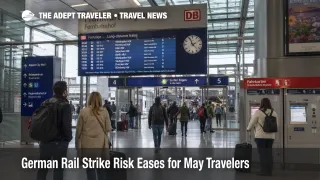
German rail strike risk looks lower for May travelers than some forward planning chatter suggests. The key difference is that Deutsche Bahn now has labor deals in place with both of its major rail unions, EVG and GDL, reducing the chance of a national DB strike hitting ICE, IC, regional, and airport rail links during the early May spring travel window. That does not make Germany disruption free. It does mean travelers should separate national rail exposure from city level transit strikes, engineering work, and the normal delay risk that still affects connections.
German Rail Strike Risk: What Changed
The verified change is not an expanded May strike threat. It is the easing of a national Deutsche Bahn strike risk after two separate labor tracks moved away from open conflict.
EVG, the larger rail and transport union, says its Deutsche Bahn agreement runs until December 31, 2027. The union's own summary describes pay increases, additional payments, job protection measures, and coverage at DB Cargo, which means EVG is not currently positioned as the source of an early May national DB strike.
GDL, the train drivers' union, also reached a wage agreement with Deutsche Bahn on February 27, 2026. Reuters reported that the deal averted strikes that had threatened passenger and freight transport, while German reporting said the GDL agreement and the EVG contract leave Deutsche Bahn without warning strikes in 2026 and 2027.
For travelers, that shifts the planning posture. ICE and IC services between Frankfurt, Munich, Berlin, Cologne, Hamburg, and other major hubs should not be treated as if a confirmed EVG strike window is already on the calendar. The more accurate risk is residual disruption from infrastructure work, late equipment, regional incidents, and possible non DB local transit action.
Which Travelers Still Have Exposure
The most exposed travelers are still those using rail as a tight connection tool rather than as a standalone trip. Frankfurt Airport (FRA) passengers using long distance rail from Frankfurt Airport long distance station, Munich Airport (MUC) travelers depending on S Bahn access through the city, and Berlin Brandenburg Airport (BER) passengers linking regional trains to flights should still build time into the itinerary.
The same applies to cross border itineraries. Travelers using Deutsche Bahn to connect Germany with Austria, Switzerland, the Netherlands, Belgium, France, Denmark, or Czechia still face normal disruption math. A delayed ICE can still break a same day international rail connection, a late airport train can still create a missed flight risk, and a canceled regional feeder can still force a taxi, hotel change, or reroute.
The bigger planning mistake is treating all German transport strikes as one thing. A February 2026 Verdi public transport strike hit bus, tram, and municipal transit operators across much of Germany, but Reuters reported that Deutsche Bahn long distance services and S Bahn trains in major cities were expected to run normally because those staff were not covered by Verdi. That distinction matters because a city transit strike can still break the first or last mile even when national rail is operating.
What Travelers Should Do Now
Travelers should keep Deutsche Bahn in May plans, but avoid building trips around minimum legal connection times. For airport departures, leave enough margin to absorb a late regional train, a platform change, or a city transit gap between the hotel and the main station. For long haul flights, the safer move is to arrive in the airport city the night before when the rail leg crosses multiple regions or borders.
The decision threshold is straightforward. Keep the train if the itinerary has 3 or more hours of airport buffer, flexible tickets, and a later backup service. Rework the plan if the train arrives close to flight check in, connects to a cruise, tour start, wedding, or separate ticket flight, or depends on the last practical train of the day.
Travelers using rail as a backup to European air disruption should also watch the wider transport picture. In an earlier Adept Traveler article, Lufthansa Cuts 20,000 Flights as Fuel Risk Deepens, the risk was thinner short haul air schedules. That makes rail more valuable as a fallback, but only if travelers leave enough time for Germany's still fragile infrastructure and city transport layers.
Why Local Strikes Still Matter
Germany's rail system is not one labor system. Deutsche Bahn long distance and regional operations, S Bahn networks, municipal bus and tram operators, airport rail links, and private regional carriers can fall under different unions, employers, and agreements. A national DB strike would be one type of disruption. A Verdi city transport strike is another. Construction closures, rolling stock shortages, and timetable changes are separate problems again.
That mechanism is why travelers should not overreact to a generic strike headline. The first question is who called the action. The second is which employer and network are affected. The third is whether the impacted link is the core rail trip, the airport access leg, or the last mile from station to hotel.
What happens next is mostly a monitoring question. The national Deutsche Bahn labor picture looks calmer for May than the seed suggested, but local transport talks and city level labor actions can still create short notice friction. Travelers should check DB, airport rail pages, and local transit operators 48 hours before departure, then again the evening before travel. German rail strike risk is lower than a confirmed May walkout, but Germany rail travel still needs buffer time when a missed connection would be expensive.