

Lufthansa Cuts 20,000 Flights as Fuel Risk Deepens
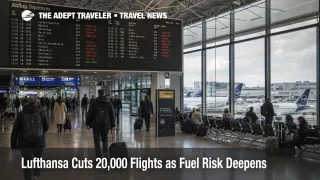
Lufthansa Europe flight cuts moved from contingency talk to a real summer planning problem on April 22, 2026, when the group said it will remove 20,000 short haul flights through October while fuel prices stay elevated and supply risk hangs over Europe. The reduction is less than 1 percent of group capacity, but that headline can understate the traveler effect on thinner routes, weaker backup frequencies, and hub to regional connections where one canceled option matters more than a groupwide average.
In an earlier Adept Traveler article, EU Jet Fuel Stocks Raise Summer Flight Risk, the focus was still official contingency planning. Lufthansa's April 22 move changes that. The market now has a major airline group making actual summer cuts to save fuel, not just warning about higher costs or asking Brussels for help.
Lufthansa Europe Flight Cuts: What Changed
What changed is the shift from planning language to named schedule removal. Lufthansa Group said 20,000 short haul flights will come out of the schedule through October, with the reductions tied to the cancellation of flights previously operated by Lufthansa CityLine and broader consolidation across Frankfurt, Munich, Zurich, Vienna, Brussels, and Rome. The group also said the first 120 daily cancellations were already implemented through May 31, and that wider summer schedule revisions will be published in late April or early May.
That matters because the cuts do not fall evenly across the network. Lufthansa said some routes from Frankfurt, including Bydgoszcz, Rzeszów, and Stavanger, were temporarily removed, while 10 other connections are being consolidated through different hubs. For travelers, that means the main risk is not a dramatic Europe wide shutdown. It is a quieter loss of redundancy, especially where a once or twice daily flight was the recovery plan after a missed connection or delay.
The fuel backdrop is also more serious than a normal fare cycle. Lufthansa said the 20,000 flight reduction would save more than 40,000 metric tons of jet fuel and noted that jet fuel prices have doubled since the Iran conflict began. Separately, International Energy Agency Executive Director Fatih Birol warned on April 16 that Europe had maybe six weeks of jet fuel left if disruption persisted, which pushed the story from price pressure toward possible operational consequences.
Which Travelers Face the Most Disruption
The most exposed travelers are not necessarily those booking Lufthansa long haul tickets. The bigger problem sits with passengers using Lufthansa Group hubs as bridges to smaller European cities, travelers on summer itineraries with only one practical same day connection, and anyone relying on a late final sector to reach a cruise port, tour start, or resort area. Lufthansa said passengers will still have access to the global network, particularly on long haul connections, which suggests the group is trying to protect its strongest banks first.
That usually pushes the pain outward. First order, marginal short haul frequencies disappear. Second order, missed connections become harder to recover, overnight stays become more likely, and nearby airports or rail substitutes start to matter more in itinerary design. This is especially important in Germany, Austria, Belgium, Switzerland, and northern Italy, where Lufthansa Group brands and hubs shape a large share of onward options.
Travelers should also separate group level reassurance from route level exposure. Lufthansa said it expects a largely stable fuel supply for the remaining summer schedule and is using physical procurement and price hedging to support that plan. That may be true at the group level. It does not guarantee the same flexibility on each spoke route once weaker flights have already been cut out of the timetable.
What Travelers Should Do Now
Travelers with Lufthansa Group bookings through October should check whether their itinerary depends on a thin regional hop before or after a long haul segment. The practical question is no longer only whether the flight is still operating today. It is whether the itinerary still has enough slack if one segment moves or disappears when Lufthansa publishes broader late April or early May revisions.
For new bookings, the main decision threshold is backup quality. A slightly more expensive itinerary can be worth it if it avoids the last flight of the day, preserves a longer hub connection, or offers a nonstop into the final destination. This is one of the clearest cases where a cheaper fare can become the more expensive choice once hotel nights, missed tours, or lost same day transfers enter the picture. Travelers comparing western and central European routings should also read Strait of Hormuz Reopening Leaves Fuel Risk in Place, because reopened shipping headlines have not fully repaired the aviation supply chain yet.
Over the next 24 to 72 hours, watch three signals. First, Lufthansa's publication of the revised summer short haul plan. Second, whether other European carriers move from warnings and surcharge talk into actual schedule protection. Third, whether Brussels hardens its contingency posture further after already preparing for coordinated stock action and other fuel measures.
Why This Is Happening, and What Comes Next
The mechanism is straightforward. Europe's airline problem is not only crude oil price volatility. It is jet fuel availability, refining fit, import dependence, and the fact that many airports and carriers plan summer schedules months ahead. Once the fuel outlook looks unstable, airlines do not wait for tanks to run dry. They start protecting the parts of the network that matter most commercially and operationally.
Lufthansa had already accelerated fleet and capacity measures on April 16, when Reuters reported that 27 CityLine aircraft would be withdrawn and older long haul aircraft would leave the fleet earlier than planned. The April 22 announcement is the sharper traveler signal because it turns those cost and fleet measures into an explicit 20,000 flight summer reduction.
What happens next depends on whether this remains a Lufthansa specific network optimization or becomes a broader European airline pattern. If more carriers start thinning weaker frequencies, Europe summer travel will not necessarily collapse, but recovery options will narrow, thinner city pairs will get riskier, and travelers will need to value itinerary resilience more than they did at the start of April. That is the real seriousness here. Lufthansa Europe flight cuts are still small in percentage terms, but they are one of the clearest signs yet that fuel stress is now reshaping the summer schedule, not just the fare screen.
Sources
- Lufthansa Group optimises flight offering in summer across all six Hubs
- AP Exclusive: Europe has 'maybe 6 weeks of jet fuel left,' energy agency head warns
- Lufthansa cuts capacity amid rising cost of fuel, labour disputes
- EU Jet Fuel Stocks Raise Summer Flight Risk
- Strait of Hormuz Reopening Leaves Fuel Risk in Place