

Spirit Bailout Review Raises Summer Booking Risk
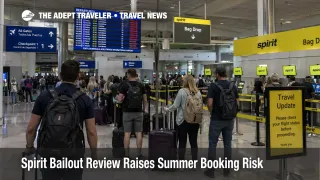
Spirit bailout review moved from political speculation to a near term booking risk on April 24, 2026, after Reuters reported that Spirit's major creditors are reviewing a $500 million government financing offer. The carrier is still operating, but the deadline pressure is now concrete. Spirit's outside lawyer said the airline needs new financing or access to $240 million of its own funds by the end of next week, which makes the next several days a real decision window for travelers holding summer tickets.
Spirit Bailout Review: What Changed
The change is that Spirit now has an actual term sheet under review, not just public discussion about whether Washington might step in. Reuters reported that the offer includes $500 million in financing, with sources saying the government would receive warrants equal to 90% of Spirit's equity. That financing would be senior debtor-in-possession funding intended to help Spirit exit its second bankruptcy restructuring since 2025.
This updates the booking picture from the prior rescue-talk phase. In an earlier Adept Traveler article, Spirit Rescue May Save Summer Flights, Not Cheap Trips, the main traveler tradeoff was whether a rescue could preserve flights while still leaving fares higher and schedules thinner. The new development is sharper because creditors are now reviewing specific federal financing terms while the carrier faces an end-of-next-week cash deadline.
Spirit's own restructuring plan already pointed toward a smaller airline. The company said on March 13, 2026 that it expected to emerge from Chapter 11 by early summer and planned to rightsize its fleet to 76 to 80 planes by the third quarter of 2026. That means even a successful bailout would not restore Spirit to its pre-bankruptcy footprint quickly. The traveler question is whether the financing keeps enough service intact to protect summer itineraries, not whether Spirit immediately returns to normal growth.
Who Faces The Most Spirit Summer Booking Risk
The highest exposure is on Spirit-heavy leisure routes where the carrier provides the lowest fare, the only nonstop, or one of the few same-day backup options. Fort Lauderdale-Hollywood International Airport (FLL), Orlando International Airport (MCO), Detroit Metropolitan Wayne County Airport (DTW), Newark Liberty International Airport (EWR), and New York LaGuardia Airport (LGA) matter because Spirit's restructuring materials have pointed toward a more focused network built around stronger demand periods and core markets.
Travelers with simple nonstop trips have the most room to wait. If the trip is flexible, the fare gap is large, and a cancellation would be annoying but not trip-ending, Spirit can still be a rational choice while the airline continues operating. The risk rises quickly for cruises, weddings, tours, international connections, and prepaid resort stays where one missed departure can trigger hotel penalties, missed embarkation, or expensive last-minute replacement flights.
The first order effect of a failed financing deal would be uncertainty over Spirit's ability to keep operating through restructuring. The second order effect would hit fares and recovery options beyond Spirit. If a low fare carrier shrinks further, routes where Spirit acted as the price check on larger airlines can get more expensive, and travelers lose one more option when weather, air traffic control delays, or crew problems disrupt the original plan.
What Travelers Should Do Before The Deadline
Travelers already booked on Spirit should check whether their trip can survive a same-day cancellation. If the answer is no, price backup flights now, especially for departures tied to a cruise, major event, international connection, or nonrefundable hotel stay. Waiting may preserve the cheapest ticket, but it can also leave fewer replacement seats if more travelers try to move at the same time.
For new bookings, use Spirit more selectively until the creditor review produces a clear result. A nonstop Spirit ticket still makes more sense when the fare gap is large and the traveler has schedule flexibility. It is harder to justify for a high-stakes trip where a missed flight would cost more than the savings. The practical threshold is simple: if replacing the flight at the last minute would damage the whole trip budget, build the backup into the plan before purchase.
Watch for three signals over the next 24 to 72 hours: creditor approval, court authorization to access funds, and any schedule or route changes that follow. A financing approval would reduce immediate liquidation risk, but travelers should still monitor their reservations because a smaller Spirit may continue trimming weak routes and off-peak flying as it tries to leave bankruptcy.
What Happens Next For Spirit And Fares
The mechanism is financial first, operational second. Spirit's restructuring plan depends on enough liquidity to keep flying while it cuts debt, leases, fleet costs, and weaker flying. Higher fuel prices have made that path harder, and Reuters reported that Spirit's problems predate the Iran war even though the fuel spike since late February has worsened the carrier's position.
The politics are unsettled. The Associated Press reported that President Donald Trump said on April 23, 2026 that he was weighing a taxpayer-funded takeover of Spirit with the intent to resell the carrier after oil prices decline. AP also reported pushback from lawmakers and skepticism from Transportation Secretary Sean Duffy about whether federal help would create a precedent for other airlines seeking aid.
For travelers, the clean read is that Spirit is still flying, but the booking risk has not disappeared. A rescue deal would likely protect near term continuity better than liquidation, but it would not erase the fare pressure created by fuel costs, creditor demands, and a smaller fleet. Until the Spirit bailout review produces a signed financing outcome, travelers should treat the carrier as usable for flexible trips and risky for itineraries with little margin for failure.
Sources
- Union says US bailout of Spirit Airlines must protect employees
- Trump considers a taxpayer takeover of Spirit Airlines and would aim to resell carrier
- Spirit Airlines Announces Restructuring Support Agreement and Plan of Reorganization
- Spirit Airlines Reaches Agreement in Principle on Key Terms of Restructuring Support Agreement with Its Secured Creditors
- Spirit Rescue May Save Summer Flights, Not Cheap Trips