

American Chicago Weather Waiver Opens ORD Rebooking
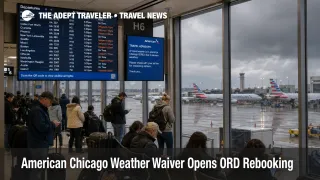
The American Chicago weather waiver gives eligible passengers a narrow chance to move April 27, 2026 flights before thunderstorms squeeze Chicago O'Hare International Airport (ORD). American's alert covers passengers flying to, through, or from Chicago, Illinois, and it matters because the best rebooking options usually disappear before the worst airport delay programs are visible to travelers. The waiver does not erase every cost risk, but it does remove the change fee barrier for qualifying tickets, including Basic Economy, if the itinerary stays within American's rules.
American Chicago Weather Waiver: What Changed
American Airlines posted a severe weather travel alert for Chicago, Illinois, with information current as of April 26, 2026. The alert applies to passengers flying to, through, or from Chicago O'Hare on American Airlines flights who bought tickets by April 25, 2026, and were scheduled to travel April 27, 2026.
The permitted replacement travel window runs from April 26 through April 29, 2026. American says the change fee is waived for qualifying passengers booked in any fare class, including Basic Economy, as long as they do not change the origin or destination city and rebook in the same cabin or pay any applicable fare difference.
The practical change is that O'Hare passengers now have carrier specific remedy guidance, not just a broad weather risk. In an earlier Adept Traveler article, Flight Delays and Airport Impacts: April 24, the focus was the wider FAA delay map and how thunderstorms could slow Chicago airports. This update adds a passenger action window for American itineraries.
Which ORD Travelers Can Use The Waiver
The most obvious fit is an American passenger whose itinerary touches O'Hare on April 27 and who can move into an earlier or later flight between April 26 and April 29 without changing the origin or destination. That includes local Chicago departures, O'Hare arrivals, and connecting itineraries routed through ORD.
Basic Economy passengers should not assume they are excluded. American's alert says the waiver applies to any fare class, including Basic Economy. The catch is that Basic Economy flexibility under a weather waiver is still bounded by the waiver terms. A passenger who changes the city pair, moves outside the allowed travel dates, or rebooks into a higher fare may still face added cost.
Travelers with tight evening connections are the most exposed group. Thunderstorms can reduce arrival and departure rates, and O'Hare's size means a delay can spread from one late inbound aircraft into missed onward flights, aircraft swaps, crew timing issues, and long rebooking lines. The FAA's daily report points travelers to carriers for flight specific delay decisions, while American's waiver gives qualifying customers a way to act before the airport program becomes the final trigger.
What Travelers Should Do Before Storms Build
American passengers should check the airline app or "find your trip" page now, not only after a delay posts. The strongest use case for this waiver is moving a same day connection out of the highest risk window, especially when the original itinerary depends on a short layover, a last flight of the night, or a separate hotel, rail, or cruise connection after arrival.
Rebook voluntarily if the available alternative protects the trip purpose. A morning or early afternoon option may be better than waiting for an evening delay to become official, even if the original flight still shows on time. Wait only if the trip has real slack, the connection is long, or the replacement options are materially worse than the current itinerary.
Passengers should watch three signals through April 27: American app notifications, O'Hare arrival and departure delays, and any FAA ground stop or ground delay program. Once a ground delay program begins, seats on cleaner routings can vanish quickly. The American Chicago weather waiver is most valuable before that point, when travelers still have choices instead of only reaccommodation.
Why The Waiver Matters For O'Hare Operations
Weather waivers are not delay predictions. They are airline tools for moving demand before a disruption becomes harder to manage. In this case, the waiver aligns with a Chicago forecast that called for two rounds of storms, with a morning round and a stronger late day round capable of damaging wind, hail, tornado risk, heavy rainfall, and gusty winds outside thunderstorms.
That timing matters for O'Hare because late day storms can hit the same bank of flights that many travelers use for connections. First order, thunderstorms can force air traffic managers to slow arrivals, hold departures, reroute traffic, or briefly stop inbound flow. Second order, late aircraft and crews reduce the number of same day recovery options, which can push misconnected travelers into overnight stays.
The next operational question is whether the storms line up with O'Hare's heavier departure and arrival banks. If the strongest storms miss the airport or arrive outside peak banks, the waiver may function mostly as a precaution. If storms arrive during the late afternoon and evening push, eligible American passengers who used the waiver early may avoid the worst airport queues and hotel pressure. Travelers who keep April 27 ORD flights should preserve backup plans until the weather window clears.