

Flight Delays and Airport Impacts: April 24
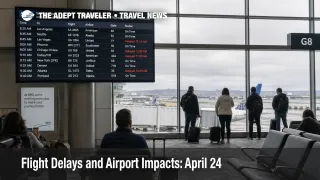
Flight delays and airport impacts on April 24, 2026 are not centered on one collapsing hub. The Federal Aviation Administration's morning outlook points instead to a wide, weather driven risk map, with thunderstorms threatening Miami, Chicago, Detroit, Memphis, and Washington area airports, high winds affecting Dallas, Las Vegas, and Seattle, and low clouds pressuring San Francisco. The operating picture is still selective, but the risk is meaningful because several affected airports sit inside major connection flows where one afternoon program can quickly turn into missed onward flights.
Flight Delays and Airport Impacts: What Changed
The FAA's April 24 report says thunderstorms could delay flights at Miami International Airport (MIA), Chicago Midway International Airport (MDW), Chicago O'Hare International Airport (ORD), Detroit Metropolitan Wayne County Airport (DTW), Memphis International Airport (MEM), Baltimore/Washington International Thurgood Marshall Airport (BWI), Ronald Reagan Washington National Airport (DCA), and Washington Dulles International Airport (IAD).
The same FAA outlook flags high winds that may slow traffic at Dallas Fort Worth International Airport (DFW), Dallas Love Field (DAL), Harry Reid International Airport (LAS), and Seattle Tacoma International Airport (SEA), along with low clouds at San Francisco International Airport (SFO). That makes April 24 a multi region delay watch rather than a single airport problem.
The FAA Command Center's afternoon operations plan sharpened the picture. It listed no staffing trigger, but it showed a San Diego International Airport (SAN) ground delay program active until 0000 Z, a possible DCA ground stop for runway light repair, possible DCA, Dulles, and BWI ground stops after 1800 Z, a possible Detroit ground stop after 1900 Z, and a possible SFO ground stop or ground delay program until 2200 Z.
Which Travelers Face the Most Disruption
The most exposed travelers are those connecting through Washington, Detroit, San Francisco, Chicago, Miami, and Dallas later in the day, especially on short layovers, separate tickets, and last flight options. A thunderstorm delay at an origin airport can be annoying. A thunderstorm delay at a hub can become a broken itinerary when the late aircraft, missed connection, and reaccommodation problem all arrive together.
San Francisco deserves special attention because low ceilings can reduce arrival rates even when the airport is not under a dramatic storm threat. When SFO arrivals slow, the pressure often moves beyond Bay Area travelers into transcontinental connections, Pacific departures, and aircraft rotations that may be needed elsewhere later in the day.
Florida bound trips also carry extra routing risk. The FAA plan listed thunderstorm constraints across several en route centers, military activity and airspace constraints in Florida flows, and multiple route programs tied to Miami, Fort Lauderdale, and South Florida satellite airports later in the day. That means a traveler can be delayed by airspace routing even when their departure airport looks calm.
Chicago has two layers today. First, O'Hare and Midway are on the FAA's thunderstorm watch list for April 24. Second, the FAA separately amended the effective date for O'Hare's summer scheduling limits, moving the start from May 17, 2026 to June 2, 2026, while leaving the October 24, 2026 expiration unchanged. In an earlier Adept Traveler article, O'Hare Summer Cap Tightens Booking Options, the traveler issue was the summer cap itself. Today's change gives airlines more time to modify schedules, but it does not remove the underlying capacity concern.
What Travelers Should Do Now
Travelers flying through the affected airports on April 24 should check airline status before leaving for the airport, then check again before boarding any first segment that connects into Washington, Detroit, San Francisco, Miami, Chicago, Dallas, Las Vegas, or Seattle. The key risk is not only whether the first flight leaves. It is whether the next flight in the chain still has enough buffer once arrival metering, ground stops, or reroutes begin.
The best threshold is consequence. If a delay would only move a flexible leisure arrival by a few hours, waiting may be reasonable. If a delay would break a cruise embarkation, an international departure, a wedding, a tour start, a business meeting, or a separate ticket connection, travelers should look for earlier departures, longer connections, or same day alternatives before the afternoon push tightens.
For West Coast, Florida, and Washington area trips, watch the next FAA and airline updates through the afternoon and early evening. A forecast risk becomes a practical traveler problem once a ground stop, ground delay program, or reroute initiative appears. Travelers should also remember that the FAA report is an operations planning tool, not a flight specific guarantee, so the airline app remains the final source for rebooking and boarding decisions.
How April 24 Delays Could Spread Next
The mechanism is straightforward. Thunderstorms, wind, and low clouds reduce how many aircraft can be safely moved through an airport or airspace sector. Air traffic managers then slow arrivals, reroute flights, or hold aircraft on the ground so demand does not outrun safe capacity. The first order effect is delayed arrivals and departures at the named airports. The second order effect is late inbound aircraft, missed connections, crew timing problems, and fewer same day seats left for reaccommodation.
That is why April 24 should be treated as a connection risk day, not a panic day. The FAA did not flag a staffing trigger in the afternoon plan, which helps separate this from a controller shortage driven disruption. The pressure is mainly weather, airspace, runway, and route management, with San Diego already under a ground delay program and San Francisco, Washington, and Detroit among the places where formal controls could expand.
The next operational signal is whether the planned programs become active during the afternoon and evening. If San Francisco, Detroit, or the Washington airports move into ground stops or delay programs while Florida routes remain constrained, flight delays and airport impacts will become more serious for travelers with tight connections. If those controls do not materialize, April 24 remains a selective disruption day, with the main planning rule unchanged: protect timing before the final workable option disappears.