

Baja Border Warning Narrows Tijuana Road Options
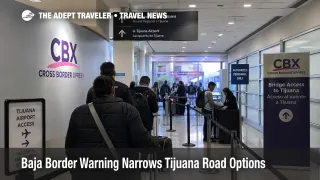
A Baja border warning from the U.K. Foreign, Commonwealth & Development Office now turns Tijuana and Tecate into route decisions, not casual detours. The advice does not close Baja California to travelers, but it sharply separates permitted transit corridors from roads the FCDO says should be avoided unless travel is essential. That distinction matters for Southern California travelers using Tijuana International Airport (TIJ), Cross Border Xpress, wine country trips, Tecate visits, and rental car itineraries that depend on switching crossings at the last minute.
Baja Border Warning: What Changed
The FCDO now advises against all but essential travel to Tijuana except for four specific movements: airside transit through Tijuana airport, use of the Cross Border Xpress bridge, federal toll road 1D, and Via Rápida through Tijuana to the border. It also advises against all but essential travel to Tecate, including roads between Tijuana and Tecate.
That is more useful than a broad country warning because it changes the road planning map. Travelers can still build a Baja itinerary around controlled airport transit, CBX, or the main toll corridor toward the border, but the advisory removes much of the flexibility that road trippers often assume they have around Tijuana and Tecate. A spontaneous stop in Tijuana, a scenic diversion toward Tecate, or a backup crossing chosen only because the wait time looks shorter now carries a different risk profile.
The FCDO also tells travelers crossing by toll road 1D to try to do so during daylight hours or use extra caution after dark. The agency describes Tijuana as extremely violent and warns that travelers could be targeted by criminals or caught in conflicts between rival groups. For planning purposes, the main change is not that every Baja trip becomes impossible. It is that routing, daylight timing, and corridor discipline now carry more weight.
Which Baja Travelers Face The Biggest Route Limits
The most exposed travelers are those using Baja California as an easy extension of a Southern California trip. That includes visitors flying from Tijuana through CBX to reach Mexican domestic destinations, travelers driving south from San Diego to Ensenada or Valle de Guadalupe, and road trippers who might normally compare San Ysidro, Otay Mesa, and Tecate as interchangeable crossings.
CBX remains one of the cleaner options for airport focused trips because it is built around passengers moving between San Diego and Tijuana airport through a dedicated pedestrian bridge. CBX says the bridge is for Tijuana airport passengers and requires a crossing ticket, boarding pass, and valid official documents. That makes it different from a loose city transfer, where travelers may need to move through surface streets, wait in mixed traffic, and make judgment calls in unfamiliar neighborhoods.
The Tecate part of the advisory is the bigger itinerary trap. Tecate is not just a border crossing. It is also a staging point for wine country, rural Baja drives, and alternate border routing when Tijuana area waits build. If a traveler's plan depends on driving between Tijuana and Tecate, using Tecate as a casual backup crossing, or adding a side trip because it looks close on a map, the FCDO language argues for rebuilding that plan before departure.
In an earlier Adept Traveler article, Teotihuacán Shooting Pushes Mexico Security Upgrade, the focus was broader Mexico tourist security before the World Cup. This update is narrower. It is about border route selection in Baja, where the practical decision is not whether Mexico is open, but which corridors still fit a lower exposure itinerary.
What Travelers Should Do Before Driving
Travelers should decide the crossing, corridor, and fallback plan before reaching the border area. For Tijuana airport trips, CBX may be the cleaner choice than entering Tijuana by road and arranging a surface transfer. For Ensenada or Valle de Guadalupe trips, travelers should favor direct, daylight movement on the most established route, avoid improvising through Tijuana, and verify whether the rental car contract, Mexican liability insurance, and travel insurance still apply to the exact route being used.
The insurance check is not a paperwork detail. The FCDO's own travel insurance guidance warns that policies may be invalidated when travelers go to destinations where the FCDO advises against all but essential travel or all travel. Travelers using U.K. issued policies should ask the insurer directly whether Tijuana, Tecate, and the roads between them are excluded, partly excluded, or covered only for specific transit movements. U.S. travelers should still check Mexican auto liability coverage, rental car cross border permissions, roadside assistance limits, and whether their travel medical policy excludes government advised areas.
The decision threshold is simple. If the itinerary requires nonessential movement through Tijuana neighborhoods, a Tijuana to Tecate road segment, night driving, or a rental car detour chosen only for convenience, change the plan. Use CBX for airport access, stage overnight on the San Diego side when timing is tight, or choose a Baja plan that does not depend on Tecate as a backup. Travelers already in Baja should keep the return route conservative, avoid after dark repositioning when possible, and monitor both the FCDO and their own government's Mexico advisory before moving.
Why The Baja Border Warning Changes Backup Planning
Border travel often fails at the edges, not the main itinerary. A traveler may book a reasonable plan through CBX, then lose margin because a flight arrives late, a rideshare is unavailable, a rental car pickup changes, or a border wait time pushes them toward another crossing. The Baja border warning makes those improvised substitutions more consequential because not all nearby roads carry the same advisory status.
The U.S. State Department takes a different structure, listing Baja California at "Reconsider Travel" due to terrorism, crime, and kidnapping, while noting that U.S. government employee travel restrictions in Baja California are limited to the Mexicali Valley. That difference does not cancel the FCDO route warning. It shows why travelers need to read advisory geography carefully instead of relying on a single countrywide headline.
What happens next depends on whether the FCDO narrows, expands, or maintains the Baja language. Travelers with near term plans should watch for any change to Tijuana airport transit, CBX, toll road 1D, Via Rápida, Tecate, and the road link between Tijuana and Tecate. Until the advisory changes, the safest planning assumption is that the Baja border warning leaves airport and main corridor travel more workable than casual road detours.