

Fuel Costs Push Summer Europe Airfares Higher
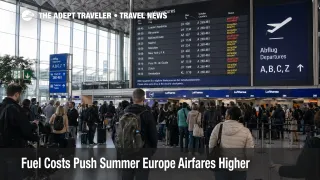
Summer Europe airfares are moving higher before peak season, and the pressure is no longer only a fare search problem. Jet fuel costs tied to the Iran war are forcing airlines to raise prices, add fees, and remove some lower margin flights from schedules. The clearest traveler risk is not a systemwide collapse. It is a narrower summer market where late bookers may find fewer nonstop options, higher checked bag costs, weaker sale inventory, and less flexibility when plans change.
Summer Europe Airfares: What Changed
The immediate change is that fuel has become expensive enough to alter both pricing and schedules. IATA's Jet Fuel Price Monitor, published with Platts data, listed the global average jet fuel price at $184.63 (USD) per barrel for the reported week, even after a 6.7 percent weekly decline. That is still a level airlines have to recover through fares, fees, schedule cuts, or weaker margins.
Reuters reported that Transport & Environment calculated an average fuel cost increase of €88.00 (EUR), about $104.00 (USD), per passenger on long-haul flights leaving Europe, and €29.00 (EUR) on flights within Europe, compared with prices before the war began on February 28, 2026. Those numbers do not automatically become the exact fare increase on every ticket, but they explain why airlines are moving quickly to protect revenue.
The operational change is already visible. KLM said it would cancel 160 European flights over the following month because of rising fuel costs, while saying the cancellations represented less than 1 percent of its European flying and that it was not experiencing a jet fuel shortage. Lufthansa Group has also accelerated fleet and capacity measures, saying sharply higher kerosene costs and geopolitical instability made the package unavoidable.
Which Travelers Face The Most Pressure
The highest pressure is on travelers booking Europe for summer or early fall, especially those who still need long-haul economy tickets, family itineraries, or flights into smaller cities with limited same-day backup. A family of four can feel the fuel increase faster than a solo traveler because airfare, baggage fees, seat fees, and schedule constraints all multiply.
Travelers using large hubs such as Amsterdam Airport Schiphol (AMS), Frankfurt Airport (FRA), Paris Charles de Gaulle Airport (CDG), and London Heathrow Airport (LHR) may still have many options, but that does not mean prices stay soft. Airlines are more likely to protect high-demand departures, peak day flights, and hub-to-hub routes while trimming lower-yield or duplicative flying. The result can be a market that still looks well served on paper but gives travelers fewer cheap or convenient choices.
U.S. travelers are not insulated. United Airlines Chief Executive Scott Kirby told analysts that ticket yields may need to rise 15 percent to 20 percent to offset the fuel surge, according to Reuters. United also said it had already implemented five fare increases late in the first quarter and raised baggage fees, with the airline expecting to recover more of the fuel increase through fares and revenue measures as the year progresses.
What Travelers Should Do Before Booking
Travelers planning Europe should price the full itinerary now, not just the base fare. A cheaper ticket can lose its value if it requires a checked bag fee each way, an overnight connection, a separate ticket, or a long self-transfer through a crowded hub. For summer trips, the safer comparison is total trip cost, including bags, seats, airport transfers, hotel penalties, and the cost of losing a day if a connection breaks.
Booking sooner is more useful when the trip has fixed dates, a cruise embarkation, a wedding, a major event, or limited vacation time. Waiting can still work for flexible travelers who can shift by several days, use alternate airports, or travel later in the shoulder season. The weaker strategy is waiting for a traditional summer fare sale on a fixed itinerary while airlines are actively trying to recover fuel costs.
Travelers should also protect connection structure. Same-ticket itineraries matter more when schedules are being trimmed because the airline has more responsibility to reaccommodate a passenger when a connection fails. Separate tickets through Europe can still save money, but they become riskier if the first flight is delayed, the second airline reduces frequency, or the traveler has checked bags that must be reclaimed and rechecked.
Why Fuel Costs Can Shrink Flight Choices
Fuel affects airline schedules unevenly. A full long-haul flight with premium demand can survive higher fuel costs because the revenue per seat is stronger. A thin route, off-peak departure, regional feeder, or short-haul duplicate can become easier to cut because it burns fuel, uses crews and aircraft, and may not generate enough revenue to justify the operation at current prices.
That is why Europe is an important early signal. Reuters reported that European airlines are preparing for a difficult spring and summer as jet fuel prices remain elevated and concerns grow that shortages could lead to cancellations. Lufthansa Group's own statement shows the mechanism clearly: removing less efficient aircraft and reducing capacity lowers fuel consumption and reduces exposure to the most expensive unhedged portion of its fuel needs.
First order, travelers pay more for remaining seats or lose some departure choices. Second order, missed connections become harder to fix because fewer extra seats may exist later the same day. The next signal to watch is whether the current cuts remain selective or expand into broader summer schedule reductions. If more carriers trim marginal routes, summer Europe airfares will keep rising not only because fuel is expensive, but because travelers will be competing for fewer practical seats.
Sources
- Jet Fuel Price Monitor
- Iran war fuel hike adds $100 to long-haul flight cost, study says
- United Airlines says fares may need to rise up to 20% to offset fuel surge
- KLM cancels 160 flights in coming month due to rising fuel costs
- Lufthansa Group Accelerates Strategy Implementation
- Flight Delays and Airport Impacts: April 27