

Flight Delays and Airport Impacts: April 27
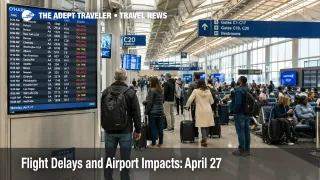
Flight delays and airport impacts on April 27, 2026 are starting as a traffic flow problem, not a nationwide airport collapse. The FAA Command Center's morning plan points to thunderstorms around Chicago, low visibility at Denver, wind in Las Vegas, low ceilings in Seattle, construction pressure in San Francisco, and Florida airspace routing tied partly to launch activity. The biggest traveler risk is timing. Several of the planned controls are aimed at afternoon and evening banks, when missed connections and late inbound aircraft have less room to recover before the last practical departure.
Flight Delays and Airport Impacts: What Changed
The FAA's April 27 operations plan says good weather along the East Coast is being offset by a rocket launch moving volume inland, thunderstorms affecting the Chicago metro area, fog at Denver International Airport (DEN), and construction at San Francisco International Airport (SFO). That mix creates a broader flow management day, where a traveler may be delayed by routing, arrival metering, or airport construction even when the departure airport looks calm.
The most immediate Chicago risk sits with Chicago Midway International Airport (MDW) and Chicago O'Hare International Airport (ORD). The FAA listed a probable Midway ground stop after 1300 Z and a probable O'Hare ground stop or ground delay program after 1300 Z. It also listed expected Chicago reroute and severe weather avoidance procedures until 2300 Z, which means the problem can affect both local Chicago flights and aircraft moving through Chicago airspace.
The FAA also listed possible ground stops or ground delay programs at SFO after 1500 Z and again after 2200 Z, Minneapolis-Saint Paul International Airport (MSP) after 1600 Z, Denver after 2100 Z, John F. Kennedy International Airport (JFK) after 2200 Z, and Memphis International Airport (MEM) after 0200 Z. That sequence makes April 27 a rolling risk day rather than a single morning disruption.
Which Travelers Face the Most Disruption
The most exposed travelers are those connecting through Chicago, Minneapolis-Saint Paul, Denver, San Francisco, New York, and Memphis later on April 27. Short layovers, separate tickets, checked bags, and last flight options are the weak points. A 45 minute delay into a hub is manageable when there are several later departures. The same delay becomes a trip breaker when the onward flight is the final workable option of the day.
Florida trips also need extra attention. The FAA listed active route initiatives tied to the Cape launch window, Northeast to Florida flows, Midwest to Florida flows, and Atlantic route restrictions. It also listed planned route changes for New York satellite traffic to Florida and later Florida arrivals. That means a traveler bound for Orlando, Tampa, Fort Myers, Fort Lauderdale, or Miami may see delay even if their origin and destination airports are not under a headline ground stop.
San Francisco has a different kind of risk. The FAA plan ties possible terminal initiatives to construction, and its runway and equipment section lists SFO runway and taxiway construction lasting into November 2026. Construction does not have to look dramatic to matter. When airport capacity is already narrowed, low ceilings, volume, or late inbound aircraft can push delays through the afternoon bank faster than travelers expect.
In an earlier Adept Traveler article, O'Hare Summer Cap Tightens Booking Options, the focus was O'Hare's reduced summer schedule capacity. April 27 is a shorter term operating story, but the traveler lesson is similar: Chicago itineraries need more buffer when weather and flow controls begin stacking on top of an already tight hub environment.
What Travelers Should Do Now
Travelers flying through Chicago on April 27 should check airline status before leaving for the airport, then check again before boarding any first segment that connects into Midway or O'Hare. If a Chicago connection is under 90 minutes, or if the onward flight is the last workable departure, the safer move is to look for earlier options before the afternoon controls harden.
Florida bound travelers should monitor the route, not only the airport. A flight can be delayed because the FAA is moving traffic around launch activity, military airspace, storms, or closed oceanic routes. If the trip involves a cruise embarkation, prepaid hotel night, timed park reservation, or separate ticket connection, travelers should avoid assuming that clear weather at the gate means the route is clear.
For SFO, Denver, JFK, Minneapolis-Saint Paul, and Memphis, the decision point is whether planned controls become active during the afternoon or evening. A possible ground stop is not the same as a current delay, but it is enough reason to protect tight connections and avoid waiting until the airline app shows a long delay. Once a ground delay program starts, same day reaccommodation can tighten quickly.
How April 27 Delays Could Spread Next
The mechanism is straightforward. Thunderstorms, low visibility, wind, construction, rocket activity, and airspace restrictions reduce the number of aircraft the system can safely move through a constrained area. Air traffic managers then slow departures, meter arrivals, close routes, or move traffic onto alternate paths. First order, flights leave late or wait for a release time. Second order, aircraft and crews arrive late for their next trips, connections shrink, and rebooking seats disappear.
April 27 is not a panic day based on the FAA plan, but it is a connection risk day. The Command Center listed no staffing trigger, which helps separate this from a controller shortage driven disruption. The risk is mainly weather, construction, launch activity, route structure, and runway availability. That is still enough to affect travelers because several of the exposed airports are major connection points.
The next signal to watch is whether probable Chicago controls become active and whether possible evening controls expand at SFO, Denver, JFK, or Memphis. If those programs activate together, flight delays and airport impacts will become more serious for travelers with late day hub connections. If they do not, April 27 remains a selective disruption day where the main move is simple: protect the itinerary before the last workable option is gone.