

London Tube Strike Dates Hit May, June Travel
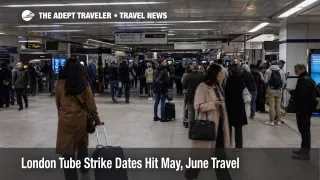
London Tube strike dates are back on the planning calendar for May and June, and the risk is broader than a missed Underground ride. Transport for London now lists four additional midday to midday Tube driver strike windows on May 19 to May 20, May 21 to May 22, June 16 to June 17, and June 18 to June 19, with disruption expected to continue into afternoons and evenings. For visitors, the weak points are Heathrow transfers, rail station handoffs, West End theater timing, and event arrivals when backup routes absorb the same displaced demand.
London Tube Strike Dates: What Changed
TfL's strike page now gives travelers a forward calendar instead of only a same week warning. The listed Tube driver strikes are scheduled from 1200 midday to 1200 midday the following day across two windows in May and two more in June. TfL says disruption will continue into the afternoons and evenings of strike days, which means the risk does not end cleanly when a strike window expires.
That makes this different from the April Tube strike coverage. In an earlier Adept Traveler article, London Tube Strike Hits Heathrow Again on April 23, the immediate issue was live Heathrow access during an active strike window. The new planning problem is that spring and early summer visitors can now see several future disruption blocks before hotels, flights, theater tickets, and airport transfers are locked.
The operational significance is meaningful disruption, not citywide travel failure. TfL says some Tube drivers are involved, while other TfL services, including the Elizabeth line, Docklands Light Railway, London Overground, trams, and buses, are expected to operate, though they may become very busy when passengers shift away from the Underground.
Which London Trips Face The Most Risk
The most exposed travelers are visitors who treat the Tube as the cheapest, simplest default for every transfer. Heathrow itineraries are especially sensitive because the Piccadilly line normally gives travelers a low cost, one seat link between the airport and much of central London. When that route thins, the traveler problem moves to the Elizabeth line, Heathrow Express, taxis, coaches, and hotel timing.
Heathrow Express is the cleaner fallback for travelers already near Paddington because it runs between London Paddington and Heathrow every 15 minutes, with a 15 minute trip to Terminals 2 and 3 and additional time for Terminal 5. The Elizabeth line is broader for central and east London, serving Heathrow Terminals 2 and 3, Terminal 4, and Terminal 5, with six trains an hour to Heathrow and different frequencies by terminal.
Rail station transfers also become tighter. Visitors moving between Heathrow and Paddington, St Pancras, King's Cross, Euston, Victoria, Waterloo, or Liverpool Street should assume station approaches, platforms, buses, and ride hail pickup points will be more crowded than a normal weekday. Theater and event travelers face a different problem: the trip may still be possible, but a delayed cross London transfer can erase dinner plans, timed entry bookings, or the margin needed to reach a show before doors close.
How Travelers Should Plan Around The Strikes
Travelers with flights from London Heathrow Airport (LHR) should choose the airport transfer before strike day, not while standing in a disrupted station. If the itinerary depends on a long haul departure, checked bags, mobility assistance, children, or a self connection, build the plan around Heathrow Express, the Elizabeth line, a prebooked car, or an airport hotel rather than the Piccadilly line.
The decision threshold is simple. If missing the next item would break the trip, use the more reliable route even if it costs more. That includes same day arrival to a cruise, same day Eurostar or National Rail transfer, nonrefundable theater tickets, stadium events, and early morning departures after a strike window. Travelers with flexible sightseeing plans can wait longer, but they should still avoid stacking multiple timed bookings across the same strike afternoon or recovery morning.
For visitors planning their first London itinerary, London Travel Guide: The Ultimate 7-10 Day Itinerary for First-Time Visitors remains useful for grouping neighborhoods and attractions. During strike windows, the practical adjustment is to cluster days by walking distance, keep West End and central sights together, and avoid hotel choices that depend on only one Underground line.
Why The Disruption Spreads Beyond The Tube
The Tube strike mechanism is a capacity shift. First order, Underground service becomes reduced, uneven, or unreliable across key corridors. Second order, the travelers who would normally be underground move into the same remaining options at the same time, including Elizabeth line platforms, buses, DLR interchanges, Overground routes, taxis, ride hail, coaches, and sidewalks.
That is why a strike affecting Tube drivers can still affect airport transfers, rail connections, and theater timing even when other services are officially running. A route can be open and still be a poor bet if station access, boarding, luggage handling, or road traffic adds enough delay to break the next step of the itinerary. Heathrow is the clearest example because several backup modes exist, but they do not all serve every terminal with the same frequency or price.
What happens next depends on whether the dispute is resolved before the listed May and June windows. Until TfL removes the dates or publishes revised service plans, travelers should treat the London Tube strike dates as live planning constraints. Recheck TfL status the night before travel, again before leaving the hotel, and avoid building airport, rail, theater, or event plans around the assumption that normal Tube service will recover quickly after midday.