

London Tube Strike Hits Heathrow Again on April 23
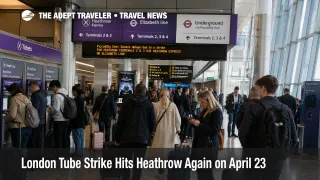
Travelers moving through London, England, on Thursday, April 23, 2026, should treat the London Tube strike Heathrow problem as live again, not left over from Tuesday's disruption. The second 24 hour RMT walkout began at midday on Thursday and runs to midday on Friday, April 24, with National Rail warning of significant disruption across the Underground, no service expected on the Piccadilly and Circle lines, and early shutoffs around 8:00 p.m. on strike days. For Heathrow Airport (LHR), that means the cheapest direct rail path is weak again just as more travelers are forced onto the same backup options.
In an earlier Adept Traveler article, London Tube Strike Disrupts Heathrow Access on April 21, the operational shift was that live line damage had started to match the warnings. The change on April 23 is that the second strike window is now active, so this is no longer about whether Thursday could go bad. It is about whether travelers still trying to use the Piccadilly line, or still timing tight cross London transfers, are making a bad bet.
London Tube Strike Heathrow: What Changed
The strike pattern itself is the first thing travelers need to understand. National Rail says each action block runs from midday to midday, with disruption continuing into afternoons and evenings. On Thursday, April 23, normal service only lasts until mid morning, then the network ramps down before significant disruption takes hold after midday. On Friday, April 24, any Underground services that do run are not expected before 7:30 a.m., with recovery only building through the afternoon and evening.
The live Heathrow picture remains weak. TfL status updates on Thursday showed the Circle line fully suspended, severe delays across several major lines, and the Piccadilly line under severe delays between Acton Town and Heathrow Terminals, as well as the wider Uxbridge branch, with minor delays on the rest of the line. TfL also warned Tube services would finish early and told travelers to complete journeys by 8:00 p.m.
That matters because Heathrow normally gets its broadest low cost direct Tube access from the Piccadilly line. Once that path weakens, demand does not disappear, it shifts. Heathrow has already told passengers to expect little to no Underground service between April 21 and April 24, and to rely instead on Heathrow Express, the Elizabeth line, and local buses, all of which are likely to be busier than normal.
Which Heathrow Trips Are Most Exposed
The most exposed travelers are the ones still building Heathrow around a cheap, simple, one seat Tube transfer. That includes leisure visitors with luggage heading from central London hotels, travelers trying to bridge Heathrow with Paddington, St Pancras, or Euston on the same day, and anyone arriving late enough that a reduced evening service window leaves little recovery room. If your plan depends on everything working in sequence, hotel checkout, Tube, airport processing, and departure, the strike turns a normal city transfer into a chain with more failure points.
Terminal fit matters. The Elizabeth line serves Terminals 2, 3, 4, and 5, which makes it the broadest rail fallback when the Underground is weak. Heathrow Express is the faster premium option from London Paddington, running every 15 minutes, with a 15 minute trip to Terminals 2 and 3 and only a few minutes more to Terminal 5. That makes Heathrow Express the cleaner choice for travelers already near Paddington, while the Elizabeth line is usually the better fallback for wider central and east London origins, and especially for Terminal 4.
The second order problem is crowding migration. When the Piccadilly line becomes unreliable, travelers spill into the Elizabeth line, Heathrow Express, coaches, local buses, taxis, and ride hail at the same time. Even if those modes are officially running normally, boarding, platform access, curbside pickup, and travel times become less predictable because everyone is chasing the same substitute capacity.
What Travelers Should Do Now
For Thursday afternoon and evening, the safest default is to stop treating the Piccadilly line as your primary Heathrow plan. If you are starting near Paddington, switch early to Heathrow Express. If you are elsewhere in central or east London, price and route around the Elizabeth line first, not as a backup after the Tube fails. If your airport run lands late in the day, or after the 8:00 p.m. early finish threshold, coach, taxi, or an airport hotel may be the lower risk choice even if it costs more.
The clearest decision threshold is how tight the rest of your itinerary is. If you have checked bags, a long haul departure, a same day rail connection, or a nonrefundable evening event after landing, do not wait to see whether the Piccadilly line behaves. Move to the first stable option you can board. Waiting can still work for hand luggage only travelers with flexible timing, but only if they can absorb crowding, longer station access times, and a miss without losing the whole trip.
Friday is not a clean reset. National Rail says there is no service expected before 7:30 a.m. on the Underground, with significant disruption through midday and recovery only later in the day. That means overnight stays near Heathrow or Paddington make more sense for some travelers than trying to salvage an early Friday airport run from farther across London. In an earlier Adept Traveler article, Heathrow Tube Risk Runs Past the Strike Window, the key warning was that Heathrow access weakness would outlast a single strike block. Thursday's second walkout confirms that logic.
Why Heathrow Access Stays Weak Through Friday
The mechanism is not just that a strike exists. It is that the disruption window is structured to bleed across two calendar days, while Heathrow depends on one Tube line for its cheapest direct city link. The Thursday midday start hits afternoon departures, evening hotel moves, and post flight transfers into town. The Friday morning recovery lag then catches early departures, rail handoffs, and business travelers trying to restart normal plans too quickly.
There is also no sign of a quick settlement. Reporting on Thursday said the second 24 hour strike had begun with no further talks to resolve the dispute, which centers on London Underground plans for a voluntary four day workweek. TfL says the change would be voluntary, while RMT says it is worried about longer shifts and fatigue. For travelers, the immediate point is simpler than the labor argument itself, the system is still unstable, and more strike dates are already planned for May and June if the dispute is not resolved.
The practical readthrough is that Heathrow access remains a routing story, not just a Tube story. Travelers should check TfL status the night before and again before departure, but the better move on April 23 and early April 24 is to assume the London Tube strike Heathrow problem remains real until stable service is visibly back, not merely scheduled to return.
Sources
- Incident: IA London Underground | National Rail
- Strikes | Transport for London
- Tube, Overground, Elizabeth line, DLR & Tram status updates | Transport for London
- Customers urged to check before they travel ahead of strike action next week | Transport for London
- Heathrow Express | Heathrow
- Elizabeth line | Heathrow
- London faces more disruption as second 24-hour tube strike begins | The Guardian