

SFO Delay Program Puts Connections at Risk April 27
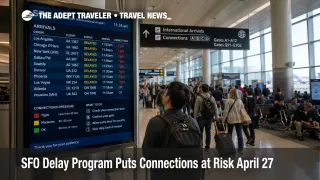
San Francisco Airport delay program risk is now a live arrival problem for April 27, not just a general construction warning. The Federal Aviation Administration posted a proposed ground delay program for San Francisco International Airport (SFO) arrivals from 1000 a.m. to 329 p.m. CDT, with an anticipated rate of 36 arrivals per hour, an average delay of 53 minutes, and a maximum delay of 126 minutes. That window is long enough to break tight connections before travelers even reach the Bay Area.
San Francisco Airport Delay Program: What Changed
The FAA's proposed April 27 program gives travelers a specific operating window and delay estimate to plan around. A ground delay program does not close the airport. It meters arrivals by assigning later departure times to inbound aircraft so the number of planes reaching San Francisco does not exceed the airport's arrival capacity.
That is the shift from broader risk to immediate trip planning. In an earlier Adept Traveler article, Flight Delays and Airport Impacts: April 24, SFO was already flagged for low cloud and possible traffic management controls. The April 27 advisory adds a defined arrival program, a 36 aircraft per hour rate, and delay values that travelers can compare against their own connection buffers.
The program window matters for more than Bay Area arrivals. If an aircraft is held at its origin before flying to SFO, the delay can follow that same aircraft into its next departure. First order, inbound travelers arrive late. Second order, aircraft positioning, crew timing, onward connections, and late hotel arrivals can all move out of sequence.
Which SFO Itineraries Are Most at Risk
The most exposed travelers are those connecting at SFO during or shortly after the program window, especially if the onward flight is the last workable option of the day. A 53 minute average delay is enough to turn a normal domestic connection into a sprint, and the 126 minute maximum delay is enough to break many international and separate ticket itineraries outright.
Transpacific connections deserve special attention because SFO is a major West Coast gateway. A delayed inbound domestic segment can leave travelers with fewer same day alternatives if they miss a long haul departure to Asia, Australia, or other Pacific routes. The same risk applies to travelers connecting from Canada, the U.S. West Coast, Hawaii, and smaller western markets into limited frequency onward flights.
Origin airports also matter. A traveler starting in Los Angeles, Seattle, Denver, Vancouver, or another North American city may see the SFO delay before departure, not after arrival. That can be useful if the airline app offers a same day change before the first flight boards. It is much harder to recover once the traveler has already departed and the connection margin has disappeared.
What Travelers Should Do Now
Travelers arriving at SFO on April 27 should check their airline app before leaving for the airport and again before boarding the first segment. If the itinerary connects at SFO during the late morning through mid afternoon program window, a connection under 90 minutes is less safe than usual. A connection under 60 minutes should be treated as fragile unless the onward flight has multiple later backups.
The rebooking threshold should be based on consequence, not inconvenience. If a delay would only move a flexible arrival by an hour or two, waiting may be reasonable. If the delay would break a cruise departure, an international flight, a separate ticket, a tour start, a business event, or a last flight of the day, travelers should look for an earlier arrival, a longer connection, or a routing through another hub before same day inventory tightens.
Travelers should monitor whether the FAA program is canceled, extended, or converted into a different traffic management action later in the day. The airline app remains the flight specific source for departure time, reaccommodation, and boarding decisions, but the FAA advisory is the better early signal for whether San Francisco flight delays are becoming a system problem rather than a single late aircraft.
Why SFO Has Less Arrival Slack
SFO is already operating under a construction constraint. The airport closed Runway 1 Right on March 30, 2026, for a six month repaving and taxiway improvement project scheduled to run until October 2, 2026. During the project, SFO said arrivals and departures would use Runways 28 Left and 28 Right, while Runway 1 Left would serve as an additional taxiway to reduce ground congestion.
That runway work interacts with FAA arrival spacing. SFO's parallel east west runways are close together, and FAA guidance has restricted side by side approaches in clear weather, requiring staggered approaches instead. That reduces how quickly arrivals can be accepted when demand is high, especially if weather, peak banks, or traffic management constraints compress the schedule.
The April 27 San Francisco Airport delay program is therefore meaningful even though it is not a full airport shutdown. It shows how a constrained runway layout, construction work, and arrival metering can combine into a connection risk day. The next signal is whether delays stay within the proposed window or push later into evening departures, when reaccommodation options usually become thinner.