

Southeast Asia Floods Turn Winter Beach Trips High Risk
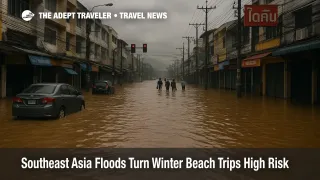
Lethal Southeast Asia floods winter travel plans to Indonesia, southern Thailand, peninsular Malaysia, and Sri Lanka after a cyclone driven storm cluster in late November 2025 killed more than 700 people and displaced hundreds of thousands. North Sumatra villages, southern Thai cities, Malaysian river towns, and Sri Lankan inland districts have all seen homes washed away, roads cut, and basic services knocked out. For travelers, this turns several classic winter sun itineraries into high risk choices unless plans are reworked around reliable hubs, simpler routes, and more generous buffers.
In practical terms, the Southeast Asia floods winter travel outlook has shifted from isolated local problems to a regionwide pattern where the long haul gateways mostly keep working, but many coastal and inland legs are compromised or unpredictable. Travelers now need to build trips outward from major airports and cities that have maintained operations, while treating bridge dependent road trips, rural guesthouses, and cross border bus or rail loops as higher risk for the next several weeks.
Indonesia is carrying some of the worst physical damage. On Sumatra, a rare tropical cyclone in the Malacca Strait has driven more than a week of deluge, with Indonesia's disaster agency now counting over 400 dead, hundreds missing, and tens of thousands evacuated across three northern and western provinces. Landslides and flash floods have destroyed roads and communications, leaving some towns accessible only by boat or helicopter, and Indonesian officials are openly debating national disaster status to accelerate aid.
Even in this context, the air and sea lifelines are holding better than the roads. The transport ministry reports that key gateways in Sumatra remain open, with the government stressing that airport and port facilities are largely intact, even as approach roads in some districts are damaged or periodically cut by water. Relief flights are using military and charter aircraft to move supplies into airfields that also serve as regional travel hubs, while the government deploys additional aircraft to support evacuations and logistics. For visitors, this means that reaching large cities by air is still feasible, but onward journeys into badly hit valleys or coastal districts by road may be impossible for days at a time.
Southern Thailand tells a slightly different story. Provinces including Songkhla, Nakhon Si Thammarat, Pattani, Narathiwat, and Yala have endured some of their worst flooding in decades, with Hat Yai entirely submerged for days, at least 145 deaths in earlier counts, and millions affected as rivers burst their banks. Canada has updated its Thailand advisory to flag severe flooding in these provinces, urging travelers to avoid nonessential trips into the worst hit districts and to monitor local news and weather closely.
By November 30, 2025, the Tourism Authority of Thailand was already stressing that travel conditions across much of Southern Thailand are improving, and that most popular destinations are operating close to normal with floodwaters receding. That is an important nuance for winter beach planning. Bangkok Suvarnabhumi Airport (BKK), Don Mueang International Airport (DMK), and most southern tourist airports remain open, and core resort belts like Phuket and Krabi are not dealing with the same scale of damage as river towns and low lying inland cities. In practice, the risk is less about flights actually reaching Thailand and more about whether ground transfers to and from secondary cities, small islands, or remote national parks can run reliably.
Peninsular Malaysia sits on the same storm arc, although fatalities so far are far lower than in Indonesia or Thailand. A series of government and local media updates report more than 30,000 evacuees spread across up to nine states, with Kelantan and Terengganu on the east coast bearing the brunt of river flooding and road closures. Flood situation reports describe schools and community halls converted into shelters, some rural roads impassable, and a rolling pattern of closures and reopenings as waters rise and recede. Kuala Lumpur International Airport (KUL) continues to function as a major regional hub, but travelers heading for more exposed east coast islands and beach towns should not assume that normal bus and ferry schedules will be back in days.
In Sri Lanka, Cyclone Ditwah has turned what should be the start of peak tourism season into the country's deadliest natural disaster in years. Reuters now puts the death toll at over 200, with more than 200 people still missing, nearly one million residents affected, and about 200,000 sheltering in more than 1,200 emergency centers after record rainfall, a reservoir breach, and widespread flooding and landslides in central, eastern, and low lying districts around Colombo. Power, water, and communications are badly disrupted in many areas, and there have been high profile cases of tourists stranded at Bandaranaike International Airport (CMB) before being evacuated on special flights once weather allowed.
At the same time, Sri Lanka's main long haul gateway is structurally resilient, and authorities expect gradual restoration of basic services over several days as rain bands move away and floodwaters drop. That still leaves a difficult ethical and practical question for winter visitors. Beach belts and heritage cities that rely on intact roads, clean water, and functioning small businesses are facing months of recovery work, and travelers should treat nonessential near term trips into severely hit districts as low priority compared with local needs, even if flights technically operate.
Which gateways are most reliable now
For winter trip planning, the hierarchy is clear. Singapore Changi Airport (SIN), Kuala Lumpur International Airport (KUL), Bangkok Suvarnabhumi Airport (BKK), Don Mueang International Airport (DMK), Ngurah Rai International Airport (DPS) in Bali, and Bandaranaike International Airport (CMB) in Sri Lanka remain the primary long haul gateways that airlines and governments are working hardest to keep open. Schedules have seen some delays and reroutes, especially when aircraft or crews are tied up by weather, but there is no indication of a wholesale shutdown at these hubs.
In contrast, smaller airports closer to the worst damage, local ferries, mountain roads, and cross border buses are where conditions can change overnight. North Sumatra and Aceh have seen repeated reports of bridges collapsing and roads becoming impassable, with aid agencies and Indonesian authorities relying heavily on airlifts and boats to reach isolated communities. Southern Thailand's interior districts are also dealing with destroyed homes and disrupted local utilities even as main arteries reopen.
How to rethink Southeast Asia winter itineraries
For the next few weeks, the safest pattern is hub and spoke rather than long looping overland routes. A traveler who flies into Singapore, Kuala Lumpur, Bangkok, or Bali and stays within well serviced regions that have not experienced catastrophic flooding is taking a very different risk than someone who tries to thread a multi country land trip through North Sumatra, southern Thai border provinces, and rural Kelantan.
Visitors who already booked complex trips combining places like Medan, Hat Yai, Kelantan's east coast, and Sri Lankan hill country should now map each segment against current advisories and local reporting. Canada's updated notices for Indonesia and Thailand, United States weather alerts for North Sumatra and southern Thailand, and other foreign ministry guidance all explicitly warn about washed out roads, landslides, and infrastructure damage in affected provinces. If an overland leg passes through a zone where governments are telling citizens to avoid nonessential travel, the default should be to change that plan.
Travelers who can shift dates may benefit from delaying high risk segments into mid or late December, or moving some ambitious itineraries into 2026, giving local authorities time to stabilize roads, restore utilities, and clear landslides. Where trips must go ahead, travelers should structurally overinsure their time, building longer minimum connection windows, allowing extra nights in gateway cities, and avoiding last bus or last ferry options that might be canceled or delayed if another band of heavy rain arrives.
Background, monsoon and cyclone risk
This storm cluster is unusual, but it is not an isolated accident. Relief agencies and meteorologists have spent days pointing out that the region already faces strong monsoon driven flood risk, and that warmer oceans and shifting rainfall patterns are increasing the odds of clustered extreme events, where one cyclone or depression feeds into another system and saturates multiple countries in quick succession. Northeast monsoon rains regularly hit parts of Indonesia, Malaysia, southern Thailand, and Sri Lanka between November and January, yet this year's combination of Cyclone Ditwah in the Bay of Bengal and a rare tropical cyclone in the Malacca Strait has exposed particular vulnerabilities along river valleys, informal settlements, and aging road bridges.
For travelers, the structural lesson is that winter sun in this zone now carries a more complicated baseline. Even in years without headline storms, it is prudent to check when monsoon peaks, ask hotels about drainage and access roads, and favor itineraries where a single flooded bridge cannot strand an entire trip. The current Southeast Asia floods winter travel shock simply compresses those underlying risks into a few brutal weeks and makes them impossible to ignore.
Over the coming month, Adept Traveler readers should expect a mix of repair news and lingering disruption. Our earlier pieces on Sumatra floods and landslides and on southern Thailand flooding walk through specific local conditions and will be updated as authorities reopen roads or change advisories. For Sri Lanka, our Cyclone Ditwah travel impact article will continue tracking how quickly coastal resorts and transport links come back online and when more ambitious round island itineraries look responsible again. Together, these local snapshots and this regional overview are meant to help visitors rebuild Southeast Asia winter plans that respect both safety and the needs of communities now in recovery. See also our broader guide to Southeast Asia monsoon and flood risk for structural planning advice.
Readers can review those pieces here: our Sumatra overland disruption coverage at Sumatra Floods And Landslides Isolate Towns And Challenge Overland Travel, our southern Thailand piece at Southern Thailand Floods Disrupt Travel And Isolate Communities, and our Sri Lanka focused update at Cyclone Ditwah Disrupts Sri Lanka And India Travel Plans.
Sources
- Indonesia flood death toll climbs to 303 amid cyclone devastation
- At least 500 killed in south east Asia floods and landslides
- Death toll hits 212 as Sri Lanka struggles with Cyclone Ditwah impact
- Flooding situation in Southern Thailand, travel conditions update
- Weather Alert, Cyclone and flooding in North Sumatra
- Travel advice and advisories for Thailand
- We have updated our travel advice for Indonesia due to heavy rainfall
- Indonesia, Thailand, and Malaysia in crisis after cyclone Senyar
- Govt ensures airports, ports in Sumatra remain operational despite floods
- Malaysia floods, 33428 evacuees across nine states