

China Japan Flight Cuts Disrupt December Trips
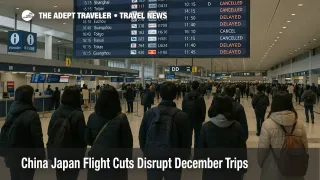
China Japan flight cuts for December 2025 are already reshaping itineraries for business travelers and winter tourists, as Chinese airlines pull hundreds of flights from the schedule and leave popular routes to Tokyo and Osaka with far fewer nonstop choices. The squeeze follows a November 14 travel warning in which China's foreign affairs and culture and tourism ministries urged citizens to avoid trips to Japan, citing safety and political concerns. Airlines then began pruning timetables, and by late November roughly 904 China Japan flights, about 16 percent of 5,548 services originally planned for December, had been removed across 72 routes, leaving around 156,000 seats off the table. Anyone flying between the two countries in the coming weeks now needs to expect thinner schedules, higher fares on remaining services, and more forced routings through third country hubs.
The core change for travelers is that China Japan flight cuts have turned a previously busy winter schedule into a constrained market where airlines are following government direction rather than pure demand. The reduction not only affects December 2025 trips, it also overlaps with a mandate that carriers keep Japan capacity lower through March 2026, which puts Lunar New Year travel at risk if the dispute drags on.
How Big The December Flight Cuts Are
According to data cited by Nikkei and summarized by Chinese and regional outlets, 5,548 China Japan services were scheduled for December before the advisory. By November 29, Chinese carriers had canceled 904 of those flights, or roughly 16 percent of the total, across 72 individual routes, removing about 156,000 seats from the market. Industry analysts quoted in Bloomberg and other business coverage say that even after these cuts, remaining December frequencies are already more than 20 percent below October levels, and they warn that more cancellations are likely as airlines adjust to weaker demand and official pressure.
Kansai International Airport (KIX) near Osaka appears to be the single hardest hit Japanese gateway, with some tallies putting its December cancellations in the 600 flight range. Tokyo Narita International Airport (NRT), Chubu Centrair International Airport (NGO), New Chitose Airport (CTS) in Hokkaido, and Fukuoka Airport (FUK) have also seen substantial reductions in China facing services, especially from Shanghai, Beijing, Guangzhou, and other coastal Chinese hubs. In practical terms, this means far fewer nonstop and one stop options on what had been some of the region's busiest leisure and shopping corridors.
Major state controlled airlines including China Southern Airlines and China Eastern Airlines are leading the pullback. Reports from Caixin, Travel And Tour World, and other trade outlets suggest China Southern has removed more than one fifth of its planned Japan services for December, while China Eastern and several smaller carriers have also trimmed capacity, particularly on routes serving Tokyo, Osaka, Sapporo, and Nagoya. At the same time, several large Chinese travel agencies have halted sales of Japan tour packages, and some have stopped selling standalone flight and hotel bundles to Japan entirely, which reduces new bookings on top of the flight cancellations already in the system.
Which Routes And Travelers Are Most Exposed
The sharpest pain is on point to point itineraries between large Chinese metropolitan areas and Japan's main tourism and gateway cities. Nonstop options from Beijing Capital International Airport (PEK), Beijing Daxing International Airport (PKX), Shanghai Pudong International Airport (PVG), Guangzhou Baiyun International Airport (CAN), and other big Chinese departure points into Kansai, Narita, Chubu Centrair, New Chitose, and Fukuoka have shrunk quickly. For travelers, this can mean either longer connection times, higher prices on remaining direct flights, or both.
Winter leisure travelers bound for Hokkaido ski resorts, Osaka shopping districts, and theme parks around Tokyo are particularly exposed, because many rely on direct or single stop flights that were popular with tour groups and independent travelers alike. Business travelers who had settled into regular shuttle patterns between financial and manufacturing centers in eastern China and Japanese cities now face a more fragile schedule where a single cancellation can wipe out the most convenient timed flight of the day. If the cuts remain in place into early 2026, frequent cross border commuters and students will find it harder to secure affordable last minute seats.
The knock on effects go beyond aviation. Japanese tourism and retail stocks have already come under pressure as markets price in weaker Chinese visitor numbers, with analysts estimating potential losses in the billions of dollars if the boycott extends through the peak holiday travel window. That in turn may prompt more aggressive discounting or package deals aimed at travelers from South Korea, Southeast Asia, Europe, and North America, which could reshape who fills hotel rooms and shopping streets in major Japanese cities this winter.
Alternatives Via Seoul, Taipei, And Southeast Asia
With nonstop China Japan capacity constrained, third country hubs are becoming the pressure valve for travelers who still need to make the trip. Seoul Incheon International Airport (ICN), Taipei Taoyuan International Airport (TPE), Hong Kong International Airport (HKG), Bangkok Suvarnabhumi Airport (BKK), and Singapore Changi Airport (SIN) already anchor dense networks into both China and Japan, and are likely to absorb some of the displaced demand.
For example, a traveler from Guangzhou trying to reach Osaka could route via Incheon on Korean Air or Asiana, or via Hong Kong on Cathay Pacific, instead of relying on a nonstop that may no longer operate. Someone starting in Chengdu or Chongqing could use Bangkok or Singapore as a connection point, accepting a longer journey in exchange for more stable schedules and better rebooking options if something changes. In many cases, these routings will cost more and may require overnight stays, but they can provide a workable Plan B when direct flights disappear.
Travelers building itineraries through these hubs should check transit visa rules carefully, especially for longer layovers or overnight stays, and should avoid stitching together tight self made connections on separate tickets. As a rule of thumb, four to six hours of buffer between flights is reasonable when you are switching airlines or tickets at a busy hub, while very late night or last departure of the day connections should be avoided whenever possible.
For a broader view of how disruptions in East Asian transport systems can compound travel risk, readers can also follow Adept Traveler's coverage of industrial action on the Seoul Metropolitan Subway network in December 2025. Seoul Metro Slowdown Signals Possible December Strike
Tickets, Waivers, And What To Expect Into Lunar New Year
After the November 14 advisory, major Chinese airlines including Air China and its affiliates, China Southern, China Eastern, Hainan Airlines, Sichuan Airlines, and Xiamen Airlines offered free refunds or ticket changes for travel to Japan through the end of December, giving already booked passengers a window to step back or reroute. Some of these waiver policies may be extended or revised as the situation develops, but the pattern so far is that airlines are using fee waivers to smooth short term disruption while quietly shrinking long term capacity.
Travelers who still intend to go to Japan from mainland China in December or early 2026 should check the latest waiver rules on their airline's official site, and should prioritize tickets that allow at least one free date change or refund without heavy penalties. Booking through a reliable travel agency or directly with the airline can make it easier to use these waivers, compared with tickets bought through opaque third party platforms that may impose extra service charges.
Because Chinese regulators have reportedly ordered airlines to maintain reduced Japan capacity through March 2026, the flight squeeze is likely to overlap with Lunar New Year peak travel, when many routes in East Asia are already heavily booked. Travelers planning Japan trips for late January or February should not assume that schedules will be back to normal by then. Instead, it is safer to lock in fully refundable or at least flexible hotel bookings, avoid prepaid nonrefundable tours, and consider flying via third country hubs that offer more daily frequencies and alliance support if disruptions spread.
For general strategies on dealing with rolling airline schedule changes and cancellations, Adept Traveler's evergreen guide to airline schedule changes and rebooking options remains a useful reference, especially for travelers who regularly book complex multi segment itineraries. Guide To Airline Schedule Changes And Cancellations
Background, How The Travel Spat Escalated
The current wave of China Japan flight cuts is part of a broader diplomatic crisis that deepened in November 2025 after comments by Japanese Prime Minister Sanae Takaichi about a possible Japanese response to a Taiwan conflict. In response, Beijing condemned the remarks, increased coastguard activity near disputed islands, and on November 14 issued a formal advisory telling Chinese citizens to avoid travel to Japan, citing security and political concerns. Subsequent reports described suspended visa processing, canceled cultural exchanges, and a surge of social media campaigns urging travelers to boycott Japan, which quickly translated into hundreds of thousands of canceled tickets and deep cuts in forward bookings.
From Japan's perspective, the rapid drop in Chinese visitors has exposed how dependent some tourism, retail, and hospitality segments have become on Chinese spending. For travelers, the immediate impact is operational rather than political, fewer flights, more rerouting, and a higher risk that even confirmed schedules for December and early 2026 will change again on short notice as airlines and regulators adjust.
Sources
- 2025 China-Japan diplomatic crisis, travel section
- More than 900 flights from China to Japan scrapped in Dec
- China orders airlines to cut Japan flights through March amid diplomatic tensions
- Chinese Airlines Cancel 904 Japan-Bound Flights
- China Southern And China Eastern Lead The Charge In Cutting Over Nine Hundred Flights To Japan
- Planned China Japan flight cancellations up about 56 percent
- China Just Froze Billions In Japan Travel, And It Might Last Until 2026
- Japan's tourism shares slump as diplomatic rift with China worsens
- Chinese travellers cancel hundreds of thousands of trips to Japan amid rising tensions
- China's flight cancellations expose Japan's tourism fragility