

US Winter Storms Delay Flights December 2025
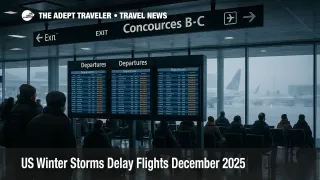
US winter storms flight delays December 2025 are now a rolling pattern rather than a one day shock, with the Sunday after Thanksgiving bringing roughly 12,000 delayed flights and about 1,000 cancellations nationwide and Chicago O'Hare International Airport (ORD) suffering the heaviest hit. Flight tracking data and local reports show that O'Hare saw hundreds of cancellations and ground delay programs over the Thanksgiving weekend, while airports in New York, Boston, Detroit, and Des Moines also struggled as heavy snow and ice moved east. Since then, new snow bands, freezing rain, and gusty winds have kept de icing trucks and air traffic control teams under pressure, with fresh delays at hubs like Denver, Minneapolis, and Chicago as each wave comes through.
In practical terms, this means US winter storms flight delays December 2025 are a sustained constraint on the system, especially at Midwest and Northeast hubs where snow, ice, and strong crosswinds repeatedly cut runway capacity and slow ground handling.
How The Storm Pattern Is Hitting Major Hubs
On the Sunday after Thanksgiving, roughly 12,000 flights within, into, and out of the United States were delayed and about 1,000 were canceled, with O'Hare repeatedly topping the national lists for both metrics as airlines worked through record breaking November snowfall and holiday crowds. In the same window, flight tracking services and local outlets reported that hubs in New York City, Boston, Detroit, Fort Lauderdale, and Des Moines also saw elevated delays as the storm belt wrapped from the Upper Midwest into the Northeast.
In Chicago, the situation has extended beyond a single bad day. O'Hare logged more than 8 inches of snow during one November event, breaking a daily record and driving several hundred cancellations and well over a thousand delays across a single weekend, followed by additional cancellations and 700 plus delays on the following Monday as crews dug out and fresh snow bands arrived. Chicago Midway has seen fewer outright cancellations, but still enough disruptions to complicate connections between domestic and regional flights.
Denver International Airport, Minneapolis Saint Paul International Airport, Detroit Metropolitan Wayne County Airport, and New York area airports are experiencing similar patterns, with intense but short lived visibility drops and bursts of heavy snow that force ground holds, runway configuration changes, and long de icing queues. These delays often ripple outward, so even airports with clear skies, such as Hartsfield Jackson Atlanta International Airport, have reported late arrivals and missed departure slots because aircraft and crews are stuck upstream in the storm zone.
Slide Offs, De Icing Queues, And Safety Margins
The recent pattern has also produced individual runway and taxiway incidents that, while nonfatal, further slow operations. Delta Air Lines confirmed that one of its aircraft slid off a runway in Iowa on the Sunday after Thanksgiving, during active snow and icy conditions, though there were no injuries reported. Each time this happens, airport and airline teams must halt some ground movements, inspect surfaces, and sometimes tow aircraft off packed snow, which compounds delays for everyone else.
Even without incidents, heavy wet snow and freezing drizzle substantially increase de icing time. When storms move across the Great Lakes and into New England, air traffic control, ATC, often needs to meter departures so that aircraft can complete de icing cycles and still take off within the fluid's holdover time, the window during which wings are protected from re contamination. By design, that safety margin reduces the number of movements per hour at affected hubs, which is why airports like O'Hare, Minneapolis, and Detroit can see departure queues spike into the tens of aircraft even when only one or two runways are directly impacted.
How Long The US Winter Storm Pattern May Last
Forecasts from the National Weather Service and private meteorologists suggest that the immediate storm complex will keep influencing travel through at least the first week of December 2025, as snow and mixed precipitation shift from the Upper Midwest into the Northeast and mid Atlantic. Advisories and winter storm warnings have already been hoisted across several Northeastern states, with some models calling for up to 10 inches of additional snow in parts of northern New England and continued lake effect bursts downwind of the Great Lakes.
The Federal Aviation Administration's current operations plan for December 4 flags strong winds in the Northeast as a driver for potential ground stops and ground delay programs at busy hubs, which means that even if snow totals taper off, crosswinds and low ceilings can still cut runway throughput. For travelers, that translates into a medium term pattern of fragility at key hubs rather than a single catastrophic day that can be written off, especially on routes that rely on narrow connection banks.
Background, How Winter Storms Turn Into Flight Delays
Winter storm disruption is not only about whether an airport is technically open. Runways and taxiways must be plowed and treated, de icing pads must be staffed and supplied, and air traffic control spacing between arrivals and departures often increases to account for slippery surfaces and blown snow. Each of those steps reduces the number of flights an airport can safely move per hour.
At hub airports, where banks of arrivals and departures are planned down to the minute, a cut of even 20 to 30 percent in hourly capacity can mean dozens of flights pushed into later time slots, causing missed connections, missed crew legal rest windows, and eventually cancellations when aircraft and staff cannot be reset in time. Once storm patterns become frequent, as they have in late November and early December 2025, airlines also start trimming schedules preemptively around certain hubs to reduce the risk of mass stranded passengers, which in turn pushes more people onto the remaining flights.
Which Travelers Face The Highest Risk
The highest short term risk sits with travelers who are connecting through Chicago, Denver, Minneapolis, Detroit, or the New York area over the next week, especially if they are on separate tickets or connecting from domestic feeders into long haul international flights. For example, a Chicago based domestic leg that feeds an overnight transatlantic departure from New York or Boston can easily be delayed or canceled by snow and de icing constraints, while the long haul flight still operates, leaving passengers stranded with limited reprotection options.
Travelers starting their journeys at smaller regional airports that depend on a single daily flight to one of these hubs are also vulnerable. If the inbound aircraft from a storm affected hub is late enough, the outbound may be scrubbed, in which case the next available seat could be 24 hours later or more, particularly on peak holiday dates when loads are already heavy. Rail travelers are not immune either, as at least one recent incident saw a fire beneath Amtrak cars near Providence, Rhode Island, compounding weather related slowdowns on the Northeast Corridor.
Practical Strategies For The Next Week
For trips in the next seven to ten days, the safest posture is to assume that winter storm impacts could recur, then plan your itinerary around that possibility. For domestic connections through Chicago, Denver, Minneapolis, Detroit, or New York, aim for at least three hours of buffer, four if you are connecting into a long haul flight or onto a separate ticket. If you have a critical departure, such as a cruise, a tour start, or an expensive business meeting, consider overnighting in the hub city the night before rather than trying to make a same day connection through an already strained system.
Whenever budgets allow, use carry on only, since checked baggage is often the first casualty of cascading delays and missed connections. If you must check a bag, keep critical medication, documents, and one change of clothes in your hand luggage in case you and your suitcase temporarily part ways. Monitor your airline's waiver policies, because multiple carriers have already issued limited change fee waivers around the storm period, and future waivers may appear if new systems line up.
Finally, build some flexibility into ground plans at both ends of your trip. That might mean choosing hotel rates with reasonable change or cancellation terms near major hubs, renting cars from larger airport locations with more inventory, or using rail tickets that allow same day time changes where available. Pair this article with our rolling delay coverage in the daily Flight Delays And Airport Impacts series to see how FAA constraints and local weather are interacting on specific dates, then adjust your plans accordingly.
Sources
- Winter storms disrupt travel across US, thousands of flights delayed or canceled
- Winter storm disrupts Thanksgiving travel across U.S., causing delays and cancellations
- Heavy snow predicted for Northeast as Midwest still struggles with Thanksgiving weather snarls
- Winter weather causes thousands of flight delays
- Thanksgiving travel: Flight delays, cancellations as snowstorm hits several big cities
- ATCSCC Current Operations Plan Advisory
- Thanksgiving weekend travel chaos hits airports amid snowstorm with over 1,440 flights grounded and 12k delayed