

England Tourist Tax On Hotel Stays Under Review
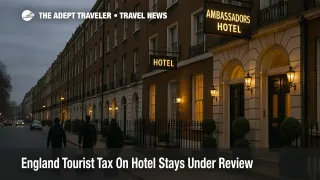
A proposed England tourist tax on hotel stays is moving forward after the UK government opened a consultation on a new overnight visitor levy for mayoral areas in England, covering popular destinations from London to Manchester. The plan would allow local leaders to add a small charge to bills at hotels, guesthouses, bed and breakfasts, and holiday lets, on top of already high costs driven by a strong pound. International travelers, including visitors from the United States, could see higher nightly bills in key English cities once the system is in place, so it is worth planning now for how these charges might show up on future trips.
In plain terms, the England tourist tax hotel stays proposal would give mayors new powers to levy an overnight charge on paid accommodation and use the proceeds to fund local transport, infrastructure, and visitor services, bringing England closer to cities such as New York, Paris, and Milan, where similar fees are already normal.
Under the current plan, the national government would create a legal framework for a local overnight visitor levy, then leave the decision to switch it on to Mayoral Strategic Authorities and other devolved local leaders in England. Any such levy would apply to overnight stays in hotels, guesthouses, bed and breakfasts, and holiday lets, including many short term rentals, while exempting emergency accommodation, homeless shelters, and registered Gypsy and Traveller sites used as primary residences. The consultation also suggests mayors could add local exemptions, for example for very low cost hostels or specific traveler categories, so the final details will vary by city region.
For travelers, the most important timing detail is that nothing changes immediately. The consultation on the overnight visitor levy runs for 12 weeks and is scheduled to close at 11:59 p.m. on February 18, 2026. After that, ministers must confirm the legal power in legislation, and individual mayors then have to design, consult on, and vote through their own local schemes before a single extra pound appears on a hotel folio. In practice, that means 2025 trips and most 2026 visits to England will not face these new levies, although some existing local charges will continue in places that already have them.
The government is selling the levy as a modest, targeted way to fund local priorities, backed by research that suggests reasonable visitor fees have little impact on total visitor numbers. England attracts more than 130 million overnight visits each year, so even a small nightly charge could unlock significant sums for transport upgrades, public spaces, cultural events, and tourism infrastructure in urban areas. Official material highlights examples such as late running buses and trams in Manchester, cleaning and improving busy streets in central London, and supporting major events in Liverpool, where local leaders argue that visitors should contribute directly to the services they use.
Ministers and mayors are also clear that the levy would be optional and locally controlled. London Mayor Sadiq Khan and Greater Manchester Mayor Andy Burnham have both welcomed the principle and signalled they are likely to use the new power once it is available, citing the need to fund cleanup, transport, and cultural programs in their regions. By contrast, the mayor of the Tees Valley has already said there will be no tourist tax there as long as he is in office, a reminder that England will end up as a patchwork of different rules rather than a single nationwide tax.
Industry groups are more cautious. Hospitality bodies have warned that higher accommodation costs could push some budget sensitive visitors away, especially when combined with a strong pound and rising airfares, and one trade estimate suggests the total cost to the public could reach hundreds of millions of pounds per year if widely adopted. Critics argue that any new levy must be transparent, ring fenced, and clearly tied to visible improvements, or it risks being seen as just another stealth tax on travelers.
Background
Visitor levies are already common across Europe and North America. In many cities, travelers pay either a flat charge per person per night or a percentage of the accommodation bill, up to a cap on the number of nights, with the final amount shown as a separate line item on the receipt. England has lagged behind that pattern so far, and although some local districts have experimented with business improvement district charges on certain hotel stays, this new power would be the first widespread, statutory visitor levy framework in England.
Scotland offers a preview of how a UK citywide levy might work. Edinburgh has already approved a visitor levy of 5 percent on the accommodation cost, applied to the first five nights of a stay for bookings made on or after October 1, 2025, for travel from July 24, 2026. The city expects the scheme to raise up to £50 million (GBP) per year, which will be reinvested in services for visitors and residents, and Scottish guidance explains how accommodation providers collect the charge and pass it on to the council. Other Scottish councils, including Glasgow and several Highland authorities, are exploring similar measures under separate national legislation.
How It Works For Travelers
If English mayors adopt the levy, travelers can expect the charge to appear as a separate line on their accommodation bill, labelled something like visitor levy or tourist tax, rather than hidden in the nightly room rate. The levy would be applied whether a room is booked directly with a hotel or through online travel agencies and short term rental platforms, although small print will determine whether rates shown at search include the levy or add it at checkout. Tour groups and packages are likely to pass the cost straight through in their per person pricing, so it will still ultimately land with the traveler.
Because the plan focuses on city regions with strong tourism demand and elected mayors, the highest risk of new charges is in metropolitan areas such as London, Manchester, Liverpool, Birmingham, and Bristol. Rural parts of England and small towns without mayoral authorities are less likely to see immediate changes, although the government has left room for other local leaders to gain access to the power in future after consultation.
For most visitors, the financial impact is likely to be noticeable but manageable rather than trip breaking, especially on short city breaks. The bigger shift is psychological and structural, as England joins the growing list of destinations that use targeted climate, congestion, and tourism taxes to manage visitor flows and fund local services. We have already seen parallel moves elsewhere in Europe, such as Venice's new day trip fee and Milan's restrictions on key boxes for short term rentals, which aim to balance resident quality of life with visitor demand and are reshaping how and where travelers choose to stay.
If you are planning multi stop trips that combine England with other European countries, it is worth looking at the full stack of charges you will face across borders, from tourist levies to new border controls and local rules on rentals, instead of treating the England levy in isolation. Our overview of Europe 2025 travel rules, border checks, and growing tourist taxes is a useful companion when planning budgets and comparing cities. For travelers who rely heavily on short term rentals, our recent coverage of Milan's crackdown on key boxes offers another example of how city authorities are tightening control over visitor accommodation, sometimes in ways that matter more than a modest nightly tax. See our explainer on wider European rule changes at Europe 2025 travel rules and costs and our report on Milan's key box ban for short term rentals for that wider context.
What Travelers Should Do Now
For trips that are already booked in England for 2025 and the first half of 2026, the overnight visitor levy proposal will not change what you pay, but you should still watch for any existing local charges on your confirmation emails. For travel later in 2026 and into 2027, especially in London and other mayoral cities, it is sensible to budget a small extra amount per room per night and to check whether your chosen hotel or rental sits inside a city region that plans to adopt the levy.
Travel agents and frequent visitors may also want to follow local consultation processes and statements from mayors and city authorities, since those will be the first places where concrete rates and start dates appear. If you live in England or run a tourism business there, you can respond directly to the national consultation and any local follow on consultations to argue for clear, simple levy structures that are easy to understand and collect. For international travelers, the best preparation is to focus on total price, including all taxes and fees, to compare central city stays with suburban or regional options, and to adjust itineraries if nightly costs in flagship cities begin to bite.