

Venezuela Airspace Warning Reroutes Caribbean Flights
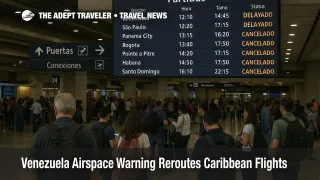
Venezuela airspace warning is no longer just a technical note for pilots, it is reshaping flight plans between North America, the Caribbean, and northern South America after the Federal Aviation Administration, FAA, issued a 90 day advisory for Venezuelan airspace on November 21, 2025. The notice covers the Maiquetia Flight Information Region, FIR, and flags a combination of worsening security conditions, increased military activity, and significant interference with satellite navigation signals that can affect aircraft at all altitudes. For travelers, that combination now means fewer direct links to Venezuela itself and longer, more circuitous routes on some connections that used to cross the country, along with a higher risk of misconnects on tight itineraries.
In practical terms, the new Venezuela airspace warning makes previously routine overflights a higher risk choice, so airlines are either adding miles to go around Venezuelan territory or suspending routes altogether if they cannot mitigate the threats and still satisfy regulators and insurers.
What The FAA Warning Actually Says
The FAA advisory is a Notice to Air Missions, NOTAM, that applies to the Maiquetia FIR, which covers Venezuelan airspace and key approaches into Simón Bolívar International Airport (CCS) near Caracas. It took effect on November 21, 2025, for 90 days and instructs operators to exercise extreme caution, to account for a deteriorating security situation and increased military activity, and to be alert for interference with global navigation satellite systems, GNSS, including GPS, that has been reported at multiple flight levels.
Under the notice, United States operators must provide at least 72 hours advance notice before conducting any operations in the region, and existing restrictions that already prohibit United States airlines from flying to or from Venezuela remain in place. The key new element is that overflights, not just arrivals and departures, are now explicitly framed as potentially hazardous, which raises regulatory and insurance stakes for any carrier that chooses to keep using Venezuelan airspace.
Background, how GNSS interference and military activity matter
GNSS interference in this context means that aircraft may lose reliable GPS and related satellite navigation signals, see them degrade, or receive misleading information about position and altitude while en route or on approach. Aviation safety groups and flight tracking analyses have highlighted repeated reports of such interference in and around Venezuela since September 2025, in some cases coinciding with military exercises and air defense activity. For modern airliners that rely heavily on satellite navigation for en route guidance and precision approaches, sustained interference can force crews to revert to backup systems, break off approaches, or divert, especially if combined with poor weather or complex terrain.
At the same time, United States military operations aimed at drug trafficking networks have increased in the wider Caribbean, including additional surveillance flights and strikes on suspected smuggling vessels, while Venezuelan forces conduct their own patrols and drills. The FAA warning reflects concern that this denser mix of military activity and unreliable navigation signals creates a more complex risk environment for civil air traffic, even if there is no specific threat to a particular airline or route.
Which Airlines And Routes Are Most Affected
The operational fallout has come in waves. After the advisory, several foreign airlines that still served Caracas, including Gol, Avianca, and TAP Air Portugal, suspended flights, citing safety concerns linked to the FAA warning and associated risk assessments. Venezuela's civil aviation authority then revoked operating permits for six carriers that did not resume service on the government's preferred timeline, among them Iberia, TAP, Avianca, LATAM Colombia, Turkish Airlines, and Gol, which sharply cut long haul options from Europe and regional links from Brazil and Colombia.
On top of those suspensions, authorities and European regulators have imposed their own restrictions, for example Spanish and Portuguese aviation authorities limiting or advising against operations to Venezuela into late December, which has led airlines such as Iberia to extend their pauses at least through the end of the year. Several other carriers, including Air Europa and Plus Ultra, have also reduced or halted services to Caracas, even when their permits technically remain valid, because of the combined regulatory, safety, and insurance pressures.
The pressure intensified in early December when Copa Airlines, a key connector between North and South America via Tocumen International Airport (PTY) in Panama City, suspended select flights to and from Simón Bolívar International Airport after its crews reported navigation signal issues on approach. Low cost carrier Wingo and other regional operators have also paused some Caracas operations while they reassess risk and wait for clearer guidance from regulators and their own safety teams. For practical traveler purposes, these steps mean very limited, and sometimes zero, options on certain days for flying directly into or out of Caracas on foreign carriers.
How Overflights Are Being Rerouted
Even for travelers with no intention of visiting Venezuela, the airspace shift is already showing up in flight paths. Flight tracking analysis by major outlets indicates that the number of flights crossing Venezuelan airspace dropped by about half immediately after the FAA warning, as airlines diverted traffic to route over neighboring countries or over open water instead. The changes are visible on routes linking Panama City, Colombia, and Caribbean hubs with North America and Europe, where aircraft that previously cut across Venezuelan territory now bend east over Guyana and the Atlantic or west over Colombia.
These reroutes add distance and time, often on the order of several minutes to tens of minutes per leg, which is manageable but erodes buffer in tightly scheduled connection banks. In hubs like Tocumen, El Dorado International Airport (BOG) in Bogotá, and key island airports in Aruba, Curaçao, and the Dominican Republic, that can turn a comfortable connection into a misconnect risk, especially for evening departures that are already near curfew or airport operating limits. Airlines can absorb some of this with extra schedule padding, but because the advisory is framed as a 90 day measure, many carriers are still in the early adjustment phase.
For itineraries that used to treat Caracas as a connecting point between the Caribbean, Mexico, and South America, the impact is sharper. With multiple foreign airlines suspended and Venezuela revoking permits for some that declined to restart, many of those multi segment routings simply disappear from inventory or reappear with long detours through third country hubs such as São Paulo, Lisbon, or Madrid.
Background, what "airspace closed" really means
United States President Donald Trump has publicly said that airspace above and around Venezuela should be considered entirely closed, and senators have responded by seeking more oversight of military operations in the region. That language is politically stark, but from a traveler perspective, it is important to distinguish between political rhetoric, regulatory notices, and operational reality.
Legally, the FAA NOTAM does not declare Venezuelan airspace closed to all civil aviation. Instead, it sets conditions, including the 72 hour notification requirement and explicit risk language, that make continued operations a business and safety judgment call for each carrier and its home regulator. At the same time, some flights, notably deportation or repatriation services operated under government agreements, have continued to land near Caracas even as commercial links have shrunk, underscoring that the system is not a total shutdown but rather a highly constrained corridor with special purpose flights.
For tourists and business travelers, the net effect looks very close to a functional closure of easy, flexible access, especially on short notice. It is still technically possible to reach Venezuela, particularly via national carrier Conviasa or limited regional services, but the combination of fewer foreign airlines, higher cancellation risk, and an underlying security and navigation warning should set a high bar for nonessential trips.
How To Plan Caribbean, Mexico, And South America Trips Now
Travelers whose itineraries simply overflew Venezuela, for example a flight from Mexico or the United States to a Colombian or Brazilian destination, are most likely to notice slightly longer flight times and, in some cases, schedule changes that move departure or arrival times by tens of minutes. The main risk is not that these flights suddenly disappear, but that marginal erosion of buffer increases the odds of missed connections when routing through Panama City, Bogotá, or Caribbean hubs on separate tickets or tight schedules.
Anyone who still has a ticket that touches Caracas should assume the routing is unstable until their airline confirms otherwise, because suspensions and permit changes are still unfolding. The safer strategy is to rebook via alternative gateways, even if it means an extra stop, and to use carriers whose home regulators have issued clear, up to date guidance on operations around Venezuela. Where airlines offer fee free changes or waivers linked to the FAA NOTAM or local regulator notices, using those proactively is usually better than waiting for last minute cancellation cascades.
For new bookings, especially multi country trips in the Caribbean and northern South America, travelers should try to keep connections on a single ticket, avoid layovers shorter than three hours when routes would normally overfly Venezuela, and favor routings that use established hubs with multiple daily frequencies. It is also worth checking whether travel insurance explicitly addresses high risk airspace advisories and military activity, since some policies treat these differently from ordinary weather or technical disruptions.
Finally, remember that this is a 90 day advisory that could be extended, updated, or allowed to lapse depending on how security conditions, military posture, and navigation interference evolve. Until there is a clear improvement in those underlying factors, the working assumption for planning should be that Venezuelan airspace remains a high friction zone that airlines will try to avoid whenever practical, and that access to Venezuela as a destination will stay constrained compared with neighboring countries.
Sources
- FAA Statement on Venezuela NOTAM
- Safe Airspace, Venezuela Airspace Risk Summary
- OPSGroup, Venezuela Airspace and GNSS Interference Briefings
- Flights avoid Venezuelan airspace as tensions build, Reuters
- Venezuela revokes permits for six airlines after safety alert, various reports
- Panama's Copa suspends flights to Venezuela over navigation issues, Reuters
- European and regional regulator guidance on Venezuela flights, including Iberia and TAP statements
- Reporting on deportation and repatriation flights between the United States and Venezuela