

Benin Coup Aftermath And Cotonou Airport Reopening
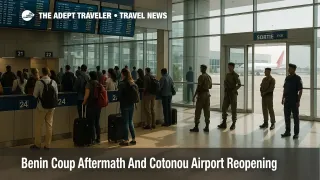
Benin coup Cotonou airport alerts have shifted quickly as the failed December 7, 2025 coup attempt in Cotonou, Benin gave way to a cautious reopening of Cardinal Bernardin Gantin International Airport (COO). In the space of one day, travelers saw shelter in place orders, reports of gunfire near the president's residence and state television, and warnings about restricted airport operations. The latest alerts now confirm that flights are running again and routine consular services are resuming, but they also stress that patrols, checkpoints, and the risk of renewed restrictions mean itineraries still need extra margin.
In plain terms, the Benin coup Cotonou airport situation has moved from acute crisis to fragile normalisation, which allows trips to restart but demands a more conservative playbook for anyone flying into or out of Cotonou in the coming weeks.
Timeline Of The Coup And Initial Travel Disruptions
In the early hours of December 7, elements of Benin's National Guard attacked President Patrice Talon's residence in Cotonou, briefly seized the national broadcaster, and appeared on air to announce that they had removed him from power and suspended the constitution. They identified themselves as a Military Committee for Refoundation and justified the move with grievances over security, military favoritism, and economic hardship. Loyal forces quickly pushed back, and by later that day the interior minister and army commanders were publicly stating that the coup attempt had been foiled and that Talon was safe.
For travelers, the most important details were not the political statements but the gunfire, explosions, and roadblocks reported across parts of Cotonou. OSAC and the U.S. Embassy used social channels to order U.S. citizens to shelter in place, citing gunfire and blasts near key sites, road closures, and restricted airport operations. Australian Smartraveller posts warned of an attempted coup, ongoing military activity in Cotonou, and potential flight disruptions as roads and airport access were affected, underscoring that this was a live security incident, not a distant political spat.
Some early reporting suggested that land borders had closed and that Cotonou's airport was operating under significant constraints or temporarily suspending some movements while the military reasserted control. That combination of uncertain air operations and armed forces on the streets is what drove the first wave of "do not move unless absolutely necessary" guidance from embassies and risk advisors.
How The Picture Changed Once The Coup Failed
By December 8, the narrative had shifted from open uncertainty to "tense calm," as loyalist troops consolidated around government sites and the coup leaders melted away or were arrested. Reuters and regional outlets reported that at least 14 people had been detained and that Nigeria had intervened with fighter jets and troops at Talon's request, while ECOWAS and the African Union condemned the attempted overthrow as unconstitutional. At the same time, ECOWAS was already describing West Africa as being in a broader state of emergency due to a drumbeat of coups and attempted coups, which helps explain why neighbors responded so forcefully to instability in Benin.
The key turning point for trip planning came with an OSAC alert titled "Security Alert: Benin, Improvement in Security Conditions / Resumption of Routine Consular Services December 9." That notice stated that the Beninese government had reasserted control, that conditions in Cotonou were calm, and that Cotonou Airport had reopened, even as some international schools remained closed and military patrols continued near government offices. Separate reporting on U.S. Embassy communications said the shelter in place advisory for American citizens was lifted, with officials emphasizing that normal activity could resume while still urging heightened awareness.
The net result is a mixed picture: the coup attempt failed and basic services are running, including flights and consular services, but the city remains on edge and the security posture is clearly tighter than before December 7.
Background: Why Cotonou Airport Matters So Much
Cardinal Bernardin Gantin International Airport, also known as Cotonou Cadjehoun Airport, is Benin's primary international gateway and the only airport in the country with regular scheduled passenger flights. It carries the IATA code COO and serves Cotonou and Porto Novo with links to major African and European hubs such as Paris, Brussels, Casablanca, Istanbul, Dakar, and Addis Ababa. That concentration of connectivity means that when the airport is disrupted, there are no straightforward domestic fallback options the way there might be in a larger market.
In normal times, Cotonou Airport already functions as both an economic lifeline and a political symbol. It sits near the commercial heart of the country, and upgrades in recent years have been framed domestically as proof that Benin is open for business. During a coup attempt, control over such a facility becomes strategically significant, which is part of why risk advisors took reports of restricted operations so seriously even before detailed NOTAMs or airline statements emerged.
What The Latest Alerts Mean For Flight Planning
With OSAC now stating that Cotonou Airport has reopened and that security conditions have improved, travelers can once again plan flights into and out of COO, but they should not assume a complete return to business as usual. Short notice security sweeps, vehicle checks, or inner city roadblocks can still delay access to the terminal, and a renewed bout of political tension could bring fresh restrictions without much warning.
For the next several weeks, the safer strategy is to book flexible or refundable tickets and to avoid itineraries that depend on tight onward connections through Cotonou or other West African hubs. Where possible, use through tickets on a single carrier or alliance rather than stitching together separate low cost legs, so that if a flight out of Cotonou is delayed or canceled, the airline has a contractual duty to rebook you. Build in long layovers when connecting onward in Europe or another African hub to reduce the risk of misconnects if departure times out of COO slip.
Daylight arrivals and departures are preferable while military patrols remain visible. Moving between hotels and the airport in the middle of the night, when curfew style restrictions are easier to impose and road checkpoints are more likely, carries more risk than catching a morning or afternoon departure. If you need to rebook, aim for flight times that keep travel on main arteries during daylight, even if that means a slightly longer total journey.
Onward Travel, Land Borders, And Regional Spillover
Early social media alerts from risk services and some embassies referenced closed land borders and heavy military presence on key routes, which reflects how jittery the region has become about cross border instability. While many of those measures appear to have been short lived, travelers should assume that land crossings into and out of Benin may still be slower than usual, with more document checks and vehicle searches.
If your itinerary relies on overland segments between Cotonou and neighboring countries, treat route choice as a security decision as much as a logistical one. Avoid travel after dark, keep plans flexible, and be ready to reroute via air if border tension or regional diplomatic spats lead to tighter controls. Nigeria's very public role in helping Talon's government reverse the coup, and the sharp reaction from the Alliance of Sahel States to Nigerian military movements, underline how quickly an incident in one country can reverberate across others in West Africa.
Hotels, Neighborhoods, And Daily Movements In Cotonou
Inside Cotonou, the OSAC improvement alert specifically notes military patrols near government offices and that some international schools remain closed, which is a strong hint about where the authorities still expect possible trouble. Visitors should minimize time around government buildings, major squares, and media facilities, especially if any new protests or gatherings are announced.
When choosing accommodation, favor hotels and guesthouses that have clear security protocols, reliable communications, and established relationships with international clients. Properties near the airport or in well trafficked commercial districts are easier to secure than isolated beach or residential stays. Keep digital and printed copies of passports, visas, and travel insurance in separate places, and register with your embassy or consulate if that option exists.
Plan movements with redundancy in mind. That means allowing extra time for airport transfers, using vetted drivers or hotel cars rather than casual street taxis, and having a backup rendezvous point in case your primary route is blocked. Avoid large crowds, and if you come across an unexpected checkpoint or roadblock, follow instructions calmly and avoid photographing security forces.
Insurance, Corporate Risk Rules, And When To Postpone
Political unrest, coups, and states of emergency present a specific insurance challenge because many standard policies exclude war and civil commotion. Travelers should review policy wording carefully, looking for cover that explicitly addresses trip interruption and evacuation triggered by government advisories or civil unrest, not only natural disasters. Corporate travelers and NGOs should coordinate with risk management teams to align Benin travel plans with internal thresholds for acceptable risk.
For some travelers, especially those on discretionary leisure trips or nonessential business, the most rational option may be to postpone visits until there has been a longer stretch of calm and a clearer sense of whether this coup attempt was an isolated episode or a sign of deeper instability. ECOWAS's broader declaration that West Africa is in a "state of emergency" due to recurring coups is a reminder that the region's political risk is structural, not a one day anomaly, so treating Benin as a low friction destination for now would be unrealistic.
Others, including people with family ties, essential business, or humanitarian mandates in Benin, will continue to travel despite the risks. For them, the key is disciplined preparation: dynamic monitoring of alerts, clear contingency plans, and honest discussions about the triggers that would prompt evacuation or temporary relocation.
How This Fits Into Wider Security Travel Patterns
The operational pattern emerging in Benin will be familiar to anyone who has planned trips under other states of emergency in recent years: a sudden security shock, partial closures, then a phased reopening where airports function again but with elevated risk and occasional surprise restrictions. Adept Traveler has covered similar dynamics in Ecuador, where an internal armed conflict designation and car bombs turned Guayaquil stays and airport transfers into high scrutiny exercises, and in Peru and Greece when state of emergency declarations reshaped road and border access.
Our broader guide to travel advisories explains how to read the language used by different governments and how to reconcile situations where your home country's warnings differ from those of local authorities or other partners. Benin's coup attempt and the rapid shift from "shelter in place" to "improved conditions" shows why those nuances matter; the color code alone rarely tells the full operational story.
Bottom Line
The failed coup has not made Benin off limits forever, and the reopening of Cotonou's airport is a meaningful step toward normal operations. However, the combination of recent gunfire in the capital, ongoing patrols, and a region already saturated with coups means that travelers should treat the Benin coup Cotonou airport environment as fragile, not stable. Trips that must go ahead should be structured with flexibility, daylight movement, and robust contingency plans, while nonessential travel can reasonably be deferred until the political trajectory is clearer.
Sources
- Security Alert, Benin, Improvement in Security Conditions / Resumption of Routine Consular Services December 9, OSAC
- Benin Government Says Armed Forces Foil Coup Attempt, Reuters
- Nigerian Airstrikes Helped Foil Coup Attempt, Benin Says, Reuters
- Benin's President Patrice Talon Says Coup Attempt Thwarted, Al Jazeera
- 2025 Beninese Coup Attempt, Wikipedia
- Calm Returns To Cotonou After Benin Coup Attempt, Africanews
- U.S. Embassy Confirms Normalcy In Cotonou After Failed Coup Attempt, Sahara Reporters
- Benin Coup, U.S. Embassy Orders Americans To Shelter In Place, Hindustan Times
- Attempted Coup In Benin, Smartraveller Facebook Post
- Cardinal Bernardin Gantin International Airport, Cotonou, Wikipedia
- Does Benin Republic Have Airport, Soluap
- Flights From Cotonou (COO), FlightConnections
- Ecuador Armed Conflict Guayaquil Stays And Transfers, Adept Traveler
- Ecuador Security, State Of Emergency, Curfews, Adept Traveler
- Peru Chile Border Closure Disrupts Arica Tacna Buses, Adept Traveler
- Corfu Floods Cut Roads And Transfers November 2025, Adept Traveler
- Travel Advisory Topic Page, Adept Traveler