

Mexico Farmer Blockades Snarl U.S. Border Crossings
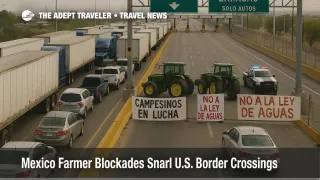
Mexico farmer blockades border crossings have shifted from a one day shock to a rolling risk for anyone driving or taking buses between the United States and Mexico, especially around Ciudad Juárez since late November 2025. What began as a megablockade of highways and toll plazas has repeatedly spilled onto ports of entry that link Ciudad Juárez with El Paso, then eased after negotiations, only to threaten renewed disruption as Mexico's new General Water Law clears Congress. Travelers who assume that the worst is over just because bridges briefly reopened could find themselves facing fresh closures, long queues, or last minute detours.
The update is that Mexico farmer blockades border crossings are now an intermittent but continuing threat rather than a single protest day. Bridges around Ciudad Juárez and El Paso have gone through full shutdowns, partial reopenings, and still congested recovery phases, while farmer coalitions in more than twenty states warn they are ready to block roads and customs posts again if the General Water Law is implemented without changes.
Why Farmers Are Still Ready To Block The Border
Farmer and trucker groups argue that the new General Water Law will strip value from hard won irrigation concessions by tightening federal control and preventing them from selling or transferring water rights, on top of long running frustrations over highway security, cargo theft, and low crop prices. When the Chamber of Deputies approved the law in early December and sent it on to the Senate, which also passed it, leaders described the text as a final breaking point and called for permanent mobilization.
That political calendar matters for travelers. Blockades have tended to spike around key legislative sessions or perceived snubs in negotiations with the Interior Ministry, then soften when authorities offer dialogue or technical changes. For anyone planning winter drives or bus trips, the practical message is that disruption can return quickly around new votes, regulatory announcements, or high profile presidential events, even if roads look normal a few days before.
What Happened At The Border Bridges
The most dramatic moments so far have centered on the Ciudad Juárez, El Paso corridor. From November 24 onward, protesters used tractors and heavy trucks to block or squeeze access to the Zaragoza Ysleta complex, the Córdova Américas bridge, the Guadalupe Tornillo crossing, the Palomas port toward New Mexico, and the San Jerónimo Santa Teresa corridor, at times closing customs offices entirely.
Local and national coverage describes kilometer long lines of freight trucks, with some reports citing more than 1,500 trailers stuck in place and drivers talking about multi day waits as maquiladoras cut production and some gas stations ran dry. Passenger cars and long distance coaches often shared the same approach roads, which meant that when cargo lanes were fully blocked, private vehicles and buses either could not reach the ports at all or faced multi hour queues while convoys were allowed through in short bursts.
By December 6, Mexico's Interior Ministry announced that all bridges with the United States had been reopened and that operations on both inbound and outbound lanes were back to normal, at least formally. That did not instantly clear the backlog. Customs brokers and trucking associations in Chihuahua still reported hours of waiting for cargo and stressed that even a brief new blockade could snarl traffic again because the system was already under strain.
Interior Highways And Secondary Crossings
Even when the main border bridges are flowing, interior highways remain fragile. Live blogs and federal toll road updates over the past two weeks have tracked more than twenty highway protest points at a time, with closures or partial convoys reported in states including Chihuahua, Zacatecas, Guanajuato, Aguascalientes, Querétaro, Tlaxcala, Hidalgo, Jalisco, and Sonora.
Key movement corridors for travelers, such as Federal Highway 45 in Chihuahua, parts of the Mexico Guadalajara and Mexico Querétaro routes, and toll plazas that feed northbound traffic toward Texas and Arizona, have all seen intermittent blockades. In Sonora, protests near the Mariposa commercial facility at Nogales and along the San Luis Río Colorado to Mexicali route have slowed both freight and long distance buses that many cross border travelers use instead of driving themselves.
For road trippers, that means the risk is not limited to the exact bridge they plan to cross. A highway blockade fifty or one hundred kilometers south can still ruin a tight schedule, because convoys, diversions, and local fuel shortages ripple into otherwise open ports of entry.
How This Differs From Earlier Megablockades
Adept Traveler's earlier coverage of the late November megablockades focused on the nationwide pattern of closures, with highways into Mexico City, Pacific beach routes, and multiple border approaches all hit at once. The current phase is narrower but more surgical. Farmer groups are now explicitly tying blockades to the General Water Law and are putting particular pressure on the Juárez bridges and on high value freight corridors, while leaving some other routes open to maintain leverage without completely freezing the country.
For travelers, that means there is more room to plan around the trouble spots, but also less predictability. You may see normal looking bridge cameras in the morning, only to find a blockade taking shape a few hours later, or see one crossing re open while another shuts down as protesters rotate their pressure points.
Trip Planning For Drivers And Bus Passengers
Anyone planning to drive or ride buses through the Paso del Norte region in December should start by checking whether a trip is truly time sensitive. Non essential shopping runs or exploratory road trips are easier to postpone than business travel or family visits, and delaying a few days could mean the difference between a routine crossing and a twelve hour ordeal.
If travel is essential, planning should happen in layers. First, choose a primary crossing and at least one backup, ideally in a different part of the region, for example favoring Santa Teresa or a more distant Texas port if the Zaragoza corridor looks unstable. Second, expand buffers. Same day crossings followed immediately by flights from El Paso International Airport (ELP) or Abraham González International Airport (CJS) are now risky. Treat the border as its own travel day and, where possible, overnight near your departure airport instead of gambling on everything going smoothly.
Tools have improved, and travelers should use them. CBP's Border Wait Times site and local portals such as PDN Uno and PuentesJuárez aggregate live traffic conditions for the main El Paso, Ciudad Juárez ports, while Chihuahua's bridge authorities post succinct Spanish language updates when closures or unusual delays occur. Checking these in the twelve to twenty four hours before departure gives a better sense of whether conditions are stabilizing or deteriorating.
On the road, basic resilience matters. Vehicles should carry extra drinking water, snacks, and any required medications, since queues can lock you in place for hours without easy access to services. Keeping fuel levels high near the border, avoiding confrontations with protesters or other drivers, and sticking to major toll roads rather than unmonitored side routes are all sensible steps.
If you prefer not to drive, intercity buses remain a real alternative, but they are not immune. Reports from this protest wave describe coaches stuck for hours at toll plazas or bridge approaches while organizers negotiate partial openings. When booking, favor large established operators whose staff can coordinate with authorities and who are more likely to reroute services proactively.
When To Consider Flying Or Rerouting
For longer itineraries, especially winter drives that combine the border with interior colonial cities or beach resorts, it can now be smarter to fly deeper into Mexico and use shorter local transfers, rather than attempting a continuous overland run. Flying into hubs such as Mexico City, Guadalajara, or Monterrey, then connecting by domestic flight or bus to final destinations, limits exposure to protest corridors and allows more flexibility if a particular region heats up.
Even within northern Mexico, it may be worth splitting trips into segments. For example, instead of driving all the way from Texas to central highland cities in one push, travelers could cross at a relatively stable port, then use a domestic flight from a regional hub if blockades flare on intermediate highways. The added cost can be offset by the reduced risk of losing full days to queues or having to abandon a road segment entirely.
How Long The Risk Could Last
There is no formal end date. With the General Water Law already approved but not yet fully implemented, farmer organizations are signaling that they intend to keep pressure on the government for weeks or months, not days. That does not mean continuous blockades, but rather a chessboard of potential actions that can be activated quickly if negotiations stall.
For travelers looking at the rest of December and early 2026, the safest assumption is that northern Mexico's road and border network will remain fragile. Each individual trip may still run smoothly, especially for those who plan buffers and choose routes carefully, but planning as if the system is back to normal would be a mistake.
Sources
- Mexico reopens all border bridges with U.S. after farmer blockades, Interior Ministry confirms normal operations
- Agricultores levantan tres días de bloqueo fronterizo en Chihuahua
- Campesinos siguen con bloqueos tras aprobación de Ley General de Aguas, Animal Político
- Se prolonga el bloqueo en puentes y provoca crisis en la maquiladora y desabasto de gasolina en la ciudad, La Verdad Juárez
- Transportistas reportan pérdidas y horas de espera por bloqueos en cruces de carga, El Heraldo de Juárez
- Más de 20 carreteras bloqueadas en distintos estados por productores y transportistas
- En vivo, bloqueos de transportistas aumentan, UnoTV