

Costa Maya Pier Blockade Disrupts Mahahual Access
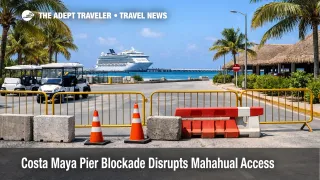
A Costa Maya cruise call day in Mahahual, Quintana Roo, Mexico saw on the ground access disrupted after a small group blocked areas around the cruise pier approach, limiting passenger movement during the port window. The immediate traveler problem was not offshore conditions or a long range advisory, it was a physical choke point at the pier perimeter that slowed disembarkation flow and interfered with how tours, taxis, and shuttles normally stage.
Reports described roughly two dozen residents from the Nuevo Mahahual area using the blockade to press demands tied to road conditions, basic public services, and neighborhood regularization, and they sought engagement from Royal Caribbean alongside local authorities. Riviera Maya News reported no public comment from either side at the time, which matters because when there is no authoritative timeline, travelers should assume the port day can swing between normal operations and sudden constraint with little warning.
Noticaribe reported that the blockade prevented tourists and service providers from entering or exiting the pier area during the disruption, and it listed a high volume call day with Celebrity Constellation, Norwegian Viva, and Harmony of the Seas scheduled to arrive. High volume is the accelerant here, because it turns a manageable delay into missed meet times, crowding, and a faster march toward hard all aboard cutoffs.
Who Is Affected
The first blast radius is anyone with a tight shore plan in Costa Maya, especially excursions that depart early, stack multiple transfers, or rely on a fixed check in time at the pier edge. When pedestrian flow is constrained, the clock keeps running, tour buses do not wait forever, and independent operators have less ability to hold space because they do not control the port side staging system.
The second exposed group is travelers who planned to book locally, outside the port, on arrival. That strategy depends on predictable access to the taxi line, predictable ability to walk out of the controlled area, and predictable re entry. A blockade breaks all three, and it can force a last minute pivot to ship sold tours, or to staying inside the port complex longer than planned.
The third group is families and mobility constrained travelers. When flow is irregular, the system becomes stop and go, shade becomes scarce, and the practical cost is fatigue and dehydration risk while you are standing in a queue that is not moving. If the ship is one of several in port, expect the recovery phase to be uneven, meaning sudden surges when access opens, followed by bottlenecks at security checks, tram points, and taxi dispatch.
What Travelers Should Do
Treat Costa Maya on call days like a variable access system, not a guaranteed open corridor. On port day, keep your first two hours flexible, bring water, sun protection, and offline copies of tour tickets, and do not schedule anything that collapses if you start 60 to 90 minutes late. If you are traveling with kids or anyone with limited heat tolerance, plan for the possibility of waiting outside longer than you intended.
Set a clear decision threshold for ship tours versus independent tours. If you must do a specific activity at a specific time, like a long drive to ruins or a timed marine activity, book it through the ship or a provider with an explicit refund and delay policy, because they are more likely to coordinate when port flow is constrained. If you are doing something short and close, like a beach club or a local taxi to town, keep it refundable, and be willing to stay onboard if access at the pier edge looks unstable when you wake up.
Over the next 24 to 72 hours before your sailing, monitor two signals, and ignore the noise. Watch your cruise line app, and any direct ship messaging about disembarkation timing or meeting points, because that is what actually changes your plan. Also watch for local reporting that specifies whether access issues are at the pier gate, on the road into the port, or inside the port area, because each location implies a different failure mode for taxis, tours, and re boarding.
Background
Costa Maya's shore day experience is a throughput pipeline. Ships arrive, passengers disembark in waves, tours stage in a narrow physical footprint, and taxis and shuttles rely on continuous flow to prevent backups. A blockade at or near the pier perimeter breaks that pipeline, and the system responds in a predictable way, first by slowing passenger release, then by forcing tours to re stage or cancel, then by creating uneven surges when the constraint lifts.
The first order effect is time loss and missed excursion departures. The second order ripples hit at least two other layers. One ripple is shipboard operations, where missed tours trigger refund processing, customer service queues, and sometimes reissued instructions for later groups, which can consume staff bandwidth for the rest of the voyage. Another ripple is the local ground network, where taxis and guides are forced into stop start staging, and where uneven crowd release concentrates demand into short windows, raising prices and reducing availability right when travelers are trying to salvage the day.
This fits a broader pattern travelers have seen across the cruise system in recent weeks, where operational friction, whether from port utility failures or shipboard systems outages, turns "I have an eight hour port day" into "I have a few usable hours, if the pipeline holds." If you want a comparable example of how a single chokepoint can compress an entire port operation, see Port of Los Angeles Outage Delays Quantum Boarding. For how a degraded processing system creates cascading queues and delays, see Carnival Fleet IT Outage Disrupts Boarding.
Sources
- Two dozen settlers block Mahahual cruise ship pier in protest - Riviera Maya News
- Bloquean pobladores el Muelle de Cruceros de Mahahual; exigen regularización y servicios básicos - Noticaribe
- Royal Caribbean's Perfect Day Mexico Project Faces Protest and Court-Ordered Halt
- Royal Caribbean's New Private Island Project Hits Roadblock
- Mahahual: residentes bloquean el puerto de cruceros pidiendo ayudas