

Tanzania Independence Day Crackdown And New Travel Warning
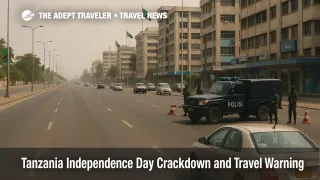
Tanzania Independence Day travel warning just escalated from protest watch to concrete disruption risk as December 9, 2025, brought a visible security lockdown in Dar es Salaam and other major cities. Police and army units are patrolling main roads, checking IDs, and warning that any Independence Day demonstrations over the October 29 election violence will be treated as a coup attempt. For travelers on safaris, Zanzibar beach breaks, or business trips, that combination of military style deployments and new foreign advisories shifts Tanzania into a destination where non essential travel needs a fresh risk calculation and on the ground visitors need robust shelter in place and rerouting plans.
In practical terms, the Tanzania Independence Day travel warning now reflects both a live security lockdown on December 9 and a new "avoid non essential travel" advisory from Canada that explicitly flags civil unrest, movement restrictions, and possible transportation and telecommunications disruptions across the country.
Background, how the holiday turned into a security operation
Tanzania entered Independence Day under the shadow of an election crisis that rights groups describe as among the worst bouts of political violence since independence. President Samia Suluhu Hassan was declared the winner of the October 29, 2025, vote with close to 98 percent of ballots in an election where key opposition parties were barred, triggering protests and a heavy security response that the United Nations and human rights organizations say left hundreds dead.
Ahead of Independence Day, the government cancelled official celebrations, urged citizens to stay home, and declared all December 9 protest plans illegal on the grounds that organizers had not filed for permits. Senior officials publicly framed the demonstrations as an attempt to paralyze economic activity or overthrow the government, a narrative that set the stage for a security heavy holiday with little tolerance for crowds.
Rights groups report that police have arrested alleged protest organizers and opposition supporters in the days leading up to the holiday, adding to earlier waves of detentions and enforced disappearances tied to the election period. The United States has already raised its overall travel advisory for Tanzania to Level 3, "Reconsider travel," citing unrest, crime, terrorism, and targeting of gay and lesbian individuals, and warning that demonstrations around holidays can turn violent with little warning.
What Canada and other governments are saying now
The most concrete new development for trip planning is Canada's decision to advise against non essential travel to Tanzania for all citizens. Ottawa's updated advisory, published on December 8 and amplified by embassy social media channels on December 9, tells travelers to avoid non essential travel to Tanzania due to civil unrest, movement restrictions, and possible disruptions to transportation and telecommunications.
The language goes beyond generic caution and spells out that access to airports may be limited, that curfews or road closures could be imposed with little notice, and that phone and data networks could be throttled or cut, affecting both safety and basic logistics like digital payments and ride hail services. Canada also urges citizens already in Tanzania to limit their movements, register with consular services, and prepare for the possibility of shelter in place periods.
Canada's move follows earlier upgrades by other partners. The United States raised Tanzania to Level 3 in late October, stressing unrest and civil liberties concerns. Australia's Smartraveller platform and New Zealand's SafeTravel service now also advise avoiding non essential travel, citing civil unrest, protest risk, and impacts on transport and airport access. Together, those advisories effectively treat the entire country as a high friction destination where only clearly justified trips should proceed.
For context and a timeline of how official messaging evolved before the crackdown, travelers can review earlier coverage such as Tanzania Independence Day Protests Hit Safaris, Zanzibar and the prior alerts about December 9 protest calls.
How the Independence Day lockdown feels on the ground
By the morning of December 9, reporters described unusually empty streets in Dar es Salaam, Dodoma, Arusha, and other major cities, with shops partially shuttered and a visible presence of police and army vehicles at key junctions. Authorities have said they will treat any protest as illegal and have equated mass demonstrations with an attempted coup, which is a strong signal that they are prepared to use force if crowds form near government buildings or symbolic locations.
The main operational risk for travelers is not organized rallies but the security response around them. Checkpoints and ID checks on trunk roads can lengthen trips to Julius Nyerere International Airport (DAR), sometimes by hours, as officers question drivers and passengers and turn back vehicles that cannot justify their journeys. In earlier unrest periods, similar measures have been paired with curfews and de facto internal travel bans that kept people near home or hotel for days at a time.
The risk profile in Zanzibar is different but connected. Zanzibar's Abeid Amani Karume International Airport (ZNZ) and the ferry route between Dar es Salaam and Zanzibar City have been disrupted before when mainland unrest spiked, including temporary ferry suspensions and flight cancellations during post election protests. Even if the archipelago itself remains relatively calm, heavy handed controls on the mainland can leave travelers stranded on one side of the channel or the other.
Northern safari gateways such as Arusha and Moshi depend on reliable road links to Kilimanjaro International Airport (JRO) and between city hotels and park gates. During heightened security, roadblocks near city centers or on intercity highways can interfere with early morning transfer times, delay day one park entries, or force operators to reroute vehicles over longer back roads that add fatigue and cost.
How to think about trips over the next few weeks
For travelers who have not yet departed, the combination of a live security lockdown on Independence Day and Canada's "avoid non essential travel" advisory is a clear prompt to reconsider discretionary trips to Tanzania in December. Safaris and beach stays can sometimes be moved with manageable change fees, especially when booked through flexible operators, while business travel may need case by case risk assessments that weigh commercial urgency against potential security and reputational exposure.
If travel is essential and must proceed, the planning baseline should assume that disruptions can flare on short notice in a wide range of places, not just obvious downtown protest spots. That means building generous buffers around every segment, avoiding tight same day connections between international flights and domestic hops, and, where possible, routing via regional hubs such as Nairobi, Doha, or Addis Ababa so that a single Tanzanian chokepoint cannot dismantle the entire itinerary.
Operators and frequent visitors point out that classic safari regions and national parks often remain physically calm even when cities are tense, and that many trips will still complete without serious incident. The problem for planners is that a single curfew, ferry suspension, or internet blackout can strand guests in the wrong city overnight or cut them off from payments and communications even if they never see a protest. That pattern should push tour designers toward extra nights in key hubs, fewer cross country jumps, and a conservative stance on any routing that relies on evening arrivals or departures.
Practical steps for travelers already in Tanzania
Travelers who are already in Tanzania or who have no real choice but to enter in the coming days should treat December 9 as a high risk day for movement and should only travel if absolutely necessary and cleared with local contacts. In many cases, the safest course is to remain at a secure hotel or lodge, stay away from city centers and government buildings, and let the main protest window pass.
Regardless of exact location, visitors should follow the shelter in place advice common to several embassy alerts. That means maintaining several days of food, water, cash, and any critical medications, keeping fuel topped up if a vehicle is available, knowing where the nearest medical facility is, and having printed copies of important documents like passports and tickets in case digital backups are unreachable during an internet shutdown.
Travelers should also pay attention to digital risk. Both earlier Adept coverage and rights group reporting note that security forces have at times searched phones and laptops at checkpoints or during arrests, looking for protest related content or perceived political activity. Minimizing the amount of sensitive local material carried on devices, relying on secure backups outside the country, and avoiding public commentary on the unrest can lower the chance of problems during ID checks or questioning.
Finally, anyone in Tanzania should make sure that their embassy or foreign ministry knows they are there, either via formal registration systems or direct contact with consular sections in Dar es Salaam or Nairobi. That step often determines whether they receive targeted security alerts, evacuation advice, or contact details if conditions deteriorate further. For travelers who still want to understand the broader safari context, evergreen destination coverage such as the Serengeti National Park, Tanzania page remains useful for park level planning once the political picture stabilizes.
Sources
- Travel advice and advisories for Tanzania, Government of Canada
- Avoid non essential travel to Tanzania, Government of Canada social channels
- Tanzania Travel Advisory, U S Department of State
- Tanzania deploys police and army to prevent Independence Day protests, Reuters
- Tanzania urges citizens to stay home ahead of expected Independence Day protests, Reuters
- Tanzania police patrol streets on national holiday ahead of planned protests, Associated Press
- Tanzania, Crackdown Ahead of Planned Protests, Human Rights Watch
- Tanzania December Protests Risk Travel Disruption, The Adept Traveler
- Tanzania Independence Day Protests Hit Safaris, Zanzibar, The Adept Traveler
- Tanzania braces for turmoil as U S issues security alert, Business Insider Africa