

Tanzania Curfews Extend Safari And Zanzibar Travel Risk
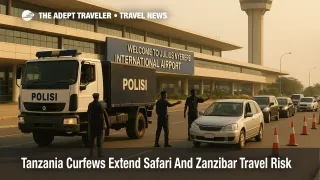
Tanzania curfews travel risk has shifted from a single Independence Day protest window to an ongoing clampdown after December 9, 2025, as heavy security deployments reshape how people move through Dar es Salaam, Arusha, Dodoma, and Zanzibar. Travelers with safaris, Zanzibar beach stays, or flights routed through Julius Nyerere International Airport (DAR), Kilimanjaro International Airport (JRO), or Abeid Amani Karume International Airport (ZNZ) now face the possibility of repeated curfews, roadblocks, and communication outages rather than a one day disruption. The practical question is no longer whether December 9 protests will go ahead, it is how to build itineraries that can survive sudden movement bans and security surges over the coming weeks.
The Tanzania curfews travel risk now reflects a pattern where Independence Day passed under a tight security lockdown, but authorities kept tools like nationwide curfews, ferry suspensions, and internet shutdowns on the table, turning December and early 2026 trips into a rolling risk calculation rather than a fixed date problem.
What actually happened on December 9
On December 9, 2025, Tanzanian authorities followed through on days of warnings by flooding Dar es Salaam and other major cities with police and army units, cancelling official Independence Day celebrations, and treating any protest as illegal. Reuters and other outlets reported that security forces patrolled key roads, carried out ID checks, and maintained an atmosphere where most residents stayed home, with only small, scattered attempts at demonstrations.
Associated Press reporting described unusually empty streets in Dar es Salaam, Dodoma, and Arusha, with shops partially closed, roadblocks at junctions, and local public transport sharply reduced or halted in some areas as police sought to prevent gatherings. Human Rights Watch documented a broader crackdown around the holiday, including arrests of activists and opposition supporters, and noted that the government cancelled celebrations and framed protests as an attempt to destabilize the state.
For travelers, that combination of heavy deployments and largely suppressed protests matters less for the politics than for what it signals operationally. The state showed it could empty central districts, choke off movement between neighborhoods, and restrict public transport with little notice. That same toolbox can now be applied again if protests flare after December 9, or around other symbolic dates.
Curfews and movement controls are now a proven tool
Embassy alerts and local reporting before Independence Day warned that nationwide curfews were possible in response to protests, on top of roadblocks, checkpoints, and transport suspensions. In several cities during the post election unrest, authorities have already imposed night curfews, restricted business hours, and ordered people to remain at home, then lifted or modified rules with limited public notice.
The December 9 lockdown demonstrated how those measures play out on the ground. Checkpoints on trunk roads into Dar es Salaam slowed traffic into the city and toward Julius Nyerere International Airport, with officers checking IDs and sometimes turning vehicles back if journeys were not considered essential. Where curfews have been used, they have typically run from evening to early morning, effectively shutting down late night airport runs, long distance buses, and overnight road transfers.
Because curfews are being framed as security responses to unlawful protests, not as fixed public health measures, they can be imposed or extended with little warning. Travelers therefore need to treat curfews as a floating risk that can disrupt plans well beyond Independence Day itself, especially in the weeks when political tensions remain high.
Foreign advisories now assume sustained disruption risk
The United States raised its country travel advisory for Tanzania to Level 3, "Reconsider travel," in late October, adding an unrest risk indicator and highlighting that demonstrations can become violent with little warning. Subsequent security alerts tied to the December 9 protests spelled out potential nationwide curfews, an internet blackout, cancellations of ferries between Dar es Salaam and Zanzibar, disruption of international and domestic flights, and limited ability to assist citizens during periods of unrest.
Canada has gone further, formally advising citizens to avoid non essential travel to Tanzania due to civil unrest, movement restrictions, and possible transportation and telecommunications disruptions, including limited access to airports. Ottawa tells those already in the country to limit movements, register with consular services, and be ready for extended periods where they may need to shelter in place.
A summary of United Kingdom advice notes that London now warns against all but essential travel, citing unrest, curfews, shortages of food, fuel, and cash, and uncertainty around international transport options, especially when internet services are restricted. New Zealand's SafeTravel platform meanwhile urges travelers to avoid all large gatherings, protests, and demonstrations, and stresses that there are more significant safety and security concerns in Tanzania than in many other destinations, including a rising threat of terrorism.
Taken together, these advisories treat the situation as a continuing risk environment rather than a single day spike. That is the core change from earlier Adept Traveler alerts about December 9 protest calls and Independence Day itself.
How the clampdown affects airports, ferries, and safari gateways
For most visitors, the main chokepoint is Dar es Salaam. Julius Nyerere International Airport (DAR) sits at the end of access roads that pass through urban districts where checkpoints, road closures, or curfews can quickly build long queues or cut off normal taxi and rideshare routes. During the Independence Day lockdown, security vehicles and roadblocks were visible on key arteries, and similar controls in coming weeks could add hours to airport transfers even if flights continue to operate.
The port and ferry terminals linking Dar es Salaam with Zanzibar are subject to the same pressures. U S alerts explicitly warn that ferry services to Zanzibar may be cancelled if unrest escalates, which could leave travelers stranded either on the mainland or on the islands if sailings are suspended or terminals are sealed off by security forces. Even short interruptions can break tight chains of same day ferry plus flight or ferry plus safari transfers.
In the north, Kilimanjaro International Airport (JRO) depends on road links from Arusha and Moshi, which have already seen heavy security patrols and checkpoints during the election crisis. Early morning departures that require pre dawn drives are especially exposed if curfews are imposed or if security forces block highways at night. Local safari operators can often reroute vehicles along back roads, but that adds time, cost, and fatigue.
Zanzibar's Abeid Amani Karume International Airport (ZNZ) may feel calmer than the mainland, but it is still vulnerable to knock on effects. If ferries from Dar es Salaam are interrupted, inbound passenger flows shift toward flights, which can increase crowding and pressure on limited ground transport. If unrest triggers airspace or airport access restrictions on the mainland, some regional connections into Zanzibar may also be thinned out or rescheduled.
Overland travel between cities faces its own set of constraints. Reports of trucks and buses backed up at roadblocks during earlier unrest, and shortages of fuel and cash tied to internet shutdowns, underline how quickly long distance routes can become unreliable.
Planning strategies for upcoming trips
For travelers who have not yet departed, the first filter is necessity. Given that Canada now advises avoiding non essential travel and multiple partners recommend reconsidering trips, leisure safaris and Zanzibar beach holidays in the next few weeks should be treated as optional, not automatic. Moving a trip into later 2026 or switching to a different destination may be less costly than trying to manage around curfews and sudden shutdowns.
Where travel is essential, itineraries should be re engineered to assume disruption rather than normal operations. That means routing international flights so that as few segments as possible depend on Tanzanian hubs, consolidating onto through tickets where feasible, and using alternative gateways such as Nairobi, Addis Ababa, Doha, or Johannesburg as backstops in case Dar es Salaam or Zanzibar become unusable for a period.
Connection times should be widened aggressively. Same day sequences like overnight arrival into Dar es Salaam followed by a domestic hop to JRO, or afternoon ferry from Zanzibar into an evening long haul flight, are now high risk. Adding overnight stops near airports before key departures, building buffer days at the start and end of itineraries, and keeping tour components changeable will make it easier to absorb curfews or last minute cancellations.
Advisors and operators also need to revisit contract language and duty of care. Clients should see clear language about protest and curfew risk alongside more familiar sections on health and road safety, plus documented contingency plans for scenarios such as a 48 hour internet blackout or a suspended ferry line.
If you are already in Tanzania
Travelers already in Tanzania, or those who cannot defer arrival, should shift from macro planning to micro resilience. Embassy alerts consistently recommend avoiding protest areas, maintaining several days of essentials, and having a shelter in place plan that can be activated if curfews or clashes flare up again.
Concretely, that means stocking several days of food, drinking water, and any critical medication, keeping cash on hand for periods when card networks or ATMs may fail, and topping up fuel in any vehicle used for transfers. Travelers should identify nearby medical facilities, understand hotel security procedures, and agree within their group which local contact or tour operator will relay updates if internet access is cut.
Digital risk needs attention as well. Rights groups and local reports note that security forces have at times checked phones and laptops at roadblocks or during arrests, especially around politically sensitive dates. Minimizing sensitive local material on devices, relying on secure backups outside the country, and avoiding public online commentary on protests can reduce exposure during ID checks.
Finally, registration with embassies or foreign ministries is more than a formality. Many governments now use these systems to push targeted alerts, offer options in a fast moving crisis, or coordinate assistance if commercial flights or border crossings are affected. Travelers should also monitor Adept Traveler's earlier pieces on Tanzania December protests and the Independence Day crackdown, which map how risk has evolved from early embassy alerts through the current security heavy phase.
Background, why the risk persists
The current travel risk is rooted in the October 29, 2025 general elections, in which President Samia Suluhu Hassan was declared the winner with nearly 98 percent of the vote after key opposition candidates were excluded. Rights groups and the United Nations estimate that hundreds of people were killed in the ensuing unrest, with allegations of mass graves and enforced disappearances, while the government disputes the numbers but has acknowledged fatalities and pledged investigations.
Ahead of Independence Day, authorities cancelled official celebrations, urged citizens to stay home, and declared all protests unlawful on the grounds that organizers had not filed for permits, effectively framing demonstrations as an attempted coup. That framing underpins the ongoing clampdown, and it is why embassy and foreign ministry messaging now assumes that heavy handed responses to even modest gatherings could continue beyond December 9.
For travelers, the underlying politics matter less than the practical pattern. A government that has already used curfews, lockdowns, and telecom shutdowns to manage dissent is likely to reach for those tools again if protests or opposition activity resurface, which is why the Tanzania curfews travel risk now needs to be built into trip design for the near term rather than treated as a one off spike.
Sources
- Travel advice and advisories for Tanzania, Government of Canada
- Tanzania Travel Advisory, U S Department of State
- Security Alert, U S Embassy Dar es Salaam, November 28, 2025
- Security Alert, U S Embassy Dar es Salaam, December 5, 2025
- Tanzania deploys police and army to prevent Independence Day protests, Reuters
- Tanzania urges citizens to stay home ahead of expected Independence Day protests, Reuters
- Tanzania police say any December 9 protests would be unlawful, Reuters
- Tanzania police patrol streets on national holiday ahead of planned protests, Associated Press
- Tanzania, Crackdown Ahead of Planned Protests, Human Rights Watch
- US, UK, Canada Urge Citizens To Reconsider Travel To Tanzania, RTT News
- Travel warnings issued for Tanzania as unrest erupts, Yahoo News
- Tanzania braces for turmoil as U S issues security alert ahead of planned December 9 protests, Business Insider Africa
- Tanzania, SafeTravel advisory, New Zealand Government
- Tanzania December Protests Risk Travel Disruption, The Adept Traveler
- Tanzania Independence Day Crackdown And New Travel Warning, The Adept Traveler